Wednesday, March 11, 2009

Let It Go

You certainly need to see the funny side of this "search for inner calm". Last night I was composing an email to my daughter and I was trying to express in words what I felt was the essence of the spiritual advice that accepted masters were trying to pass on to a benighted humanity. I suddenly came up with the phrase let it go.

This can be interpreted in two main ways; firstly in the sense of not following through on a reaction to something that is upsetting or hurtful. For example, if somebody insults me, I can react and insult them back or choose instead to let it go. In another sense it can mean not holding on to things. This is a practically impossible task because I can hold on to quite subtle things like my beliefs, my value systems, my memories, my plans for the future etc. This doesn't mean that I shouldn't have such things, only that I shouldn't hold on to them.

Once I hold on to something such as a belief, I am wanting it to remain the same. When I do this my belief becomes less flexible and I'm less open to facts that might challenge that belief. I become less tolerant of alternative beliefs. Worse still I come to identify with this and other beliefs and build up a belief system. This system become part of how I define myself and of who I think I am. But of course I'm not this or that or anything else. By holding on and not letting go, the likelihood of identification with what is held on to increases. For example, the more I hold on to the past, the more I am shaped by it.

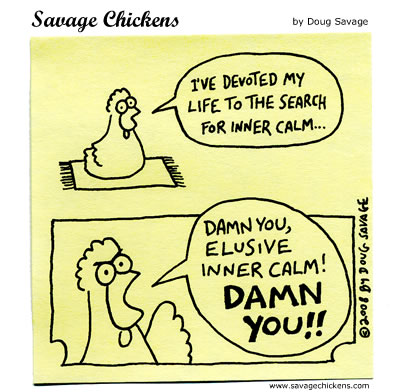
The hapless chicken in the above cartoon has held on to a need to devote its life to the search for inner calm. Of course the more intense the devotion, the more elusive that inner calm becomes. The chicken's goal-oriented mindset ensures failure and consequent anger at the failure to achieve a life-long goal. By letting go of the goal, and everything else, inner calm arises. It was always there but by grasping at this and that I created turbulence and disturbed that calm. Let it go.

Sunday, March 08, 2009

Sanskaras

"Sanskaras" is the plural form of the Sanskrit word "sanskara" that is translated usually as "impression" or "imprint". However, I'm reluctant to use the word "sanskaras" when speaking with people who are unfamiliar with the term but using the terms "imprints" or "impressions" is equally unsatisfactory because these words by themselves don't convey what I'm trying to communicate. Interestingly and not surprisingly, the Wikipedia article on the term makes mention of Meher Baba in the following context:

According to Meher Baba, in the course of evolution sanskaras play a vital role in that they aid in the formation of conscious experience, and thus eventually bring about self-awareness in the human form, but then serve no further purpose. According to Baba they are actually a hindrance once full consciousness is achieved in the human form because they slant our experience of things as they are. The goal for the human being then is to be rid of them by "unwinding" them or through "shakings" caused by progressive variously opposite life experiences over many human lives in reincarnation, thereby eventually unveiling and revealing the true nature of reality and the true identity of the self. According to Meher Baba the ridding of sanskaras can be quickened by the help or guidance of a perfected master or satguru.

The article likens the effect to Sanskaras to that of "a lens through which the subjective aspects of our experience arise. Thus when we perceive (either thoughts or external objects) we apperceive those objects through the lens of past experience. We perceive through the imprint or conditioning of past impressions or sanskaras." Apperception is explained as:

The process by which new experience is assimilated to and transformed by the residuum of past experience of an individual to form a new whole" (Ledger Wood in
Runes). In short, it is to perceive new experience in relation to past experience.

Example 1: We see a fire (visual perception). By apperception we correlate the appearance of fire with past experiences of being burned. Having combined present and past experience we realize this is a situation in which we should avoid placing our hand in the fire and being burned.

Example 2: A rich child and a poor child walking together come across the same ten dollar bill on the sidewalk. The rich child says it is not very much money and the poor child says it is a lot of money. The difference lies in how they apperceive the same event - the lens of past experience through which they see and value (or devalue) the money.

I was sitting in the garden this morning pondering such matters. Nearby somebody was revving a motorcycle and I was observing the impression that the sound was having on me. As always the impression was negative and I thought about some related words. One of them was oppression because from my perspective I was being oppressed, in the tranquillity of my garden, by the sound of the motorcycle. I struggled to suppress negative thoughts such as wishing the offender ill-fortune when he finally mounted his steed and roared away. It would seem that impressions may be the source of oppressions, suppressions, repressions and depressions so it is important to properly understand their mechanism.

The sound of the motorcycle was not loud enough to cause discomfort, only annoyance, and I was certainly apperceiving by taking the perception of the sound and relating it to my mainly negative experiences with motorcycle riders on the streets of Jakarta. Somebody else, hearing the same sound, might be reminded by happy bike riding days, wishing to be in the saddle once again and heading off on the open road. So I sat there and got slightly annoyed but at least I was reflecting on my annoyance. Reflecting on ones reactions is the best that can be done initially by becoming a witness as well as a participant in what is happening subjectively. If lost completely in subjectivity, there is no chance to perceive rather than apperceive. All spiritual masters are unanimous on the importance of this witnessing.

Friday, February 27, 2009

Mad, Mad World


Never let the facts get in the way of a good story. I think Osho may have been telling a porky when he said that Gurdjieff was ten when his father died and gave him his deathbed advice. The Wikipedia article on Gurdjieff has this to say:

In March 1918, Ouspensky separated from Gurdjieff, and four months later Gurdjieff's eldest sister and her family reached him in Essentuki as refugees, informing him that Turks had shot his father in Alexandropol on 15 May.

Now Gurdjieff was born sometime between 1866 and 1877, nobody is really sure, and his early life is a bit of a mystery. There's very little known about him until he showed up in Moscow in 1912 and started attracting followers. One thing's for sure, he wasn't ten years old in 1918. Of course, Osho might be quoting from Gurdjieff's autobiographical "Meetings with Remarkable Men", I haven't read this yet but it is regarded as highly suspect in terms of its historical authenticy.

I was interested to learn that this book was made into a movie in 1979 and starred Terence Stamp, with somebody called Dragon Maksimovic playing the adult Gurdjieff. Suffice to say that both Osho and Gurdjieff were never averse to bending the facts to serve their purposes and that's fair enough. To quote from Brian Eno, "if you study the heuristics and logistics of the mystics, you will find that their minds rarely run in a line" or something like that. Their primary aim is to unsettle the minds of their followers, to shake them up, and playing with historical facts is a great way to do that.

The mind loves nothing more than a solid timeline to make sense of whatever the hell is going on. If we read that Gurdjieff was nine or ten when his father died and was given this deathbed advice and later he found this advice incredibly helpful, we feel that we have a bit of a handle on what the guy is all about. Of course, we haven't but we like to think that we do. Our minds try to make the mystics understandable but of course they can't be understood with the mind at all. Our mind is the biggest barrier to understanding. Well my mind is anyway, I don't know about yours.

Gurdjieff said that most people were asleep, sleepwalking through life, caught up in daydreams and mental meanderings, going nowhere as in Gary Jules' "Mad World" lyrics:

All around me are familiar faces
Worn out place, worn out faces
Bright and early for the daily races
Going nowhere, going nowhere

Their tears are filling up their glasses
No expression, no expression
Hide my head I wanna drown my sorrow
No tomorrow, no tomorrow

And I find it kind of funny, I find it kind of sad
The dreams in which I'm dying are the best I've ever had
I find it hard to tell you, I find it hard to take
When people run in circles it's a very, very
Mad world, mad world

As Ouspensky, an early follower of Gurdjieff, quotes him as saying "Man lives his life in sleep, and in sleep he dies". I'm finding it quite a struggle to wake up.

Monday, February 23, 2009

Osho on Gurdjieff

As I continue my reading of Osho's "The Book of Wisdom", I've found some interesting anecdotes and commentaries about various spiritual figures. One figure mentioned is George Gurdjieff and the story Osho tells about him is this. When he was about ten years old, his father lay dying and he gestured to young George, who was standing at a respectful distance, to come closer. His father whispered that he some very important advice to give him and that he should never forget it. The advice was this: if ever anybody insults you, wait 24 hours before you respond to the insult. His father then passed away.

George really didn't understand what to make of this but he dutifully remembered his father's advice and faithfully practised it for the rest of his life, rating it in adulthood as the best advice that he'd ever been given. The reason was that it forced him to reflect on the insults that were directed at him during his life and he was denied the ego's usual response which is to react instantly and defensively. Normally the ego steps in to defend itself and people are drawn into an argument with insults and counter-insults being hurled about. The situation rapidly escalates and all because the ego has been slighted and wants to defend itself.

This approach of course is what all spiritual teachers advise. Create a space between what happens in your life and your reaction to it. In that space, you can decide on the most appropriate course of action rather than being overwhelmed by emotion. At times this is very difficult to do and it has to be practised continously. It is important not to be too discouraged by the setbacks that inevitably occur. I assume Osho's little story is true but I haven't corroborated it in any way. He also has some hilarious things to say about The Theosophical Society and Krishnamurti but I'll save these for a later post.

Sunday, February 22, 2009

The Black Stone

Pursuing my theme of the significance of stones, I was reminded of the famous Black Stone that is located at one corner of the Ka'ba in Mecca. Here is an excerpt from the Wikipedia article about this stone.

The Black Stone (called الحجر الأسود al-Hajar-ul-Aswad in Arabic) is a Muslim object of reverence, which according to Islamic tradition dates back to the time of Adam and Eve. It is the eastern cornerstone of the Kaaba, the ancient sacred stone building towards which Muslims pray, in the center of the Grand Mosque in Mecca, Saudi Arabia. The Stone is roughly 30 cm (12 in.) in diameter, and 1.5 meters (5 ft.) above the ground. When pilgrims circle the Kaaba as part of the Tawaf ritual of the Hajj, many of them try, if possible, to stop and kiss the Black Stone, emulating the kiss that it received from the Islamic prophet Muhammad. If they cannot reach it, they are to point to it on each of their seven circuits around the Kaaba. The Stone is broken into a number of pieces from damage which was inflicted during the Middle Ages. The pieces are held together by a silver frame, which is fastened by silver nails to the Stone.

While Muslims don't ascribe any healing powers to it, they do believe that it has an abundance of what is called Baraka. I hadn't heard of this term before but it translates as something like divine blessing. The LOOKLEX Encyclopedia has this to say about the term:

In Islam, divine blessing that is normally associated with holy men or women, waliy, either in life or in death. Baraka can be transferred from one person to another, or from a material item to a person. Common in Islam is baraka that comes from local shrines, but the strongest baraka is in Mecca, and then especially, at the Ka'ba.


Saturday, February 21, 2009

Healing Stones

There's been a lot of news coverage here in Indonesia recently about a ten year old who was out playing in the rain when he was struck by lightning. He was temporarily stunned but otherwise unharmed and immediately formed an attachment to a stone that he found nearby. This stone seems to have remarkable healing properties and thousands of people have flocked to the Indonesian village where he lives in order to be healed. Here is an article reporting on the phenomenon.

The Javanese love this sort of thing and it's easy to dismiss the whole business as mass hysteria. However, it got me thinking about rocks and their healing powers. The different varieties of crystals have well documented healing properties, regardless of whether you believe in crystal healing or not, and even quite ordinary looking rocks often contains small quantities of crystals like quartz. The photo that I used in this blog post was taken from a site called "Healing Rocks!" by Ananaia O'Leary and here is a quote:

The first step is realizing that stones are allies, not objects. They have ancient wisdom to share and will work with us generously if we approach them with respect. If you wish to find a stone ally, set your intention to welcome a healing ally and go out into Nature with an open heart. Remember, you are inviting partnership with the mineral realm, not hunting for a resource. Take a walk in your favorite green space: your backyard, local park, greenway or along a river or stream. As you walk, breathe in the scents of the Earth, feel the soil beneath your feet, the Mother holding you with each step. Be open and aware … your stone ally may come to you in many forms, a piece of landscaping rock, street gravel or a rock jutting out of a riverbank. It may jump out at you, catching a gleam of the sun, whispering to you as you walk by “Notice me.”

Now it's easy to scoff at advice like this and ridicule the idea of having a pet rock but it's obvious that this person does not view the mineral kingdom as being populated by inanimate objects. Meher Baba is quite clear about the fact that rocks possess a rudimentary form of consciousness and there is a great deal of literature on the topic of nature spirits connected with the mineral kingdom. I'd like to pursue this subject further but right now it's past midnight and sleep calls.

Friday, February 13, 2009

Osho on Love and Relationships

This being the eve of Valentine's Day, it maybe appropriate to include a little quote from Osho's "The Book of Wisdom" that can be downloaded from here. I haven't read all that much of the book but the little I have read makes excellent sense. I particularly like the way in which he draws a clear distinction between the noun "relationship" and the verb "relating". Here is a small extract:

Love is not a relationship. Love relates, but it is not a relationship. A relationship is something finished. A relationship is a noun; the full stop has come, the honeymoon is over. Now there is no joy, no enthusiasm, now all is finished. You can carry it on, just to keep your promises. You can carry it on because it is comfortable, convenient, cozy. You can carry it on because there is nothing else to do. You can carry it on because if you disrupt it, it is going to create much trouble for you. Relationship means something complete, finished, closed. Love is never a relationship; love is relating. It is always a river, flowing, unending. Love knows no full stop; the honeymoon begins but never ends. It is not like a novel that starts at a certain point and ends at a certain point. It is an ongoing phenomenon. Lovers end, love continues. It is a continuum. It is a verb, not a noun. And why do we reduce the beauty of relating to relationship? Why are we in such a hurry? -- because to relate is insecure, and relationship is a security, relationship has a certainty. Relating is just a meeting of two strangers, maybe just an overnight stay and in the morning we say goodbye. Who knows what is going to happen tomorrow? And we are so afraid that we want to make it certain, we want to make it predictable. We would like tomorrow to be according to our ideas; we don't allow it freedom to have its own say. So we immediately reduce every verb to a noun.

In fact, in "The Golden Wing" he makes further reference to nouns and verbs:

My suggestion to all my sannyasins is don’t trust in nouns, trust in verbs. Become a verb than becoming a noun. Rather than love, think of loving. Rather than being, think of becoming. Rather than of a flower, think of flowering. Always think in terms of verbs and you will never be frustrated. Your life will become a constant growth from one peak to another peak, and those peaks go on becoming higher and higher.

Monday, February 09, 2009

Gravity's Rainbow

I've recently come across a fertile source of ebooks and was elated to discover that Thomas Pynchon's "Gravity's Rainbow" was amongst them. I've been searching for this book for quite some time. It's widely regarded as a "difficult" book, akin to James Joyce's "Finnegan's Wake", but I'd come across some intriguing references to it and had managed to read an excerpt in Google Books. The little that I'd read there inclined me to read further and now I can. I'll have to choose my time. Some people have been known to sit down with this book and keep reading non-stop until they've finished.

My fertile source contains many books that I recognised and some of which I'd already read. At first I thought that it was just a collection of someone's personal predilections but then I happened upon Time's list of the 100 best English-language novels from 1923 to 2006. Most of the books on that list are in this collection and so with the number of my ebooks growing by the day the prospect of an iLiad becomes even more appealing.

Sunday, February 08, 2009

The iLiad

https://en.wikipedia.org/wiki/ILiad
This is no reference to Homer but to a portable device that let's you read and write just like you can do on paper. The image is stable in the sense that it isn't getting refreshed 60 times a second or so. The subliminal flicker caused by this refreshing is what makes reading ebooks on a computer quite tiring on the eyes. The technology is called e-Ink and involves the manipulation of little microcapsules that appear as black or white pixels depending on whether a positive or negative charge is applied. The slow page refresh, more than adequate for book reading, means that animation is not possible and the display is limited to black and white.

The fact that you can write on it with a stylus and thus add notes to what you are reading or draw your own diagrams is of course very useful. Connectivity is via Wi-Fi or USB cable and the price is around US$600 which I can't really afford at the moment but hopefully I can buy it in the middle of the year. I have a growing mountain of ebooks to read but I'm not getting through them using the software-based ebook readers on my computer and laptop. The good thing about technology however, is that the longer you wait to buy a technological device the cheaper and more feature-rich it becomes.


POSTSCRIPT (written 14th October 2018): 

Here is the start of the Wikipedia article:

The iLiad was an electronic handheld device, or e-Reader, which could be used for document reading and editing. Like the Barnes and Noble nook, Sony Reader or Amazon Kindle, the iLiad made use of an electronic paper display. In 2010, sales of the iLiad ended when its parent company, iRex Technologies, filed for bankruptcy.
Well I fortunately never did buy an iLiad but I did buy a Kindle some years later, in early 2015, for a little over US$100. I'm still using toward the end of 2018 and have felt no need to replace as it does its job. It's fine for ebooks but not adequate for PDFs so I use my old iPad for that.

Saturday, February 07, 2009

A Visitor to the Garden

This morning I spotted this beautiful lizard in our garden. It was absolutely motionless and I was fortunate enough to be able to get up close and take this shot with my Nokia N73 camera. Our garden is a walled garden with jagged pieces of glass along the top which tends to discourage wildlife from entering but little fellow found its way in. Before taking this shot, I had picked it up by the tail and repositioned it in our front garden, away from the family dog who only the night before had killed a mouse that found its way in. I didn't want the same fate befalling this creature. Sightings of animals like this are relatively rare in heavily populated Jakarta and so this discovery was a pleasant surprise. Let's hope it lives long and prospers.

Friday, February 06, 2009

Mao's Last Dancer

I was supervising an examination earlier in the week and noticed a book on a shelf called Mao's Last Dancer by Li Cunxin (pronounced Lee Schwin Sing). Now that I'm heading to Shanghai in August, I'm starting to take more of an interest in China where I'll be staying for at least two years and probably more. The book has caught my interest and I'm already well into it. Apparently, there is a film adaptation of the book and that is due for release this year. Li has his own website and has certainly come a long way from his impoverished life in rural China. In 1972, as an 11 year old, he was plucked from obscurity and chosen to train for ballet in Beijing. As an astute observer may have noticed, I am reading the Young Reader's Edition of the book.

Monday, February 02, 2009

Books Loved by OSHO

Not long after my post about shelfari and booklists, I received a Google alert about a post on a blog called http://enlightensoul.blogspot.com and the title of the post was Books Loved by OSHO. Meher Baba's God Speaks was on the list and that's why I received the alert. I won't reproduce the list here but here is the link to the actual blog post for those who might be interested.

Osho, also known as Bhagwan Shree Rajneesh was of course an interesting and controversial character. Followers of Osho are often called Orange People because of the colour of the clothes that they favour. When I first arrived in Pune in the late 90s, I remember being surprised by the number of westerners wandering around in orange robes. As I later learned, they were from the famous Osho ashram that attracts visitors from around the world. At the time, I was just passing through on my way to Ahmednagar and then on to Meherabad.

Followers of Osho are sometimes called sannyasins or neo-sannyasins (the word means "renouncer" in Sanskrit) and following Osho's death in 1990 quite a few of them were attracted to my old guru Barry Long. When I first started attending Barry's talks in the early 1990s, I noticed that a leaflet was always on display that was addressed specifically to any Osho followers who might be in attendance. Barry was based at Tambourine Mountain and often gave talks at the Gold Coast. There is a large Osho community around Byron Bay and many would have come from there to attend his meetings. Barry was always respectful of Osho and acknowledged his spiritual credentials.

Saturday, January 31, 2009

Amartithi

Today is the 40th anniversary of the death of Meher Baba. The photograph above shows where he is buried and is referred to as his Samadhi. However, Baba lovers don't think of this anniversary as a death but as the dropping of his physical body. Baba emphasised that there was really only one birth and one death, the birth of the soul into ignorance of its true nature and the death of ignorance once the soul realises its true nature. He described physical death as being akin to sleeping. When a person goes to sleep, he or she wakes up in the same body but when a person dies, he or she wakes up in a new body.

At the moment thousands of people from India and from around the world are gathered at Meherabad for a three day celebration of this anniversary. There is live coverage of the event of the Internet while video and audio highlights can be viewed here. The term Amartithi is used for this celebration and Wikipedia describes the origin of the term as follows:

Amartithi is the day which commemorates Meher Baba's death on January 31, 1969. The word "Amartithi" appears to have been coined by Meher Baba and means "deathless day" (Literally, amar, deathless; tithi, day). Also translated as "eternal date" or "date with the Eternal." 10,000-12,000 overnight and 25,000-30,000 daytime visitors from all over the world gather at Meherabad for the three-day program. Amartithi is celebrated by Meher Baba's followers all over the world, including in the United States, Europe, and Australia, and, besides "Silence Day" (July 10, commemorating the commencement of Meher Baba's lifelong silence), it is considered the most significant holiday among followers of Meher Baba. At Meherabad the climax of the event takes place on Amartithi day itself when the assembled crowd keeps silence for fifteen minutes in honor of the physical passing of Meher Baba at 12:15 p.m. on January 31, 1969. Meher Baba's flag is flown over Meherabad during Amartithi.

When I first visited Meherabad over ten years ago, it was difficult to even reach the centre via email but now there is even a live video feed to the Internet on the big occasions such as this. Times have certainly changed. Out of necessity, I remember leaving behind in Singapore in 1999 the few volumes of Bhau Kalchuri's Lord Meher that I had purchased. Now the entire collection is freely available online along with all of Baba's books and those of a great many of his followers.


Thursday, January 29, 2009

Social Networking via Books


A friend introduced me to shelfari, a site where you can keep track of books you've read, books you're currently reading and books you would like to read. You can also write your own reviews and share them with other people. It's quite interesting to reflect back on all the books that you've read over the years. Some of the first books that I can recall reading in the late 1950s were a series of science fiction books written by W.E.Johns who was better known for his Biggles novels. Around the same time, I read another series of science fiction novels, written by Ivan Southall, about a character called Simon Black. There are no biographical details in shelfari for either of these authors so I can supply these if I like, along with a photograph of the author, and everyone can then share this information. Additionally you can add a widget, as I've done, that will appear in this blog showing the book that I am currently reading.

Monday, January 12, 2009

the five people you meet in heaven


During the holidays, I finished reading the five people you meet in heaven by Mitch Albom and quite enjoyed it. I'm to keen to view the movie version that was released in 2005 and starred Jon Voight as Eddie, the central character who dies and meets these five people in heaven who explain certain things about his former life. They have all touched his life in some way although he only knew two of the people directly. There's been lots of movies made about the after-life over the years. I watched recently relaeased one tonight called Passengers starring Anne Hathaway and Patrick Wilson. I found it very moving. Books and movies like this attempt in different ways to depict the experiences that a suddenly discarnate consciousness undergoes in the immediate after-death state. A little research in Lord Meher about sudden death turned up this interesting quote from Meher Baba:

If a person dies by a sudden accident before his natural death, he immediately takes birth again and completes the remaining time of his past life, after which he dies. Some live for one, two, three, four or five years; and after finishing the remaining period of their past life, they take another body according to the sanskaras of the life which ended suddenly by accidental death. However, they cannot live longer than it takes to complete this remaining time. This is why some children die – some in a few days, some in a few months, and some after a few years. Generally, children up to the age of seven do not incur sanskaras. Their life until seven years of age is passed through according to, and depending on, the push of the sanskaras in their previous life. They are happy or miserable in accordance with the push being smooth or violent.

This makes perfect sense when you think about it. For example, in the tsunami that devastated Aceh in Indonesia, the lives of at least 120,000 people were suddenly expunged in a matter of minutes. It would be unlikely that all these people had simultaneously worked out their sanskaras and were ready for their natural death. However, I found another reference that suggests that this unlikely gathering of ill-fated individuals does indeed take place.

God is not kind, he is the ocean of mercy. But it is all according to law. And law is not complicated, it is simple. You sow a seed, you water it, you have a plant that grows - it is so simple. Law gives you all this from one seed, because all this was latent in the seed. Law deals individually, and also in multitudes of the same type. Your taking birth at a certain time, your giving up the body at a certain time, is all according to law, which shapes your actions. You are not responsible. But what about those who all die at one and the same moment, like thousands in an earthquake? Law gathers all of the similar types in one country, and ends it in one time.

I suspect that the majority of those who die in natural disasters have been gathered in the one place by the Law of Karma but a minority do die before their appointed time simply because of the indiscriminate nature of the disaster.

Friday, January 02, 2009

Life on the Road

For a few days recently, I swapped my safe, predictable and comfortable life in Jakarta for a decidedly unsafe, unpredictable and uncomfortablelife on the road to various locations in North Sumatra. Choosing to travel largely by public transport added to the stress because I found myself crammed into minivans containing more people than seats. Invariably, some male in the vehicle would light up a cigarette to add to the discomfort already caused by the overcrowding, heat and dust. It was an opportunity to exercise non-reaction in the face of provocative stimuli and overall I did very well.

I started to find that it was easier simply to accept the situation, rather than work up the emotional energy required to get annoyed and express this annoyance or try to contain it. Simply observing the situation and seeing the humour in it helped. At one point in my journeying, I was stuck in the back of a minivan when an old guy decided to light up in the seat in front of me. He was sitting beside a woman nursing a new born baby and had his own granddaughter on his lap. At least I was beside an open window and had some escape from the smoke. Nobody complained or even looked annoyed and neither did I. This old guy obviously had no awareness that the smoke from his cigarette might be harming the lungs of the baby beside him.

On another occasion, I was reminded of Meher Baba and his widespread travels throughout India. Usually he traveled by train in the third class compartments and often slept rough. My discomfort was mild and transient compared to what he would have gone through. So I just watched and found myself repeating, in mantra-like fashion, "observe but don't react, respond appropriately if the situation requires it". This practice was put to the test during the final leg of the journey when the driver of a private vehicle that we were sharing with other people was recklessly overtaking vehicles and it seemed that the appropriate response would be to ask him to stop and for me to get out. However, it was the middle of nowhere and as fate would have it, the car finally died because the driver had been pushing it beyond its limits and it had fatally overheated.

Thus it was that all the occupants of the vehicle alighted while the driver surveyed the situation. We had been standing by the side of the road for no more than two minutes when a fatal accident unfolded a couple of hundred metres up the road. A bus collided with a female motorcyclist who had been killed instantly. The bus overturned and its occupants suffered cuts and abrasions but nothing more serious. I uncovered these details because I walked up to the accident scene. This was New Year's Eve by the way and the young woman who was killed would have been looking forward to the coming year. It reminded me of the futility of thinking excessively about the future because it may not arrive.

I was also appreciative of the breakdown of our vehicle because it meant that we transferred to a taxi whose driver who was certainly less reckless and we completed our journey in safety. I have a final image of passing the motorcyclist's body as it lay by the side of the road. The body had been covered by pieces of cardboard but the bottom of the legs were visible. The victim had been wearing blue jeans and her toenails were painted red. When we arrived at the hotel it was 7pm and I wasn't in any mood to celebrate the arrival of the New Year but at least I was alive to see it in.

Monday, December 22, 2008

Puddle Consciousness


Here is a graphic of a famous woodcut created by M.C.Escher in 1952 of which Wikipedia has this to say:

Since 1936, Escher’s work had become primarily focused on paradoxes, tessellation and other abstract visual concepts. This print, however, is a realistic depiction of a simple image that portrays two perspectives at once. It depicts an unpaved road with a large pool of water in the middle of it at night. Turning the print upside-down and focusing strictly on the reflection in the water, it becomes a depiction of a forest with a full moon overhead. The road is soft and muddy and in it there are two distinctly different sets of tire tracks, two sets of footprints going in opposite directions and two bicycle tracks.

I'm using it as an illustration to introduce a spiritual reflection on the puddle as a metaphor for the human ego. The Ocean is often used as a metaphor for The One as in the Ocean of Forgiveness, the Ocean of Mercy and the Ocean of Compassion. In light of that I thought that a puddle is an appropriate and complementary metaphor for any centre of consciousness that is identified with its separateness, as is most human consciousness. A puddle is defined at Answers.com as a small pool of water, especially rainwater. If you think of yourself as a puddle then it is hard to feel self-important. A puddle is essentially transient. It owes its existence to the rain that falls from the sky, rain that came from the ocean originally. A puddle will soon disappear when the sun breaks through and evaporates its contents. In essence it is one and the same with the ocean that provided that content. As humans, we identify with the form of our puddle and forget that it is merely a temporary container for the water that circulates ceaselessly via the water cycle, always arising from and eventually returning to the ocean.

Of course when the surface of the puddle is perfectly still, it reflects the sky above it, the sky that brought the rain that created the puddle in the first place. If we can become still enough, we can glimpse that we are part of something much larger than the little puddle with which we have been identifying. We can then appreciate how really limited we are, that we are only puddles of forgiveness, puddles of mercy, puddles of compassion. I can forgive a little and I have a capacity for mercy and compassion but such qualities are most definitely finite. I am circumscribed in every possible way as long as I remain immersed in puddle consciousness.

More commonly the metaphor for the individualized consciousness is that of a drop or bubble within the ocean. Eventually the drop or bubble bursts and becomes one again with the ocean that it was always a part of. All metaphors are limited when confronting the ineffable but I find the puddle versus ocean metaphor a useful way of conceptualizing my relationship with The One, a term by the way that I'm preferring to use nowadays in preference to the G word that now carries too much baggage to be useful.

Sunday, November 30, 2008

Forms of Meditation


The above excerpt is from page 237 of Meher Baba's Discourses and it was only after reading Eckhart Tolle's The Power of Now that I realised that Baba is describing an approach that is the same as the one that Tolle is recommending. In his book (available for download here), Baba describes many different forms of meditation that he divides into two categories: personal and impersonal. Personal meditation relates to a person whereas impersonal meditation relates to aspects of human personality or things that are beyond the realm of human personality. He describes four forms of personal meditation:
  • meditation on the divine qualities of a Master
  • concentration on the form of a Master
  • meditation of the heart
  • meditation of action
These four forms in practice represent a continuum in which the spiritual aspirant's initial meditation on the one of more of the Master's divine qualities, such as egolessness, leads to a focus on the physical form of the Master that in turn leads to the release of unrestrained love for the Master (meditation of the heart) and a life of selfless service to the Master (meditation of action).

The eight forms of impersonal meditation that are described are:
  • meditation on all forms of life
  • meditation regarding one's body
  • meditation on the formless and infinite aspect of God
  • quest for the agent of action
  • considering oneself as witness
  • writing down one's thoughts
  • watching mental operations
  • making the mind blank
In the first type of meditation, the goal is to acquire the constant habit of regarding all forms as equally the manifestations of the same one all-pervading life. The second type of meditation aims at creating detachment from the hypnotic identification with one's own physical body so that it is seen as just another form of life. Both types focus on finite forms of life and are a preparation for a shift in focus to the formless and infinite. Some symbol of infinity is commonly used, such as the ocean, but the focus is firmly within. It is reinforced with mental suggestions such as "I am as infinite as the ocean within".

These first three forms of impersonal meditation are predominantly concerned with the impersonal objects of experience but the other five types are more concerned with the subject of experience. One such important form of meditation consists in ceaselessly pressing the query "Who is it that does all these things ... who is this 'I'?" This is the quest for the agent of action and is logically connected to considering oneself as witness, writing down one's thoughts, watching one's mental operations and making the mind blank. It is these final five of the eight types of impersonal meditation that Ekhart Tolle and Barry Long are connected with in their teachings.

Meher Baba admits that making the mind blank is one of the most difficult things to do but interestingly he describes a possible method involving:

an alternation between two incompatible forms of meditation, so that the mind is caught between concentration and distraction. Thus the aspirant can concentrate on the form of the Master for five minutes; and then as the mind is getting settled on the form of the Master, he can steady his mind for the next five minutes in the impersonal meditation in which the thought is "I am infinite". The disparity between the two forms of meditation can be emphasized by keeping the eyes open during meditation on the form of the Master and closing the eyes during impersonal meditation."

I've recently been trying this (with Meher Baba as the Master) and have experienced quite positive results but I need to build the practice into my daily routine and not just make it something that I do intermittently.

Friday, November 14, 2008

Seeing God in All

An Indian teacher at the school where I teach asked me to suggest some teaching resources for a friend of his who had started teaching the same course as I was teaching in Bali. I made some suggestions and sent them in an internal email that the teacher forwarded to his friend. In turn, his friend responded with thanks and the teacher at school forwarded the email on to me. It began with the quote "if you cannot see God in all, you cannot see God at all". I'd been thinking about that idea a lot but this morning I was very busy with school matters and hadn't had time for a spiritual thought at all and I certainly wasn't expecting a little gem of wisdom to pop up at the top of an internal email. The author of the email is clearly Indian judging from his name and it was refreshing to receive a whiff of the divine amidst the mundane tasks that were occupying my morning. So many emails are generated nowadays and it's not a bad idea to embed a little spiritual wisdom within them to counteract the spell that the world casts over us, especially when we are at work.

Our daily, world-focused consciousness sees the figures in the foreground (people, animals and things) and ignores the background that they all share. Seeing God in all requires us to focus on the background instead of the foreground figures. This page from Ram Dass's "Be Here Now" expresses this idea very "graphically".