Showing posts with label ego. Show all posts

Friday, September 04, 2026

God and Ego

For some reason I was reminded of the equation:$$ \text {GOD}=\frac{1}{\text { EGO}} $$It's an effective way of communicating a spiritual truth to someone with some mathematical or scientific understanding. As Meher Baba said:

The less you think of yourself and the more you think of Baba, the sooner the ego goes and Baba remains. When you - ego - go away entirely, I am One with you. So bit by bit, you have to go.

Here is what Gemini had to say about the equation.

The equation GOD = 1/EGO is a spiritual metaphor meaning that God and the ego have an inverse relationship, where as one increases, the other disappears. 
The Inverse Relationship
    • Opposite forces: You cannot be full of your own self-importance and fully aware of the divine at the same time.
    • Growing the ego: When your ego goes up toward infinity, your connection to God approaches zero.
    • Surrendering the ego: When your ego drops toward zero through humility, your experience of God approaches infinity. 
What the Ego Means
    • Separation: The ego makes you feel like a separate, isolated creature fighting for survival and status.
    • Edging God out: It traps your identity in your body, possessions, and reputation.
    • Blindness: A loud ego blocks you from feeling love, peace, and unity with others. 
What God Means
    • The infinite whole: God represents the universal reality and unconditional love that exists beyond human pride.
    • What remains: God is what you experience when you finally let go of the illusion of your separate, fragile self. 
There are many variations on this theme:

Sunday, January 18, 2026

The Limited Ego

This was the daily quote from the Avatar Meher Baba Bombay Centre:

(Jan. 1939) . . . Dr. Deshmukh arrived from Nagpur to see Baba in Jabalpur. His mind was quite troubled and he told Baba that people were asking him why Baba was calling himself “God.” They were saying, “Isn’t this the expression of his ego? Isn’t he a supreme egotist?” Deshmukh did not know how to answer them. To pacify Deshmukh, Baba gave this explanation:

In all that a God-Realized soul or an ordinary man says or does, the “I” in him asserts itself. The difference between the two is that the “I” in the ordinary man is limited, whereas in the God-Realized being it is unlimited. If Deshmukh says, “I have written the book,” it is the limited “I” in Deshmukh asserting a certain job he has done. But when I say, “I am God,” it is the unlimited “I” asserting its universal aspect.

The limited “I” must go for the unlimited “I” to take its place. The limited “I” is like a seven-headed demon. The seven heads of lust, anger, greed, attachment, pride, jealousy and hatred must be killed so thoroughly that not even the slightest trace remains. When the false “I” is completely destroyed, another “I,” which is Real and Unlimited, takes its place.

 Lord Meher, Original Publication, Bhau Kalchuri, Vol.7, p. 2354. 

I put the final paragraph to Gemini with the following prompt:

Imagine the following quote as an image that encapsulates the essential message in the text. Harte is the text: “ The limited “I” must go for the unlimited “I” to take its place. The limited “I” is like a seven-headed demon. The seven heads of lust, anger, greed, attachment, pride, jealousy and hatred must be killed so thoroughly that not even the slightest trace remains. When the false “I” is completely destroyed, another “I,” which is Real and Unlimited, takes its place.” 

Figure 1 shows its Gemini's response:


Figure 1

Here was Gemini's thinking leading to its creation:

Dissecting Key Elements

I'm now focusing on deconstructing the quote to isolate the critical components. I've pinpointed the key elements: a "limited 'I'," represented as a seven-headed demon, the "Real and Unlimited 'I'," and the core process of destruction and transition. The goal is to visually represent this dynamic.

Defining Visual Representation

I'm now progressing toward the creation of a visual representation. I've broken down the central quote to clarify its key elements. I'm focusing on the "limited 'I'," the "Real and Unlimited 'I'," and the process of change. I'm developing imagery of a seven-headed figure and a glowing orb.

Considering Symbolic Visuals

I'm currently focused on the symbolic representation within the generated content. The aim is to ensure the visual elements effectively convey the intended meaning, specifically the contrast between limitation and boundlessness. The core concern is the accurate depiction of this transition.

Refining Symbolic Depiction

I'm now zeroing in on the visual metaphors used to communicate the core concept. The central focus is on refining how the images depict the shift from constraint to freedom. I will emphasize the relationship between the visual elements to ensure clarity, as this is critical to the image's effectiveness.

Figure 2 shows a seven-headed Naga:


Cambodian seven-headed nāga
at the 
Royal Palace in Phnom Penh.

Wednesday, October 12, 2022

The Ageing Ego

The ego is a marvelous construct and in my case it arrived fully formed as I rolled down the front steps of my grandmother's house when I must have about two going on three. By this I mean, I was lying length-ways along the top step and then I rolled to the lower steps until I reached the bottom. There was nobody with me and there were only about half a dozen steps but I had the realisation when I reached the bottom that "I am". Prior to that I'd enjoyed the freedom and spontaneity of animal consciousness.

With that "I am" experience, I slowly became painfully shy whereas before I'd been the quintessential Aries: footloose and fearless. It took me decades to grow out of my shyness and it certainly handicapped me in the first half of my life. However, like most egos, it did the job and got me through life and at age 73 is still getting me through. As I age though it becomes more and more apparent that my ego is just a construct, artificial and temporary, that has no solidity or permanence. 

I shall be glad to shed it and, while consciousness is retained after death, it's of a very different quality to the ego-bound variety that most of us experience on Earth. First and foremost, as the fraud Freud said, the ego is a body ego and once the body is dropped, consciousness experiences a profound shock and fundamental change. It's experienced as a liberation compared to the tyranny of the ego with its sly, self-serving interests and petty vanities that limit us and make us far smaller than the infinity that we really are. As Barry Long called it: the stinking self. Like electricity, the ego is a useful servant but a terrible tyrant. 

With the body gone, the barriers that the ego set up to preserve its identity drop away and we can review the life just lived objectively. We can experience the effect that our actions had on others whereas as in life we weren't fully aware of them or didn't care. It's a self assessment. No one is judging us. It's our own review and we draw our own conclusions. The lessons learned shape our future life: its circumstances, the time and place, karmic debts to be repayed etc.

Toward the end of life, my life at least, the ego feels like a straight-jacket formed by the habits of a lifetime. I realise that I'm part of something much larger of which this current life is just a facet. My consciousness is focused on that facet currently but soon the light will shift and illuminate another facet. This multi-faceted reality is what Jung termed the Self. All the facets exist simultaneously but the focus of consciousness produces the illusion of time. The goal is to experience the light that is illuminating each facet and with that experience comes liberation. The facets were a means to end, a way of drawing our attention to the light.

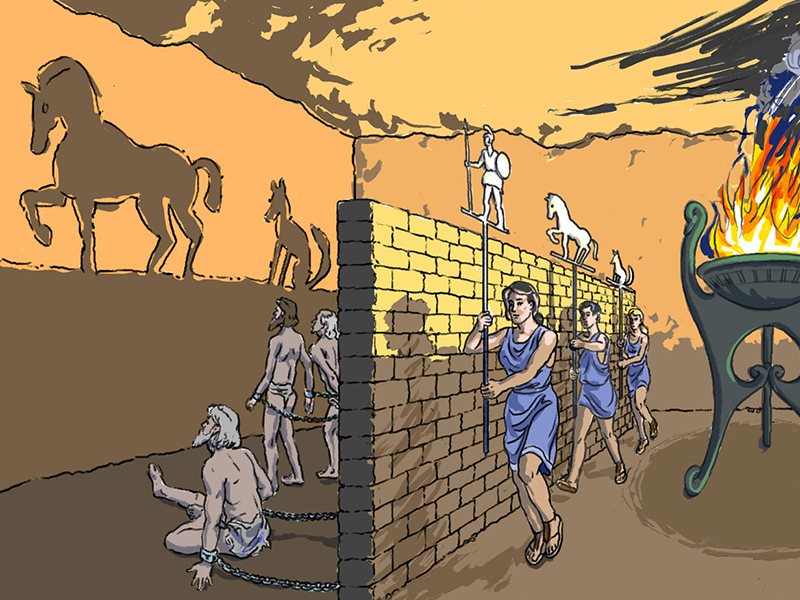
For most of our life we are absorbed at a granular level in the details of one facet of this multi-faceted reality, with our backs firmly to the light. We are absorbed in the shadow play on the wall of Plato's cave.

Monday, January 17, 2022

Personality and Perfection

I once entertained the notion that those who are spiritually advanced must display a calm and pleasant personality. My early interest in Buddhism sustained this because Siddhartha Gautama, once He attained enlightenment, was in my understanding imperturbably calm in the face of all adversities and frustrations.

It was thanks to Meher Baba that I was disabused of this notion. As Baba explained:

In the evening some of the other mandali asked Baba whether the nature of a person changes after the divine experience of Realization. A long discussion ensued, and in the end the Master clarified the matter in relation to the personality of Hafiz:

Even after Realization, a man's nature is the same but in a different way. In the normal human state, his anger, his curses, his strong language and his mannerisms express themselves because of his ego. Where there is ego, there is no God; and where there is God, there is no ego. For this reason, the words and deeds of a Perfect One are egoless.

But his special nature and personality remain the same, even after Realization, and when expressed due to some mood, they are of the greatest benefit to others.

This is the meaning of Hafiz's couplet:

At one time I craved to see various things; 

But since I saw you, I no longer desire to see anything else!

This means that the nature to see is still there. Before, Hafiz craved to see a variety of different subjects; after the divine sight, he longed only to see God. It means: The desire of seeing remains the same but undergoes a change after becoming egoless.

Suppose a man is in the habit of getting angry and beating other people. His nature will remain the same even if he turns into a saint, but the change is beyond imagination. Behind his anger there is now no self-interest. It is simply an impulse with divinity behind it. It comes from the divine flow, and anyone who comes in contact with it is greatly benefited.

For us mere mortals however, it doesn't mean that we shouldn't strive to bring the more ugly features of our personality under control. When we act out our anger, we disturb those around us and create more sanskaras for ourselves. At the same time, Baba is quick to point out that we shouldn't suppress or repress our anger but instead be quick to catch it before we act on it. If we can do this, we will see that the anger or other negative emotion is purely ego-driven and it will quickly dissipate.

If we try to repress our negative emotions and push them into our subconscious mind, they only gain more influence over us and strengthen what Jung called "The Shadow". Baba regarded hypocrisy as the worst of failings and emphasised that we must not pretend to be what we are not. This prohibition extends to the way we see ourselves. If we are troubled by anger, lust or jealousy, then we must acknowledge this and not pretend to be free of these negative emotions. The psychological tendency to suppression is encouraged if we have an idealised notion of what a spiritual person should be feeling. Suppression can lead to repression in which an individual genuinely believes that he or she is free of troubling emotions. This is no longer hypocrisy but delusion and this brings disaster in one form or another.

So neither suppression or repression is to be encouraged. Instead we should strive as far as possible not to act on our feelings of anger, lust, jealousy etc. Firstly the thought arises and then almost instantly an accompanying desire to give it expression arises. If we are quick enough, we can catch the thought, observe it and allow its energy to dissipate. Often we will not be quick enough and in that case the impulse to act can be suppressed while still holding the thought and its accompanying emotion in our consciousness. 

Baba would constantly goad his mandali into feeling angry or jealous by praising those who were undeserving of praise and criticising those who thought themselves deserving of praise. This served to grind down their egos. Situations in our own lives that arouse similar emotions can serve the same purpose. If someone insults us, our ego is quick to rise to our defence because that is its nature. When this happens, we simply need to observe this and recognise that the ego is simply doing its job. Human consciousness is capable of this objectivity whereas animal consciousness is not.

The following explanation by Baba in January of 1939 is instructive concerning the difference between a Perfect Master and a person of normal consciousness:

Dr. Deshmukh arrived from Nagpur to see Baba in Jabalpur. His mind was quite troubled and he told Baba that people were asking him why Baba was calling himself “God.” They were saying, “Isn’t this the expression of his ego? Isn’t he a supreme egotist?” Deshmukh did not know how to answer them. To pacify Deshmukh, Baba gave this explanation:

In all that a God-Realized soul or an ordinary man says or does, the “I” in him asserts itself. The difference between the two is that the “I” in the ordinary man is limited, whereas in the God-Realized being it is unlimited. If Deshmukh says, “I have written the book,” it is the limited “I” in Deshmukh asserting a certain job he has done. But when I say, “I am God,” it is the unlimited “I” asserting its universal aspect.

The limited “I” must go for the unlimited “I” to take its place. The limited “I” is like a seven-headed demon. The seven heads of lust, anger, greed, attachment, pride, jealousy and hatred must be killed so thoroughly that not even the slightest trace remains. When the false “I” is completely destroyed, another “I,” which is Real and Unlimited, takes its place.

Wednesday, August 25, 2021

The One

I was listening to Van Morrison's "Have I Told You Lately That I Love You" where he sings of giving praise to THE ONE. 

There's a love that's divine

And it's yours and it's mine

Like the sun

And at the end of the day

We should give thanks and pray

To THE ONE, to THE ONE

I thought I'd check out anagrams of THE ONE and discovered NO THEE which is most apt. THEE is an archaic form of YOU and so what more eloquent equation that this:

THE ONE = NO THEE

From the perspective of THE ONE, there is indeed NO THEE but our perspective that means NO ME. The mention of ME conjures up the word EGO and recently I came across another eloquent equation that involved this word.


For a mathematician, this makes perfect sense. This talk of Mathematics and ME and THEE puts me in mind of Omar Khayyam and his famous Rubaiyat where he says (in Edward Fitzgerald's translation anyway):

There was a Door to which I found no Key: 
 
There was a Veil through which I could not see:  
 
Some little Talk awhile of Me and Thee 

There seemed — and then no more of Thee and Me.

I found this blog post from July of 2010 that interprets these words very well I thought:

It’s been too many months since we last had a selection from Omar Khayyam’s Rubaiyat. First, just take a moment to speak these lines aloud. Really feel its rhythm on your tongue, and let its rhyme dance in your ear. I’m not normally a big fan of strictly rhymed verse, especially in translation, but something about Edward FitzGerald’s translations of Omar Khayyam bring a big smile to my face every time I read them. You can taste the sugar in each line.

There was a Door to which I found no Key:

There was a Veil through which I could not see…

The door that has no key and the veil through which one cannot see is the final barrier that separates us from the Divine Beloved. That barrier is dualism itself.

Some little Talk awhile of Me and Thee

There seemed

At first there is the dualistic perception of “Me and Thee,” of the separate identities of the lover and Beloved. That sense of separation — separation from God, separation from Source, separation from the True Self — is the fundamental pain of the soul.

Caught in the midst of this dynamic, we feel pain, we struggle, we encounter a terrible emptiness we try to hide from through the dramas of life. But looking back from the perspective of deep realisation, it can be seen as a sort of dialog between the soul and the Eternal. The dramas of life… “Some little Talk awhile of Me an Thee…” But there is only a surface appearance here, a seeming — “There seemed”

— and then no more of Thee and Me.

When we look, when we learn to really see, that’s when an amazing thing happens — suddenly that final veil falls away. The barrier is passed, not through some action or “key,” but through the instantaneous recognition that the barrier does not, in truth, exist at all. We are stunned to discover that there is no separation (only the ego’s pretence of a separation). And then — “no more of Thee and Me,” only Divine Presence within, without, everywhere!

Omar Khayyam was best known in his time as a mathematician and astronomer. His theorems are still studied by mathematicians today. His poetry really only became widely read when Edward FitzGerald collected several quatrains (rubaiyat) that were attributed to Khayyam and translated them into English as the Rubaiyat of Omar Khayyam.

The common view in the West of the Rubaiyat of Omar Khayyam is that it is a collection of sensual love poems. Although some scholars debate this question, many people assert that Omar Khayyam was a Sufi, as well as a poet and mathematician, and that his Rubaiyat can only be truly understood using the language of mystical metaphor.

Saturday, July 10, 2021

Silence Day 2021

Another Silence Day. For the first time ever, I was aware of needing to maintain silence in my dreams and remember making at least a couple of slip ups in them. It's only mid-morning now in my waking life and so far so good. In the past, I've slipped up by speaking a word or two to my dog. Not so this morning. 


The current climate of fear makes it easier to keep silent due to the reduced opportunities for visiting people and the fewer people likely to visit. These are strange times and the need to maintain equanimity or poise is greater than ever. As Baba said:
What is spirituality? It is the undoing of what you have been doing since ages. You always thought of selfish motives for eating, preserving your life, and attending to every need with zeal. All these lives you have made a habit of looking [out for] yourself. If the slightest thing goes against your habit you are upset. Now, to undo all these selfish bindings, you have to do what you have not been doing, or not to do what you have been doing.

What you have been doing always is thinking of yourself; so now you must not think of yourself, but think of others. This is what is called love. But it needs character, poise, perseverance. Poise — what is it? That state of mind where nothing excites you, nothing upsets you. Only [if you have poise] can you help others, then only can you make others happy. That means love. Thinking not of yourself but of others.

If you are in the Sahara, and for four days you have no water to drink and all of a sudden one bottle of water appears — how do you react? If you have poise, you will let your companion drink and not mind dying and letting her live. But if you fight and grab for it, you lack poise and spirituality. It is this poise that makes you sacrifice and [make] others happy.
I just reread my post of December 25th 2020 titled Complete Detachment. In that post, I wrote:
As humanity heads into a dystopian future, it's not all bad news. If it lived in a utopia, the incentives for individuals to turn inward would be minimal. In a utopia, the lure of attachments draws the individual away from the inner life and makes detachment difficult. The growing dystopia that humanity is now entering poses the danger that individuals will actively shun the world and retreat into isolation, cynicism and misanthropy. 

In our pre-Covid world, we were attached to travel, socialisation and an illusion of freedom. Suddenly that was taken away and severe restrictions were placed on travel and socialisation. The illusion of freedom was cruelly shattered. For some, this was accepted as the necessary price for combating and controlling a dangerous pathogen. For others, like myself, who understand what is really going on, acceptance is not easy. 

It's tempting to be drawn into the great divide that is opening up within humanity between those who accept what is happening and those who do not accept it. Amongst the former is the belief that governments and the medical establishment are doing the best they can for us. If we just cooperate, we'll get through these trying times and, while things will never return to the way they were, things will at least get better.

For those who do not accept what is happening, reactions are mixed. Some want to resist. Others are resigned to the "sound of inevitability" as Agent Smith put it in the original Matrix movie. Whether an individual embraces opposition, withdrawal, resignation, acceptance or cooperation, there is in each case attachment. It's difficult not to take a side or choose a position. The powers-that-ought-not-to-be know this and exploit it, playing different sides off against one another.

It's not easy to remain detached. Retreating into "isolation, cynicism and misanthropy" is not detachment but instead it is a very powerful form of attachment. The fact that our former way of life has disappeared should remind us how illusory it really was to begin with. The freedoms that we thought were our God-given right were snatched away or willingly surrendered by the muzzled masses. These freedoms were not God-given after all but granted by our benign overlords.

Worldly-wise, things have gotten worse since I wrote those lines, making detachment even more difficult, and things are going to get far worse. The abnegation of basic human rights is chastening for the egos of those who realise the game plan of the cabal but seem powerless to oppose it. The spiritual aspirant must learn the learn the lesson that the ego is nothing but now even the non-spiritually inclined are learning that lesson as they are trampled underfoot by the fascist boot of the State.


What is the difference between squished under the fascist jackboot and being dust at the feet of the master? Someone who has been reduced to dust at the feet of the master has had their ego crushed by a spiritual master who has the enlightenment of the disciple as the goal. It is a very personal process between master and disciple. Someone who is being squished under the fascist jackboot is a victim of an impersonal process that is spiritually barren and that seeks to enslave and not liberate.


Humanity is currently being herded into a spiritually barren future and all we can do is to nourish our spiritual roots so that we do not wither and die. Baba of course saw where humanity was headed and it was not his intention to see a spiritual winter descend over the Earth only a few decades after he dropped his body. A spiritual flowering will occur but Baba, as Lord and Master of the Universe, works in mysterious ways and we can only hope and wait, and not lose faith in Him.

In these trying times, when the evil forces seeking to control the world have come out of the shadows, it's more important than ever to cling to Baba's daaman and not let go. It's easy to fall prey to despair and depression unless we constantly remember Him. Jai Baba!

Sunday, February 23, 2020

God is a State not a Person

When I say that God is a state, I mean of course a state of consciousness: the ultimate state of consciousness in which all duality vanishes and there is only the experience of an indivisible Oneness. It is certainly preferable to view God in this way and to abandon these silly anthropomorphic conceptions of God. Having done this, God no longer punishes us for our sins. We punish ourselves thanks to the impartial workings of karma. The hurt and suffering we cause others rebounds upon us, either in this life or the next. If we hurl a ball against a wall, it rebounds under the laws of physics. God has nothing to do with the rebounding ball or our so-called sins.

The notion that I'm espousing does not bring us any closer to God but it can save a lot of wasted energy. How many prayers are offered up to God, asking for this or that, in the mistaken belief that these prayers are being heard and assessed by some divine being? Consciousness develops in physical organisms to the point where, in the human species, it is capable of realising Oneness but rarely does because of the karmic knots accumulated during countless lifetimes, the most recent in human form but before that in animal form. Because of this the majority of us identify with our ego, that sense of self that arises around three years of age and that we cling to throughout the remainder of our lives. Only very few can abandon that identification with the ego.

At the instant of illumination, the limited ego dissolves and consciousness experiences the infinite bliss of union. There is no awareness of the creation. The physical world disappears and in most cases the body is discarded after a few days. In some cases, the body is retained and functions more or less automatically while consciousness remains divinely absorbed and oblivious of the body's continued existence in illusion. A very, very few are destined for whatever reason to return to the physical world to become Perfect Masters. They are God in the sense that they retain their awareness of Oneness after their return. The very first human to realise Oneness is unique however, and is referred to as the Avatar. The Avatar feels a sense of responsibility for ignorant and suffering humanity and returns to Earth every 700 or 1400 years in order to lend us a helping hand as it were.

These incarnations of the Avatar are very special, each one having a unique flavour. Zoroaster, Ram, Krishna, the Buddha, Jesus Christ and Mohammed are some of his incarnations, with Meher Baba being the most recent. The Avatar always returns in male form. That is not to say that God is a male. Before Realisation, the Avatar was a male and remains so in subsequent incarnations. God is of course neither male nor female but a state that transcends all opposites. Both males and females can realise this state but the ego must be extinguished before this is possible. Extinguishing the ego of course is all but impossible and definitely so without the direct help of a Perfect Master. In a sense the aspirant never achieves illumination because he or she must die in the process, not physically (although this is often a side-effect) but mentally. The illusion of a separative ego must vanish.

Religions cause a great deal of confusion in our attempts to understand God. While inspired by the Avatar, religions continue to develop following the death of the Avatar, taking the form of Zoroastrianism, Hinduism, Buddhism, Christianity and Islam. Some of course would argue that Buddhism, in its essence, is not a religion but there's no point debating that here. Religions were intended to help us realise our essential Oneness but often serve to highlight Duality. This is the fault of the religion's adherents who lose touch with the originating spirit of the religion. The problems caused by religions have come to outweigh their benefits and that is why Meher Baba, the latest incarnation of the Avatar, chose not to establish a new religion. If someone is following a religion, Baba didn't recommend that he or she abandon it. Instead, he recommended that the adherent be true to the spirit of the religion and not become absorbed in empty rituals.

What I've written here is only a very brief summary of my interpretation of what Meher Baba has said. The reader is advised to go the source if there is desire to understand more about what I've written. Many books, in electronic format, by or about Meher Baba are available for free download at https://www.ambppct.org/library.php.

Tuesday, May 21, 2019

Attention

Following is a quote from pages 185 and 186 of Richard Chamberlain's Shattered Love: A Memoir. The link is to the Goodreads reviews of the book where it doesn't score all that highly, achieving only a 3.37 rating. I'm not surprised. Those expecting saucy behind-the-scenes revelations about famous Hollywood actors will be sorely disappointed. The memoir is spiritually orientated and in tune with my own views, so I found it an enjoyable read.
The other day I was driving along the H-2 freeway in Honolulu. Traffic was heavy and slow, and at one point choked to a standstill. To relieve my boredom I looked off toward the mountains, vaguely noticing a random row of coconut palms among some nondescript buildings.

All of a sudden one palm tree caught my attention and I really looked at it, not as just another thing I called a "tree" among many other things of the same name, but as its single self, standing there fanning out its fronds to catch the sunlight and dance with the breeze.

The minute I really saw this tree I felt a subtle connection with it and for a moment we were in each other's lives, that tree and I. This was the first time I ever realized that there are two distinct and very different ways of seeing our world and the people in it. There is generalized observation, which is heavily reliant on remembered concepts, names, and ideas: oh, there are some palm trees, the sky is cloudy, here comes my friend Sally.

In this generalized mode of observation, we see our idea of the thing more than the thing or person itself. There is a vague kind of seeing, but not much detail and very little contact. Then there is the connected, relational kind of seeing in which you give the object or person your entire attention. This form of seeing notices the particular tree and what it's doing, it sees the shapes and changing forms of the clouds against the blue sky, it sees how Sally is moving, how she is dressed, what her mood is, and it sees and feels the look in her eyes. In my experience, general observation, while obviously useful, is remote and uninvolved; you see things and people in a generic sort of way. Its inner feeling is somewhat passive. It is a necessary, but impersonal function of our intellect.

Giving our wholehearted attention, on the other hand, is akin to love. Its inner feeling is expansive, alive, connected. You are suddenly in genuine relationship with the object of your interest. When you give your full attention you automatically give yourself, your spirit and life energy, to the object of your interest. Your attention is the flow of your being. Giving your complete attention is an act of love. The recipient of this flow of your total interest, whether a person or a bird or a book or a tree cannot help but respond, however silently, and share itself with you.
The poet Mary Oliver: Born September 10, 1935
Died January 17, 2019 (aged 83)
His observations about attention hit home but the impact was further emphasised later when I read an article in The Atlantic titled Attention is the Beginning of Devotion about the recently deceased poet Mary Oliver. To quote from the article by Franklin Foer:
Her collected works amount to an instruction manual for how to focus the gaze. The exhortations that filled her poems became my command:

“To pay attention, this is our endless and proper work.”

Her final collection of essays was called Upstream. In the title piece, she remembers getting separated from her parents in the woods as they stroll along a creek. But what she recalls isn’t the trauma of being lost, but the attentiveness she achieves in that charged moment of aloneness, “the sense of going toward the source.” In her narration, this is the very instant she began her long career as a noticer.

What she sees isn’t an undifferentiated mass of a forest or an abstraction called “nature.” Her revelation is the pluralism of the woods. “One tree is like another, but not too much. One tulip is like the next tulip, but not altogether.” This discovery of the “harmonies and also the discords of the natural world” fills her with ecstatic joy.

“Doesn’t anybody in the world anymore want to get up in the
middle of the night and
sing?”

The piece concludes with a sentence that implants itself in the brain, because it is, in fact, so far upstream from the way we live: “Attention is the beginning of devotion.” And, of course, this is so. The unnoticed can’t possibly be loved.

Nowadays of course, the word "attention" is locked into the acronyms ADD (Attention Deficit Disorder) and ADHD (Attention Deficit Hyperactivity Disorder). For those with these disorders, attention is crippled. Even though I don't suffer from these particular maladies, I feel my attention is all too superficial and fleeting. I remember watching a documentary once about the history of rock climbing in Yosemite National Park. In the beginning (maybe in the 1920's), teams inched their way up using ropes carefully fixed to the rock wall. In the end (maybe in the 1980's before climbing was made illegal), single persons were scaling the rock faces without ropes. Part of the appeal for these singleton climbers would be (I imagine) the necessity of absolute focus - complete attention - to the minutiae of the climb and the consequent feeling of being totally present and very much alive, with death only one slip away.

Not everybody wants to go to those extremes to achieve this sort of intense focus. If we lose ourselves in what we are doing, then we must love what we are doing. Our complete attention is given willingly and unreservedly. We let go of ourselves, drop the mask and, for a while, we are not. For the rest of the time, by contrast, we are this or that, clinging to one ideology or another, defending or attacking one system or another, embracing this religion or another and on and on. At such times, our ego is alive and well and keeping the world at bay. A stranger approaches us and before a word is spoken a number of provisional judgements have been made. If the person is dishevelled and unwashed, we may suspect that we are about to be accosted for money. If the person is young, well-dressed and smiling, we may suspect that we are about to be asked to sign up for a charity or be persuaded to accept a particular religious viewpoint. Whatever their appearance and attitude, we are already on the defensive and ready to push them away if their initial words confirm our suspicions. We see the person through the lens of our preconceived notions. Our full attention is not engaged because we are relating to an abstraction created by our thought processes.

How might a person without an ego, such as Meher Baba, interact with strangers:
Baba would make everyone feel that they were special; when he would greet someone, he would give that man or woman his full attention. The moment that person bowed and lowered his eyes, Baba would greet someone else, but when the person raised his head and looked up, Baba would always be ready and look at the man or woman again. Each felt his or her welcome was special and exclusive. "It was like clockwork," said Bernard. "I was intrigued watching this for hours." And, if Baba did not turn back, it was always when the person bowing did not look back up at him before moving on.
He was perfectly in tune with the stranger, usually but not always a devotee, because he did not put any distance between himself and the person. People would feel that Baba was totally accepting of them and that he knew their innermost secrets but did not pass judgement on them.

Wednesday, April 17, 2019

The Grand Ilusion

I post fairly often to my Alternative Media blog. There's plenty of material to comment on, whether it be the latest false flag event, vaccination propaganda, political machinations or whatever. I don't regret the amount of time I've put into delving deeper into the workings of the world and finding out what's really going on beside the facade that is presented to us by the mainstream media. At the same time, it can be very draining. Once I realised the extent of the deception and propaganda, a sense of helplessness and frustration sometimes overcomes me as it did tonight. That's why I'm writing this.

Figure 1: multifaceted crystal ball
as a metaphor for the Self
The world is either run by psychopaths or by a global elite who, if not psychopaths themselves, employ psychopathic minions to maintain control over an increasingly deluded humanity. If I were younger I might be more active in opposing some of the worst excesses of this Synagogue of Satan but, to quote from the lyrics of the song Carrickfergus, "I am old now and my days are numbered". I will soon be leaving the world behind and I don't want to waste my remaining years focused on negativity. In my final years, the focus should be on the realising the Self.

I don't mean the limited ego, the self that I largely identify with now, but the larger Self underlying it. I'm using the metaphor of a multifaceted crystal ball to represent the Self with each facet representing a life lived in Illusion and the total number of facets, making up the surface of the globe, representing all the lives, human and non-human, that I have ever lived or ever will live. They all exist in the Eternal Now. Imagine the soul, unchanging and eternal, as a light within shining through each facet simultaneously. The light passes through and is projected into the darkness in the manner of Plato's cave (see Figure 2).

Figure 2: Plato's cave illustration
from https://cdn.dribbble.com/users/221477/screenshots/4180313/platos-cave.jpg

For most of my life I've been in thrall of the dance of shadows on the walls of my 3-dimensional prism but in the final phase of my life, I should at least try to turn toward the light. It's enough to recognise the madness and emptiness that has overtaken the world but there's nothing I can do about it. Dwelling too much on my impotence to make any changes in the world however, tends to merely reinforce my ego.


As Meher Baba said:
The less you think of yourself and the more you think of Baba, the sooner the ego goes and Baba remains. When you - ego - go away entirely, I am One with you. So bit by bit, you have to go.
Dwelling on my impotence is no better than embracing an imagined omnipotence. Both inflate the ego in different ways. The only way I can influence the world around me is through the people I interact with. The more ego I project into that interaction, the less harmonious that interaction will be. Returning to the analogy of Plato's cave, the most monstrous shadow that I cast on the wall of my cave is that of my own ego. The image of myself, the "idea" of myself, is always in my head. It fills my head with thoughts and those thoughts always lead back to me in a self-reinforcing cycle. I know this is not really me. It's a notion I've formed of myself but it's just a trick of the light. I'm not really there. Such thoughts as an adolescent might have signalled the onset of schizophrenia but I established a solid foundation for my ego many decades ago.

It's time to realise that what I built was a necessary but temporary structure. It served its purpose but now it's time to let go of it. Of course, the ego is rooted in the body and upon death the severance of the connection with the body is a profound shock to the sense of self and allows the ego to view the life just lived with far more objectivity than was possible in its corporeal life. The more I can prepare for that before it happens, the easier the transition will be. At birth, I took in my first breath and at death, I shall let out my last. Both are equally important but the latter I can prepare for and it's only in corporeal existence that significant spiritual progress can be made. Life may be a grand illusion but it is a delusion nonetheless and something that I must extricate myself from.