Monday, February 02, 2009

Books Loved by OSHO

Not long after my post about shelfari and booklists, I received a Google alert about a post on a blog called http://enlightensoul.blogspot.com and the title of the post was Books Loved by OSHO. Meher Baba's God Speaks was on the list and that's why I received the alert. I won't reproduce the list here but here is the link to the actual blog post for those who might be interested.

Osho, also known as Bhagwan Shree Rajneesh was of course an interesting and controversial character. Followers of Osho are often called Orange People because of the colour of the clothes that they favour. When I first arrived in Pune in the late 90s, I remember being surprised by the number of westerners wandering around in orange robes. As I later learned, they were from the famous Osho ashram that attracts visitors from around the world. At the time, I was just passing through on my way to Ahmednagar and then on to Meherabad.

Followers of Osho are sometimes called sannyasins or neo-sannyasins (the word means "renouncer" in Sanskrit) and following Osho's death in 1990 quite a few of them were attracted to my old guru Barry Long. When I first started attending Barry's talks in the early 1990s, I noticed that a leaflet was always on display that was addressed specifically to any Osho followers who might be in attendance. Barry was based at Tambourine Mountain and often gave talks at the Gold Coast. There is a large Osho community around Byron Bay and many would have come from there to attend his meetings. Barry was always respectful of Osho and acknowledged his spiritual credentials.

Saturday, January 31, 2009

Amartithi

Today is the 40th anniversary of the death of Meher Baba. The photograph above shows where he is buried and is referred to as his Samadhi. However, Baba lovers don't think of this anniversary as a death but as the dropping of his physical body. Baba emphasised that there was really only one birth and one death, the birth of the soul into ignorance of its true nature and the death of ignorance once the soul realises its true nature. He described physical death as being akin to sleeping. When a person goes to sleep, he or she wakes up in the same body but when a person dies, he or she wakes up in a new body.

At the moment thousands of people from India and from around the world are gathered at Meherabad for a three day celebration of this anniversary. There is live coverage of the event of the Internet while video and audio highlights can be viewed here. The term Amartithi is used for this celebration and Wikipedia describes the origin of the term as follows:

Amartithi is the day which commemorates Meher Baba's death on January 31, 1969. The word "Amartithi" appears to have been coined by Meher Baba and means "deathless day" (Literally, amar, deathless; tithi, day). Also translated as "eternal date" or "date with the Eternal." 10,000-12,000 overnight and 25,000-30,000 daytime visitors from all over the world gather at Meherabad for the three-day program. Amartithi is celebrated by Meher Baba's followers all over the world, including in the United States, Europe, and Australia, and, besides "Silence Day" (July 10, commemorating the commencement of Meher Baba's lifelong silence), it is considered the most significant holiday among followers of Meher Baba. At Meherabad the climax of the event takes place on Amartithi day itself when the assembled crowd keeps silence for fifteen minutes in honor of the physical passing of Meher Baba at 12:15 p.m. on January 31, 1969. Meher Baba's flag is flown over Meherabad during Amartithi.

When I first visited Meherabad over ten years ago, it was difficult to even reach the centre via email but now there is even a live video feed to the Internet on the big occasions such as this. Times have certainly changed. Out of necessity, I remember leaving behind in Singapore in 1999 the few volumes of Bhau Kalchuri's Lord Meher that I had purchased. Now the entire collection is freely available online along with all of Baba's books and those of a great many of his followers.


Thursday, January 29, 2009

Social Networking via Books


A friend introduced me to shelfari, a site where you can keep track of books you've read, books you're currently reading and books you would like to read. You can also write your own reviews and share them with other people. It's quite interesting to reflect back on all the books that you've read over the years. Some of the first books that I can recall reading in the late 1950s were a series of science fiction books written by W.E.Johns who was better known for his Biggles novels. Around the same time, I read another series of science fiction novels, written by Ivan Southall, about a character called Simon Black. There are no biographical details in shelfari for either of these authors so I can supply these if I like, along with a photograph of the author, and everyone can then share this information. Additionally you can add a widget, as I've done, that will appear in this blog showing the book that I am currently reading.

Monday, January 12, 2009

the five people you meet in heaven


During the holidays, I finished reading the five people you meet in heaven by Mitch Albom and quite enjoyed it. I'm to keen to view the movie version that was released in 2005 and starred Jon Voight as Eddie, the central character who dies and meets these five people in heaven who explain certain things about his former life. They have all touched his life in some way although he only knew two of the people directly. There's been lots of movies made about the after-life over the years. I watched recently relaeased one tonight called Passengers starring Anne Hathaway and Patrick Wilson. I found it very moving. Books and movies like this attempt in different ways to depict the experiences that a suddenly discarnate consciousness undergoes in the immediate after-death state. A little research in Lord Meher about sudden death turned up this interesting quote from Meher Baba:

If a person dies by a sudden accident before his natural death, he immediately takes birth again and completes the remaining time of his past life, after which he dies. Some live for one, two, three, four or five years; and after finishing the remaining period of their past life, they take another body according to the sanskaras of the life which ended suddenly by accidental death. However, they cannot live longer than it takes to complete this remaining time. This is why some children die – some in a few days, some in a few months, and some after a few years. Generally, children up to the age of seven do not incur sanskaras. Their life until seven years of age is passed through according to, and depending on, the push of the sanskaras in their previous life. They are happy or miserable in accordance with the push being smooth or violent.

This makes perfect sense when you think about it. For example, in the tsunami that devastated Aceh in Indonesia, the lives of at least 120,000 people were suddenly expunged in a matter of minutes. It would be unlikely that all these people had simultaneously worked out their sanskaras and were ready for their natural death. However, I found another reference that suggests that this unlikely gathering of ill-fated individuals does indeed take place.

God is not kind, he is the ocean of mercy. But it is all according to law. And law is not complicated, it is simple. You sow a seed, you water it, you have a plant that grows - it is so simple. Law gives you all this from one seed, because all this was latent in the seed. Law deals individually, and also in multitudes of the same type. Your taking birth at a certain time, your giving up the body at a certain time, is all according to law, which shapes your actions. You are not responsible. But what about those who all die at one and the same moment, like thousands in an earthquake? Law gathers all of the similar types in one country, and ends it in one time.

I suspect that the majority of those who die in natural disasters have been gathered in the one place by the Law of Karma but a minority do die before their appointed time simply because of the indiscriminate nature of the disaster.

Friday, January 02, 2009

Life on the Road

For a few days recently, I swapped my safe, predictable and comfortable life in Jakarta for a decidedly unsafe, unpredictable and uncomfortablelife on the road to various locations in North Sumatra. Choosing to travel largely by public transport added to the stress because I found myself crammed into minivans containing more people than seats. Invariably, some male in the vehicle would light up a cigarette to add to the discomfort already caused by the overcrowding, heat and dust. It was an opportunity to exercise non-reaction in the face of provocative stimuli and overall I did very well.

I started to find that it was easier simply to accept the situation, rather than work up the emotional energy required to get annoyed and express this annoyance or try to contain it. Simply observing the situation and seeing the humour in it helped. At one point in my journeying, I was stuck in the back of a minivan when an old guy decided to light up in the seat in front of me. He was sitting beside a woman nursing a new born baby and had his own granddaughter on his lap. At least I was beside an open window and had some escape from the smoke. Nobody complained or even looked annoyed and neither did I. This old guy obviously had no awareness that the smoke from his cigarette might be harming the lungs of the baby beside him.

On another occasion, I was reminded of Meher Baba and his widespread travels throughout India. Usually he traveled by train in the third class compartments and often slept rough. My discomfort was mild and transient compared to what he would have gone through. So I just watched and found myself repeating, in mantra-like fashion, "observe but don't react, respond appropriately if the situation requires it". This practice was put to the test during the final leg of the journey when the driver of a private vehicle that we were sharing with other people was recklessly overtaking vehicles and it seemed that the appropriate response would be to ask him to stop and for me to get out. However, it was the middle of nowhere and as fate would have it, the car finally died because the driver had been pushing it beyond its limits and it had fatally overheated.

Thus it was that all the occupants of the vehicle alighted while the driver surveyed the situation. We had been standing by the side of the road for no more than two minutes when a fatal accident unfolded a couple of hundred metres up the road. A bus collided with a female motorcyclist who had been killed instantly. The bus overturned and its occupants suffered cuts and abrasions but nothing more serious. I uncovered these details because I walked up to the accident scene. This was New Year's Eve by the way and the young woman who was killed would have been looking forward to the coming year. It reminded me of the futility of thinking excessively about the future because it may not arrive.

I was also appreciative of the breakdown of our vehicle because it meant that we transferred to a taxi whose driver who was certainly less reckless and we completed our journey in safety. I have a final image of passing the motorcyclist's body as it lay by the side of the road. The body had been covered by pieces of cardboard but the bottom of the legs were visible. The victim had been wearing blue jeans and her toenails were painted red. When we arrived at the hotel it was 7pm and I wasn't in any mood to celebrate the arrival of the New Year but at least I was alive to see it in.

Monday, December 22, 2008

Puddle Consciousness


Here is a graphic of a famous woodcut created by M.C.Escher in 1952 of which Wikipedia has this to say:

Since 1936, Escher’s work had become primarily focused on paradoxes, tessellation and other abstract visual concepts. This print, however, is a realistic depiction of a simple image that portrays two perspectives at once. It depicts an unpaved road with a large pool of water in the middle of it at night. Turning the print upside-down and focusing strictly on the reflection in the water, it becomes a depiction of a forest with a full moon overhead. The road is soft and muddy and in it there are two distinctly different sets of tire tracks, two sets of footprints going in opposite directions and two bicycle tracks.

I'm using it as an illustration to introduce a spiritual reflection on the puddle as a metaphor for the human ego. The Ocean is often used as a metaphor for The One as in the Ocean of Forgiveness, the Ocean of Mercy and the Ocean of Compassion. In light of that I thought that a puddle is an appropriate and complementary metaphor for any centre of consciousness that is identified with its separateness, as is most human consciousness. A puddle is defined at Answers.com as a small pool of water, especially rainwater. If you think of yourself as a puddle then it is hard to feel self-important. A puddle is essentially transient. It owes its existence to the rain that falls from the sky, rain that came from the ocean originally. A puddle will soon disappear when the sun breaks through and evaporates its contents. In essence it is one and the same with the ocean that provided that content. As humans, we identify with the form of our puddle and forget that it is merely a temporary container for the water that circulates ceaselessly via the water cycle, always arising from and eventually returning to the ocean.

Of course when the surface of the puddle is perfectly still, it reflects the sky above it, the sky that brought the rain that created the puddle in the first place. If we can become still enough, we can glimpse that we are part of something much larger than the little puddle with which we have been identifying. We can then appreciate how really limited we are, that we are only puddles of forgiveness, puddles of mercy, puddles of compassion. I can forgive a little and I have a capacity for mercy and compassion but such qualities are most definitely finite. I am circumscribed in every possible way as long as I remain immersed in puddle consciousness.

More commonly the metaphor for the individualized consciousness is that of a drop or bubble within the ocean. Eventually the drop or bubble bursts and becomes one again with the ocean that it was always a part of. All metaphors are limited when confronting the ineffable but I find the puddle versus ocean metaphor a useful way of conceptualizing my relationship with The One, a term by the way that I'm preferring to use nowadays in preference to the G word that now carries too much baggage to be useful.

Sunday, November 30, 2008

Forms of Meditation


The above excerpt is from page 237 of Meher Baba's Discourses and it was only after reading Eckhart Tolle's The Power of Now that I realised that Baba is describing an approach that is the same as the one that Tolle is recommending. In his book (available for download here), Baba describes many different forms of meditation that he divides into two categories: personal and impersonal. Personal meditation relates to a person whereas impersonal meditation relates to aspects of human personality or things that are beyond the realm of human personality. He describes four forms of personal meditation:
  • meditation on the divine qualities of a Master
  • concentration on the form of a Master
  • meditation of the heart
  • meditation of action
These four forms in practice represent a continuum in which the spiritual aspirant's initial meditation on the one of more of the Master's divine qualities, such as egolessness, leads to a focus on the physical form of the Master that in turn leads to the release of unrestrained love for the Master (meditation of the heart) and a life of selfless service to the Master (meditation of action).

The eight forms of impersonal meditation that are described are:
  • meditation on all forms of life
  • meditation regarding one's body
  • meditation on the formless and infinite aspect of God
  • quest for the agent of action
  • considering oneself as witness
  • writing down one's thoughts
  • watching mental operations
  • making the mind blank
In the first type of meditation, the goal is to acquire the constant habit of regarding all forms as equally the manifestations of the same one all-pervading life. The second type of meditation aims at creating detachment from the hypnotic identification with one's own physical body so that it is seen as just another form of life. Both types focus on finite forms of life and are a preparation for a shift in focus to the formless and infinite. Some symbol of infinity is commonly used, such as the ocean, but the focus is firmly within. It is reinforced with mental suggestions such as "I am as infinite as the ocean within".

These first three forms of impersonal meditation are predominantly concerned with the impersonal objects of experience but the other five types are more concerned with the subject of experience. One such important form of meditation consists in ceaselessly pressing the query "Who is it that does all these things ... who is this 'I'?" This is the quest for the agent of action and is logically connected to considering oneself as witness, writing down one's thoughts, watching one's mental operations and making the mind blank. It is these final five of the eight types of impersonal meditation that Ekhart Tolle and Barry Long are connected with in their teachings.

Meher Baba admits that making the mind blank is one of the most difficult things to do but interestingly he describes a possible method involving:

an alternation between two incompatible forms of meditation, so that the mind is caught between concentration and distraction. Thus the aspirant can concentrate on the form of the Master for five minutes; and then as the mind is getting settled on the form of the Master, he can steady his mind for the next five minutes in the impersonal meditation in which the thought is "I am infinite". The disparity between the two forms of meditation can be emphasized by keeping the eyes open during meditation on the form of the Master and closing the eyes during impersonal meditation."

I've recently been trying this (with Meher Baba as the Master) and have experienced quite positive results but I need to build the practice into my daily routine and not just make it something that I do intermittently.

Friday, November 14, 2008

Seeing God in All

An Indian teacher at the school where I teach asked me to suggest some teaching resources for a friend of his who had started teaching the same course as I was teaching in Bali. I made some suggestions and sent them in an internal email that the teacher forwarded to his friend. In turn, his friend responded with thanks and the teacher at school forwarded the email on to me. It began with the quote "if you cannot see God in all, you cannot see God at all". I'd been thinking about that idea a lot but this morning I was very busy with school matters and hadn't had time for a spiritual thought at all and I certainly wasn't expecting a little gem of wisdom to pop up at the top of an internal email. The author of the email is clearly Indian judging from his name and it was refreshing to receive a whiff of the divine amidst the mundane tasks that were occupying my morning. So many emails are generated nowadays and it's not a bad idea to embed a little spiritual wisdom within them to counteract the spell that the world casts over us, especially when we are at work.

Our daily, world-focused consciousness sees the figures in the foreground (people, animals and things) and ignores the background that they all share. Seeing God in all requires us to focus on the background instead of the foreground figures. This page from Ram Dass's "Be Here Now" expresses this idea very "graphically".


Sunday, November 09, 2008

Be Here Now


I managed to get hold of an electronic copy of "Be Here Now" by Ram Dass. The e-book is actually a compilation of over 200 images, each corresponding to a page of the book. The images have been gathered together in a single PDF file. Each page has the same brown background and large, uppercase text. Most of the pages feature drawings as shown above which is part of page 87 of the book's 221 pages. He wrote it in 1971 when he was thirty years old, after his return from India. He augments his spiritual reflections with quotes from Gurdjieff, Ouspensky, The Buddha, Jesus, Meher Baba and others. The book is very retro but timeless nonetheless.

I feel guilty not paying for it, given that he's living in a rented house in Maui and his friends are currently collecting money in order to buy him a house. However, I promise to buy a physical copy the next time I'm in Australia or Singapore. It' s not likely to be available here in Jakarta. It's the sort of book that is probably more useful in physical form anyway. If you just had it sitting on your bedside table, you could just pick it up, choose any page at random and gain a little spiritual boost.

Friday, November 07, 2008

Ram Dass


A friend of mine on Facebook sent me a video of Ram Dass talking on spiritual matters. I'd heard the name over the years but knew nothing about him. I was impressed by his presence in the video even though he struggled with his words due to a stroke that he suffered in 1997. "We are fingers of consciousness for the one consciousness" was one memorable phrase. I was prompted to read the Wikipedia article about him and it turns out he has a very interesting background.

As Richard Alpert, he was a close friend and associate of Timothy Leary and both of them were dismissed from Harvard in 1963 for activities surrounding their Harvard Psilocybin Project.

He visited India in 1967 and corresponded with Meher Baba who would have been in seclusion at the time and so not accepting visitors. He went on to meet Neem Karoli Baba who became his guru and gave him the name "Ram Dass" which means "servant of God". His first meeting with his future guru was quite transformative. He describes it quite poignantly in an interview as follows:

I was coming up a hillside and I saw him sitting under a tree with eight or ten devotees around him. I'm standing at a distance and the guy who is with me is on his face touching this his feet, and I'm thinking, "I'm not going to do that."

Neem Karoli Baba looked up at me and said, "you came in a big car?" We had come in a friend's Land Rover that we had borrowed so this guy could come and see his guru to get his visa. So I said, "yes." And then he said, "you will give it to me?" Now, coming from Jewish charities as I do, I had been hustled, but never like this! I was speechless. The guy I was with leans up and says, "if you want itMaharaji, it's yours." I protested and said, "you can't give David's car away!" I was aware of everybody laughing at me, but I was very serious. (laughter)

Then Neem Karoli said, "take them and feed them." So we were taken down to the temple and fed lunch. Then he called me back up and he told me to sit down. He looked at me and said, "you were out under the stars last night," Then he said, "you were thinking about your mother." My mind started to get agitated and I started to entertain hypotheses as to how he could have known that. Then he said, "she died last year," and the dis-ease kept growing. Then he said, "she got very big in the belly
before she died." My mother had died of an enlarged spleen. And then he closed his eyes and he rocked back and forth and he opened his eyes and looked at me, and in English he said, "spleen."

When he said that, my mind just couldn't handle it. I just gave up. Something shifted and I started to feel a wrenching pain in my chest. There was a radio show on many years ago called Inner Sanctum and they opened this screeching door at the beginning of every show. I felt like this door that had been long closed was being violently forced open. I started to cry and I cried for two days. And after that, all I wanted to do was
touch his feet.

I had recognized that not only was he inside my head, but that everything I was, he loved. There was not a part of me that he didn't know, and he still loved me. So, all the models of `if they only knew that little thought that I don't even admit to myself, they wouldn't love me,' didn't apply.

This wasn't an intellectual process. It was a direct experience of that quality of unconditional love. It took that long (snaps his fingers) and all the rest of it has been basically irrelevant. I cherish everything that came after and I got all kinds of teachings, but the thing happened at that moment. He didn't do anything, he just was it. He was an environment where my ripeness to open had a chance to express itself.

Now 77 years old, he lives on Maui in a rented house overlooking the ocean and a sense of the atmosphere there is conveyed by this report by a visiting journalist a couple of years ago:

His house feels like a temple. There are altars everywhere, covered with pictures of saints, tropical flowers, candles and incense. He has a photo of George Bush on an altar, “because he’s someone I have trouble loving.”

He greets every visitor with joy and fixes his attention completely on that person, even the ones I find tedious. When his assistant, Kathleen Murphy, tells him she’s going into town to do errands and asks, “Is there anything you want?” Ram Dass looks in her eyes, then smiles. “That you have a good time.”

At 75, Ram Dass feels he’s demonstrating “a way to grow old and prepare for dying.” I ask how he prepares for dying. “With quiet presence, and by practicing change,” he says. “Being content with change. I’ve been changed by a stroke…and I’m happy. Death is the biggest change we’re going to face in life. So we need to practice change.”

I particularly like the George Bush reference. 1n 1973, Ram Dass wrote his famous book "Be Here Now" which I certainly intend to read if I come upon it. The title of the book is very similar to "The Power of Now" by Eckhart Tolle, the book that seemed to reignite in me an active interest in spirituality. It was a friend at work who recommended Tolle's book to me and she was quite persistent that I read it, despite my initial reluctance. The recent recommendation from my Facebook friend is similarly appreciated. I guess you really can get by with a little help from your friends.

Thursday, October 30, 2008

Don't Burn the Day Away


A favourite song of mine is "Pig" by Dave Matthews Band and a repetitive line throughout the song is "don't burn the day away". The graphic above seems to contain all of the words that appear in the song. The pig reference is about the greedy ego that is not content to simply enjoy life but always wants more. Part of the lyrics run as follows:

Is this not enough?
This blessed sip of life,
Is it not enough?
Staring down at the ground
Oh, then complain and pray for more from above,
You greedy little pig

Burning the day away of course means not living in the moment but instead allowing all of the ego's activities to be simply means to ends that never end. An activity as mundane as brushing my teeth is usually performed in a cloud of thoughts and with a clear end in sight, namely to finish cleaning my teeth so that I can get on with some other more important business. The action is mechanical and the grip on the toothbrush is far stronger than is needed. I am not present and so I clutch (rather than grasp) the toothbrush in case I lose my grip on it during my mental meanderings. This lack of conscious involvement in routine physical activities is partly what the Alexander Method, as developed by Fredrick Matthias Alexander, seeks to address. Lately I've been catching myself half-way through such mundane activities and concentrating fully on performing them without  attending to any thoughts that might intrude.

Maybe the reason life seems to pass by so quickly when we are older is because we are burning the days aways rather than relishing each one as it comes. It's easy to get caught up in this habit when you're teaching. The lessons become working days and then working weeks, terms, semesters and then finally years. Those years lead us ultimately to oblivion but the process can be slowed if we can "wash out this tired notion, that the best is yet to come" and learn that "there's much more than we see here" if we can only slow down enough to appreciate it.
.

Saturday, October 11, 2008

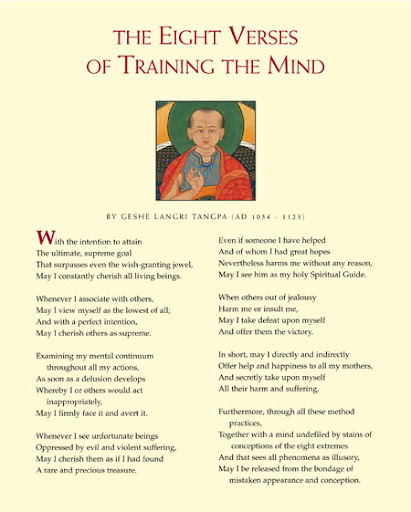
The Eight Verses of Training the Mind

I had reason today to be reminded of a quote that a Buddhist friend of mine always appended to his emails (I haven't heard from him in a while). It went like this:

I will learn to cherish ill-natured beings
And those oppressed by strong misdeeds and sufferings
As if I had found a precious
Treasure difficult to find.


It had always struck me as an exceedingly hard thing to do. Having not ventured out of the house for two days, Desy and I went to the local mall today. It was fairly crowded as expected for a Saturday and the coffee shop was almost full. There was only one place to sit and that was beside a guy who was smoking a cigarette. This is a common occurrence in Jakarta malls where smoking is supposedly banned but where patrons of restaurants and coffee lounges can light up uninhibitedly. It's difficult not to feel intense dislike toward the "ill-natured being" who is the source of the noxious smoke that is drifting into my nostrils.

However, rather than viewing the person as a source of irritation, the Buddhist verse sees the person as a "precious treasure" and an opportunity to practise compassion, understanding and non-reaction. It's possible to muster some compassion and understanding, after all the person is probably addicted to nicotine and he is steadily destroying his lungs. He can only relax in a coffee lounge if he is smoking. Non-reaction is more difficult because my tendency now is to stifle the negativity. I still see the person as rude and insensitive but I'll ignore it because I want to remain calm and unperturbed.

Indeed I have remained remarkably calm and unperturbed for two days but of course I never left the house and so it was rather easy. Outside, it's a different matter as I discovered in the coffee lounge. I can now see this Buddhist verse as a way of not suppressing the emotion that rises up when "oppressed by strong misdeeds". If the person or situation can be seen as an opportunity to cultivate equanimity, then that thought may be enough to stop the emotion arising in the first place.

A little investigation revealed that the verse my friend was quoting is part of a larger whole called "Eight Verses on Training the Mind". Here it is:


Here is a slightly different translation to the one that appears above (and that may be difficult to read easily because of the small print):

Eight Verses on Training the Mind   
                                            
by Geshe Lang-ri Tang-pa
translated by Jeffrey Hopkins

               
With the determination to accomplish
The highest welfare of all sentient beings,
Who surpass even a wish-granting jewel,
I will learn to hold them supremely dear.

Whenever I associate with others I will learn
To think of myself as the lowest amongst all
And respectfully hold others to be supreme
From the very depths of my heart.

In all actions I will learn to search into my mind
And as soon as a disturbing emotion arises
Endangering myself and others,
I will firmly face and avert it.

I will learn to cherish ill-natured beings
And those oppressed by strong misdeeds and sufferings
As if I had found a precious
Treasure difficult to find.

When others out of jealousy treat me badly
With abuse, slander, and so on,
I will learn to take all loss
And offer the victory to them.

When the one whom I had benefited with great hope
Unreasonably hurts me very badly,
I will learn to view that person
As an excellent spiritual guide.

In short, I will learn to offer to everyone without exception
All help and happiness directly and indirectly
And respectfully take upon myself
All harm and suffering of my mothers.

I will learn to keep all these practices
Undefiled by the stains of the eight worldly concerns,
And by understanding all phenomena as like illusions,
Be released from the bondage of attachment.


Well I can tell you, I'm a long way from that but I'll definitely try this approach in future difficult situations or when interacting with difficult people. Tolle explains emotion as the body's reaction to thought and that's a useful way of viewing things. If I think that the person smoking the cigarette in the coffee shop is annoying me personally then emotion is inevitable. Whether that emotion finds outer expression is another matter but it will certainly have inner expression in terms of increased blood pressure and pulse rate. If I realise that he's annoying everybody that is nearby and not just me, then the emotional response will be more subdued because there is less ego involved.

However, if I think of the person's behaviour as an opportunity rather than an insult or annoyance, the emotion doesn't arise in the first place. In this case, the ego doesn't instinctively leap to my defence. The ego is like a guard dog that protects its owner from perceived threats like smoke wafting from a cigarette. It's not that the ego sees the smoke as physically threatening (even though it probably is) but it views the inconsiderate behaviour as a threat because it feels diminished. "What right has this guy got to smoke a cigarette near me", it thinks? Of course, one thought leads to another. I may not like the way the person looks or the way that he's sitting. In fact, this rotund, middle-aged man was lounging back in his seat as if he were in his living room. The chain of thought quickly escalates the intensity of emotion generated. The ego thinks "who's this rotund, middle-aged guy anyway? I shouldn't just sit here and take this."

It all comes down to ego of course and even if, in future, I can sit down beside people who are smoking and "cherish" such "ill-natured beings", the ego may will be there to claim some credit. It may whisper in my ear "you really have come a long way from the quick-tempered son-of-a-gun that you used to be, old son. Well done." As Meher Baba says on page 170 of his "Discourses", "the ego is hydra-headed and expresses itself in numberless ways ... (it) is activated by the principle of self-perpetuation and has a tendency to live and grow by any and all means not closed to it. If the ego faces curtailment in one direction, it seeks compensating expansion in another."


Thursday, October 09, 2008

The Pit and the Pendulum


I was given a copy of the above Arthur Rackham painting by Ali Reeves, over thirty years ago now.  The painting was created in 1919 to illustrate a short story by Edgar Alan Poe called "The Pit and the Pendulum". I still have the painting after all these years and I've long pondered its significance but it was only tonight that I decided to do some investigation into it on the Internet. It didn't take long to track down the painting and the associated story. Given my recent preoccupation with time, the title and content are interesting. Here is a description of the prisoner's first sight of the pendulum.
Looking upward, I surveyed the ceiling of my prison. It was some thirty or forty feet overhead, and constructed much as the side walls. In one of its panels a very singular figure riveted my whole attention . It was the painted figure of Time as he is commonly represented, save that in lieu of a scythe he held what at a casual glance I supposed to be the pictured image of a huge pendulum, such as we see on antique clocks.
Prior to this, the prisoner, awakening in his unlit cell, describes the experience of "mere consciousness of existence, without thought, a condition which lasted long. Then, very suddenly, THOUGHT". The final word is capitalized in the story, the gist of which is that the pendulum is actually a swinging, razor-shape blade that is slowly descending on his bound and supine body. A movie, starring Vincent Price, was made that seems to be rather loosely based on the Edgar Alan Poe story.

The content of the story is highly symbolic. We come into the world as "mere consciousness of existence, without thought" but then suddenly acquire it. As our thought processes become clearer, we begin to see and understand our situation. We are trapped in a very circumscribed world and we know full well that the Sword of Damocles is descending on us. If we remain bound by time, it will eventually kill us but in the story the prisoner breaks free of his bonds with the help of a horde of rats that are eating their way through a sort of straight jacket that is holding him down.

The rats are intent on eating him of course but they have to gnaw through his straight jacket before they can start on him. With the pendulum of death beginning to graze him, the prisoner breaks free and tosses off the devouring rats. He has evaded the pendulum and it then ascends again. However, the walls become red hot and devilish faces and forms on the wall leer at him as he is forced ever closer to the pit. The pit he has tested out earlier but dropping something into it. He knows it is very deep and what is at the bottom is unknown.

In the light of my current reading, I'd say that having attained stillness by escaping time, the prisoner needs to have his remaining ego attachments burnt away before he can enter the realm of pure Being. The pit is terrifying to the ego because it symbolizes its extinction. In the final scene, he is rescued as he teeters on the brink of the abyss: "I struggled no more, but the
agony of my soul found vent in one loud, long, and
final scream of despair
". In letting go (of his ego), he finds himself although in the story the ending is quite mundane. He is rescued by General Lasalle of the French army that has entered Toledo and overthrown the agents of the Spanish Inquisition.

I'd been looking at the pit in the painting recently because I'd been having some experiences of my own regarding disappearing into bottomless pits. A couple of times now, as I've been meditating on my breathing and not attending to any thoughts that arose, a mild sense of panic has arisen due to a sense of nothingness. My instinct has been to cling on to a passing thought in order to get a handle on things. This is the ego panicking of course when it doesn't have anything to think about and fears that it is disappearing (which it is). I think this is a good sign but the panic pulls me out of the meditative state and I start thinking about what just happened. I have to go beyond that and sink into the panic. Over the years, I've been drawn to Rackham's painting and now I can use it as a source of spiritual inspiration.

Monday, October 06, 2008

Seeing Blindness

I came across a quote on a blog from an essay by David Duncan called "Bird Watching as a Blood Sport". It appeared as an article in Harper's Magazine on July 1997 but I've not been able to access it yet. Here is the quote anyhow:

"While writing the last paragraph, for instance, I swiveled my eyes from the page to grab a blue ceramic coffee cup from a shelf directly behind me. En route to and from this cup, my eyes moved across dozens of plainly lit objects. Yet I perceived none of them. By retracing, slowly, my eyes' route to the cup, I see that they swept across a brass banker's lamp, a Japanese painting of Ebisu playing a red carp on a cane pole, a photo of Meher Baba feeding a monkey, an old L.C. Smith Bros. typewriter, a bunny-ears cactus, an almost life-sized figurative sculpture, two jars full of pens and pencils, fifty or so books, and a large window. Yet I saw none of this. Something in me sought an object it knew to be blue, behind me, and full of hot caffeine--sought it so decisively that I turned 180 degrees, 'filming' all the way, yet made an essentially blind turn. This 'seeing blindness' is the great contradiction of human eyesight."
The reference to Baba is what caught my attention and the fact that he is feeding a monkey is ironic and suggests the so-called "monkey mind" that causes me so much trouble when I try to stay in the present moment. This is probably quite unfair to monkeys who are certainly far less occupied with the past and future than I am. Another walk with the dog tonight but I kept drifting off, not for long periods but very frequently. If I had any insights, it was simply that the mind will seize on the slightest thought in order to escape into the past or future.


I like this graphic of the mischievous monkey who has dominion over its hapless owner. At least now I know that the monkey is there, whereas before I was oblivious to its existence. In the past, I've often glibly used the phrase "monkey mind" without ever really understanding what I was talking about.

Saturday, October 04, 2008

The Inner Dialogue


Tonight, while walking the dog, I succeeded for the first time in a long time to stop the inner dialogue that is normally playing in my head. I don't know how ... I just did. Two nights ago I had gone on the same walk and could feel, as I walked along , that my head was enveloped in a cloud of incessant mental activity. Tonight I was able to switch it off for reasonably lengthy periods. I would still drift off into the past and future but only for a few seconds and then I would snap back to the here and now. Previously, I had been using the inner dialogue paradoxically to try to achieve a state of presence. I'd say things to myself like "sink into your inner stillness" and in retrospect this was quite silly.

Try this simple experiment. Listen for one second to the thoughts in your head. Turn your attention inward. What is it you hear? Perhaps you may see or hear that there is nothing there at all. You see by looking for the thoughts, for the noise, for the incessant spinning, it all seems to disappear. Of course, one second later it starts again and our attention is blindly attracted to the thoughts.

Perhaps, through your busy day, if you can take a second here and there to once again look inside and see this inner dialogue, you will again and again be amazed that by attending to it and simply being aware of it - it just disappears. Rest there in that point of disappearance. And resting there brings with it a great sigh of relief and peace. You have found your true identity: the pure silence, your true self and home.
I also like this approach to the problem as presented at http://bookfloozy.wordpress.com/
“When you run after your thoughts, you are like a dog chasing a stick: every time a stick is thrown, you run after it. Instead, be like a lion who, rather than chasing after the stick, turns to face the thrower. One only throws a stick at a lion once.”
The phrase "inner dialogue" or "inner dialog" returns a huge number of websites and images in Google, which is not surprising I guess. In turning my inner dialogue off, I felt a lot more in control and a lot more focused on what was happening around me. I felt more mentally alive, instead of feeling like my head was full of cotton wool.

Thursday, October 02, 2008

The River of Time


Many years ago I read a novel by C.S.Forester called "Randall and the River of Time" (not related to the graphic above).It wasn't a great novel and an excoriating Time Magazine review from the 1950s had this say of the book:

On page 5 of Randall and the River of Time, the hero stands, in the year 1917, at the crossing of  two trenches in France, and wonders which way to go. At that point Hero Charles Randall and Author C. S. Forester make their big mistake: the hero turns left. Had he turned right, Randall would have been neatly dispatched in a German raid on a British strongpoint. Author Forester, whose Captain Horatio Hornblower is one of the best historical romances in the language, would thus have been spared the shame of scattering Hornblower's wake with a fictional mess for the gulls; and poor Randall would have been spared a life that is not much better than death, anyway.
Well I liked the book's title which is why I picked it up in the first place. The river of time imagery connects to my previous post in which I observed that my stream of thoughts and emotions had emptied into the ocean and that I was now bobbing about on its surface. I was of course getting a little big-headed and a dream that I had last night put things in perspective. In this dream, I was in a large, shallow, concrete swimming pool and I was holding a metallic wrist-watch. There was a channel flowing out of the pool and I allowed myself to be carried into it. I let go of the watch, thinking that it would not be lost but easily retrieved because the channel was shallow with a concrete base and the water was not flowing too swiftly. Quickly however, the current became stronger and the base turned to sand and pebbles. I suddenly realised that I had no hope of ever retrieving the watch.

The channel emptied into a small river and that's where I ended up. As I looked upstream I saw a huge wall of water bearing down on me and was momentarily alarmed. However, the place in the river where I was floating was quite calm, there was no strong current and I was close to some rocks that I could use to climb out if I needed to. The danger from the wall of water seemed to evaporate with that observation. That's the dream and I woke up at that point, making a mental note to remember it in the morning.

It would seem that I have come from the safe haven of a swimming pool and that I am in a little tributary of a river that probably flows into a larger river that may finally empty into the ocean. 'm clearly a long way from "the Limitless Ocean of love, bliss, knowledge and goodness" that Meher Baba describes. The swimming pool is a good metaphor for the limited and predictable, mental-emotional life that I've been living for quite some time now. My movement from this shalllow, concrete-based pool to a small river that has some depth to it seems positive, as does losing the watch. I never wear a wrist-watch but holding one, as I was doing in the dream, indicates an attachment to time and thus mind that can only exist in time. Letting go of the watch and accepting its loss suggests detachment from the mind's dominance.

In his book, "The Power of Now", Tolle talks of the mind's chronic attachment to memory (the past) and anticipation (the future). I thought that combining these two words together to form a neologism "memantic" is a good way to describe the sort of consciousness that dwells in the past or future and never in the present moment. I'm still largely absorbed in  this "memantic" consciousness but having moments of lucidity. I like the word because it rhymes with "semantic" and memantic consciousness is certainly obsessed with words. These words replace the real experience so that when I look at a tree, I'm not really seeing the tree. I have a mental label that I put on the tree but that label derives from the past and totally obscures the living reality of the tree. The final part of the word "antic" reminds us of the antics that the monkey mind gets up to its attempts to distract us from the stillness that it hates.

Tuesday, September 30, 2008

A New Earth

I've started reading "A New Earth" and have also been downloading video clips from YouTube featuring discussion of the book's contents by Oprah Winfrey and its author, Eckhart Tolle. I'd never associated Oprah with spirituality and yet here she is, adding his book to her book club and hosting a so-called online spirituality university. It prompted me to read her biography in Wikipedia. She is certainly a remarkable success story and, by some accounts, the most influential woman on the planet at the current time. With the United States teetering on the brink of economic collapse, the message that Tolle is trying to get across is certainly timely and is reaching more ears and eyes than would have been conceivable without Oprah's support.

Let's hope that the collective transformation in consciousness that Tolle says is needed to save the planet does gather pace. Predictably, YouTube is full of videos by Christians from within the USA denouncing Oprah for turning her back on Jesus Christ and promoting somebody whom they see as a New Age guru. To them , "one way with Jesus" means there is no other way except their way. As he says in his book, "some religious institutions will be open to the new consciousness; some will harden their doctrinal positions". Realistically however, he states that "the new spirituality, the transformation of consciousness, is arising to a large extent outside the structures of the existing institualized religions".

Be that as it may, it is up to each person to bring about the change in herself or himself. So what happened today that reduced my identification with the physical form known as Sean Reeves and his accompanying thought and emotional forms? I certainly didn't face any challenges because I spent the entire day at home and didn't venture out at all. I was free to read my book, meditate in air-conditioned comfort or sit out in the garden for short periods to take in the rustle of the breeze, the sound of birdsong and the sights of colourful flowers and fruits. While in the garden, I experienced very briefly an intense immersion in the moment as I looked at some yellow flowers against the backdrop of the blue sky. That was something.

Last night, I had a dream in which I was walking through a crowded cafeteria and my way through was blocked by tables and chairs. I tried to get through one way and was blocked so I backtracked and tried another way, only to be blocked again. In frustration, I kicked over a chair and immediately felt ashamed of myself because I'd allowed myself to be taken over by a negative emotion. I rarely if ever have dreams like that and so the dream is perhaps a positive sign. In the meantime, I'll enjoy my distance from the pressures of the outside world. Those pressures will return soon enough but I don't think I can ever go back to the way I was.

As I look back and see how I was caught up in the stream of my thoughts and emotions, it seems like that stream has emptied into the ocean and now I'm bobbing about on its surface. I'm not being swept along anymore and I can try to dive down into its depths if I want to and experience whatever is down there. On that note, I'll finish with a quote from Meher Baba:

Every being is a point from which a start could be made toward the Limitless Ocean of love, bliss, knowledge and goodness already within him. No spiritual Master brings religion to the world in the form it eventually assumes. His very presence is a blessing and radiates spirituality. He imparts it to others by personal contact. The so-called religions are an effort to commemorate that association with a great spiritual Master, and to preserve his atmosphere and influence. It is like an archeological department trying to preserve things which only resuscitate the past. The living spirit being absent, religions or organizations gradually lose their glamour. The result is a mental revolt against the established order. Something more substantial and practical is required which expresses the life of the spirit.


That I guess is where we are at now. Each one of us needs to initiate "a mental revolt against the established order" which means overthrowing identification with mind and emotions, and doing something "substantial and practical which expresses the life of the spirit".

Sunday, September 28, 2008

Monkey on a Bicycle

I ventured forth today to purchase Eckhart Tolle's latest book, "A New Earth", and sitting behind the wheel of my car I managed to more or less maintain my equilibrium. I say "more or less" because there were a couple of occasions when I passed close to small monkeys that were performing various tricks on the median strip under a blazing sun. These poor animals are usually prodded continously to perform and treated poorly by their owners who view them only as a source of income.

The first one I saw was riding a bicycle around and around. The second one was repeatedly fetching a small rag-doll that was being tossed away. Fortunately, I didn't pass close enough to give my usual response, a hand gesture, but I could feel my temperature rising. According to the Urban Dictionary, the phrase "monkey on a bicycle" means "an inconspicuous phrase that gets one out of dangerous situations". In fact there are a great many phrases in the Urban Dictionary that contain the word "monkey" and I was only familiar with "monkey shines" and "monkey on your back".

Apart from that, my equilibrium wasn't really challenged because there was very little traffic on the roads thanks to the Lebaran holidays. It was smooth sailing to the mall where I bought the book and settled down to a coffee at Starbucks, which was largely deserted. While I was there, I tried to remain present and not drift off into thought. Of course, I had to keep pulling myself back to the here and now. At one point, I told myself to listen to music that was playing and as I did, there was a song by The Doors playing. The lyrics that were being repeated were "learn to forget" and while I did focus for a moment, I suddenly found I was contemplating the reason for Jason Bourne's "supremacy". He had forgotten his past and was thus unencumbered by it and far more focused in the present moment than his time-traveling adversaries.

So there are monkeys on the roads of Jakarta riding bicycles and my monkey of a mind is alive and well in my head, taking me in all sorts of unexpected directions. I guess I just have to keep watching its antics and try to keep it off my back.


Saturday, September 27, 2008

The Joy of Sitting

This image of the sitting Buddha illustrates that is possible to simply sit, do nothing and enjoy the bliss of being. As with all depictions of the Buddha, the hand gestures are significant. The hand gestures here are referred to as the Bhumisparsa Mudra : Subduing Mara, Calling the Earth to Witness. The following is quoted from http://www.buddha-images.com/hand-gestures.asp.

The left hand lies in the lap, palm upward. The right hand bends over the right knee, with fingers slightly touching the ground. During meditation, Siddhartha is subjected to many temptations many posed by the evil Mara, who bombards him with his demons, monsters, violent storms and his three seductive daughters. The Buddha remains steadfast. Then to testify to Mara of his meritorious past, he points to the earth with his hand and calls the Earth Goddess. Thorani, the Earth Goddess rises from the ground and wrings the water from her long black hair, by this action raising a torrential flood that drowns Mara and his army of demons. This gesture symbolizes enlightenment, as well as steadfastness (imperturbability). It is easily the most common Buddha gesture in Thai wats.

Well, the evil Mara certainly assails my meditation but not quite so dramatically. He pulls me via random thoughts into the past and future, distracting me from the stillness within. At least I've started to meditate again and the practice provides the opportunity for detachment from the incessant mental activity that dominates my daily life. Meditation sessions need not be lengthy. I've started to cultivate what I call micro-meditation in which I close my eyes and sink into what is not so much an inner stillness as a mental-emotional slurry but at least the coarser material is settling to the bottom. I can do this practically anytime, anywhere. Of course, longer sessions at home are useful for deeper meditation.

Activity in the outer world provides the opportunity for detachment from the emotions that arise in frustrating situations. Sitting behind the wheel of an automobile that's negotiating Jakarta traffic provides such an opportunity but one's equanimity is constantly under challenge. At such times, my ego is quick to defend me against any challenges even though the driver whose actions have offended me is not targeting me personally. Every minute of every day provides an opportunity to practise detachment from the mind or emotions and the more successful I am the more contentment I find.

Friday, September 19, 2008

The Sound of the Sky

The 21st century with its Internet-connected computers, mobile phones with direct uploads to YouTube, HDTVs, Internet radio, online newspapers etc. stirs my monkey mind to a frenzy at times. Taking the dog for a walk is a way of physically disconnecting from these technological temptations and provides an opportunity to "listen to the sound of the sky". The problem is that the monkey mind comes along for the walk as well.

I try to be as present as I possible, watching and listening to the sights and sounds as they arise. The dog is totally present and taking in the sights, sounds and especially smells. During the walk and following several eruptions of the monkey mind, I made a conscious effort to exercise my olefactory senses. However, "they ain't got no noses those fallen sons of Eve and all I could smell was the smoke from the burning-off in the nearby kampung (or village). Overall, I probably have only a few seconds of being in the now on these walks and the rest of time I am wandering mentally in the past or the future.

However, I'm catching myself earlier so that the lapses are becoming shorter and maybe the moments of mental stillness will grow longer, but it's hard. I'm addicted to thinking and have been all my life. Toward the end of these walks, the focus on my body increases as my muscles and joints tire and this is helpful in reducing the mental static. Bringing attention back to the body by concentrating of the sensory input is probably the best way of quieting the mind during these walks.


Thursday, September 18, 2008

Ripple Effect

Having recently become aware of Eckhart Tolle, I watched a movie called Ripple Effect and was instantly reminded of his philosophy. Not surprisingly, I later discovered that Tolle has passed comment on the film and his favourable review is included on the film's website. He describes the film thus: a powerful archetypal journey from unenlightened living, dysfunction and despair to spiritual awakening. It's an impressive film and very well acted.

Meanwhile I've been slowly making my way through The Power of Now and more importantly I've been trying to practise it. As I wrote in an earlier post about taking my grand-daughter to the amusement centre at the local mall. There is an enclosed area that children can enter with an admission ticket and once inside, there is an assortment of play equipment to keep the little ones amused. She will play in there for more than an hour while I sit outside listening to a mind-numbing loop of children's nursery rhymes, sung in a grating sort of sing-song fashion by a group of children. In the past, I filled in the time by browsing the Internet on my mobile phone, catching up on the bogus news. Last time I visited, I didn't do this but instead tried to sit there and be in the now. I more or less succeeded and realised how little of my surroundings that I normally take in. Just sitting there, watching and listening to events as they unfolded, was quite satisfying and not boring at all. I need to do this sort of thing more often.

Saturday, August 30, 2008

Eckhart Tolle

A colleague at work recommended Eckhart Tolle's latest book, A New Earth, and told me that it had been chosen for Oprah Winfrey's book club and that Oprah herself was an ardent fan of the guy. I was naturally suspicious but she was persistent so I did a little research. It turns out he knew my old guru Barry Long and had sought his advice after his own "transformation". His ideas, as presented in the Wikipedia article about him, seemed very much like Barry's and I wondered if he'd simply ripped off his advisor's ideas and refashioned them slightly.

However, after reading further, I was impressed by what he had to say and decided today to go out and buy his first book, The Power of Now, that he wrote in 1999 and which became an international best seller. I'm reading it at the moment. Tolle was born in Germany on February 16th, 1948 as Ulrich Tolle and changed his name to Eckhart probably in deference to the famous German mystic Meister Eckart. This struck me as a little pretentious (if true) but I'm prepared to read his book and reserve judgement for the time being.

Others have passed judgement however, and there is an amusing account of et as he is referred to in this article by Avery Wiseman. I'm quoting from the final part of the article:

so to sum up, et goes from....

  • being a terminally depressed, emotionally wrecked, failed would-be academic, sitting in his darkened room with his head stuck in dusty volumes of mediaevel theological texts.
  • career prospects: very grey indeed
  • chances of getting laid: zero
  • prognosis: pills or the noose

to......

  • internationally most famous guru of all time. primetime talking head.
  • record book sales. big venues. own limo.
  • pretty asian girlfriend, twenty years younger than him, good figure, she likes swimming, keep fit and bodywork, agrees with everything he says, doesn't argue with him cos there's no one to argue with, and is even awakened herself (by him)!

so, ladies and gentlemen of the jury, i put it to you:
if that's not enlightenment, then what the fuck is?


This highly cynical and sarcastic article appears on a rather strange website called Sarlo's Guru Rating Service but Sarlo himself gives Tolle the top rating (in terms of credibility as a spiritual teacher) and his reference to an interview by John W. Parker caused me to start taking the guy seriously.

Monday, August 18, 2008

Angel Movies

The more you delve into the business of angels, the more confusing it gets. That's why the above book might be the place to start. The product description runs like this:
You're no idiot, of course. You've seen angels in movies since you were a kid, you made a great angel in the school play, and you've even heard of guardian angels. But when it comes to really knowing about angels, you feel like your wings have been clipped. Don't surrender that halo just yet! The Complete Idiot's Guide to Angels will enlighten you with fantastic angel stories from around the world, and it includes revelations about who they are and how they came to be.
While understanding angels is a daunting task, it hasn't discouraged Hollywood from making a lot of films about them. I've mentioned the soon-to-be released Daniel and my favourite angel film City of Angels about there are plenty more. On this website, I found an interesting question:
Question: What do Denzel Washington, Warren Beatty, Cary Grant, Nicholas Cage, and John Travolta have in common? Answer: Besides being movie stars, they have all played an angel in a movie.

In fact, there have so many films, books, songs and discussions about angels that it would seem that they are an intrinsic aspect of the human psyche and constitute perhaps an archetype, in the Jungian sense of the term, alongside the mother, father, puer aeternus, senex and other archetypes.


This site has the following to say on the matter:
Psychologist Carl Jung says that angels personify the coming into consciousness of something new arising from the deep unconscious. Jung opened the door to looking at angels as symbols of our recognition of our inner world.
This might be an interesting avenue to explore further.

Saturday, August 16, 2008

Personal Elementals and Angels

One of the interesting ideas expressed in Iosos's article referred to in the previous blog is that of personal elementals and angels. He writes:
For each human soul that chose to take the evolutionary route of physical incarnations, there was one elemental being that "volunteered" to make that journey with them - to create and maintain a physical body for them - for as many lifetimes as it took - until they made their "ascension" and graduated from the physical-dimension school room!
This elemental thankfully gets to rest between incarnations. He goes to say this about personal angels:
There are of course, also personal angels, or guardian angels, focusing on the spiritual and emotional well-being of one particular human. Every human has at least one of them.
He makes the point that we should thank both of these "entities" for the largely thankless job that they've both been doing on our behalf. Having a good relationship between your personal elemental and angel is, not surprisingly, good for both physical and psychological well-being.

The whole grand scheme of things is difficult to grasp and it's probably not all that important that we do. After all, all these "entities" are part of the Creation and thus part of the grand illusion. They live in ignorance of their true nature as most of us do. It's interesting to read what Meher Baba had to say on the matter of angels. On page 1325 of Lord Meher, we read:
There is an Ocean of infinitude in God. In this Ocean there are waves which produce the creation of drops. The drops in the waves, which were created in the beginning with the whim in the infinite Ocean, do not pass through the seven stages of evolution as others do, but immediately assume the form of angels instead. These angels are in the same state for cycles and cycles – for eons and eons. They have subtle forms and are in the second heaven in the third subtle plane. They unconsciously thirst for a human form, even though they are in the highest state of happiness. But this bliss is of no use to them without full consciousness. 
It rarely happens, but after millions and millions of years one angel is born as a human being in order to realize its Real Self. Why? In order to gain consciousness which up to now it lacked, though it has passed numerous years in the subtle world as an angel. After an angel is born as a human being, it does not have to pass through human reincarnation, but becomes Realized in that very first human birth. These angels are not born on the gross plane together, but one at a time.

Therefore, from a spiritual point of view, man is far superior to angels because the angels, in spite of enjoying millions of years of bliss in heaven, have to take human form before attaining liberation.
On page 1189 he also makes similar comments:
The angels are free from the lower animal qualities and possess higher qualities of godliness, but they have no love, longing – real love for God – which makes one worthy of Union. Angels of course have love, but it is in their nature – essence. They have what can be called natural love, which makes angels higher than human beings. But being devoid of love for God, angels cannot realise God. For that, they must assume human form with these higher qualities developed. In human form alone can they create love for God, qualifying them for the attainment of God-Realisation. Realisation of God can never be attained without the human form; angels must assume one human birth to realise God.
One of my favourite movies is "City of Angels" in which one angel decides to take human form for the love of a woman. Basically, the theme of the movie is an allegory of what Baba is saying.

Wednesday, August 13, 2008

Angels, Elementals and Humans

My previous post about angels reminded me of an interesting article that I read that helped me to understand a little more about where angels stand in the grand scheme of things. It's written by a guy called Iasos (pronounced Ya-sos) who was born in 1947 and as is reported in his biography:
In 1967, to his surprise, Iasos began spontaneously "hearing" a new type of music in his mind, which he then referred to as "paradise music". After graduating from Cornell in anthropology in 1968, Iasos decided to move to California and to dedicate his life to manifesting this "heavenly music" he was experiencing internally, since he was convinced it would have an uplifting, healing, spiritually-invigorating and harmonising effect on many potential listeners.
He has been involved in New Age music ever since and so maybe that qualifies him to talk about angels, elementals and humans. In his account, there are three kingdoms:
  • the human kingdom comprising humans whom he describes as "step-down transformers for Divine thought forms"; they work with thought and feeling and energise these thought forms with their feelings
  • the elemental kingdom comprising elementals who work primarily on the mental plane and are known as "builders of form"; they translate thought forms into physical forms and are divided into four different types: earth, air, fire and water
  • the angelic kingdom comprising angels who administer to the spiritual needs of both the human and elemental kingdoms
This is just a very brief summary of some of what he says and you are directed to the website to explore the matter in more detail. His conception is interesting and I'm interested in exploring it further.

Monday, August 11, 2008

Guardian Angels


I was researching about Tielhard de Chardin when I stumbled upon this article by a guy called Tobin Hart who has written a book called The Secret Spiritual World of Children. He was describing what led him to write the book in the first place and he begins:

Children have a secret spiritual life. They have spiritual capacities and experiences - profound moments that shape their lives in enduring ways. These are sometimes stunning, often tender, and reveal a remarkable spiritual world that has been kept largely secret.

It's quite a touching little anecdote that involves his daughter's guardian angel. His daughter was seven years old at the time. It got me thinking on the subject of angels. The best known angel of all is the Archangel Gabriel, or Jibril as he's known in Islam, and while doing a little investigation I discovered that an Australian film had been made in 2007 with the title Gabriel that is a sort of science fiction tale about this angel. Here is the link to the Wikipedia article about the film. It's gotten mixed reviews but it's certainly one I'll try to watch.

Saturday, August 09, 2008

Nursery Rhymes


Today I took my grand-daughter to the amusement centre at the local mall. There is an enclosed area that children can enter with an admission ticket and once inside, there is an assortment of play equipment to keep the little ones amused. She will play in there for more than an hour while I sit outside listening to a mind-numbing loop of children's nursery rhymes, sung in a grating sort of sing-song fashion by a group of children. One of the songs was "Ring a Ring o' Roses" which is supposedly a reference to the symptoms of the pneumonic form of the bubonic plagues of the middle ages. However, the Wikipedia article for the rhyme casts doubt on the theory that a rosy rash ... was a symptom of the plague, posies of herbs were carried as protection, sneezing was a final fatal symptom , and “all fall down” was exactly what happened. It is assigned the status of urban myth. However, The Phrase Finder is a little more accepting of the idea and, while urging caution, suggests it might be possible.

This site on the origin of English rhymes is totally supportive of the idea, although admitting that the idea has its skeptics:

The words to the Ring around the Rosy children's ring game have their origin in English history. The historical period dates back to the Great Plague of London in 1665 (bubonic plague) or even before when the first outbreak of the Plague hit England in the 1300's. The symptoms of the plague included a rosy red rash in the shape of a ring on the skin (Ring around the rosy). Pockets and pouches were filled with sweet smelling herbs (or posies) which were carried due to the belief that the disease was transmitted by bad smells. The term "Ashes Ashes" refers to the cremation of the dead bodies! The death rate was over 60% and the plague was only halted by the Great Fire of London in 1666 which killed the rats which carried the disease which was transmitting via water sources. The English version of "Ring around the rosy" replaces Ashes with (A-tishoo, A-tishoo) as violent sneezing was another symptom of the disease.

You can actually order of the 27" x 22" poster of the above print for $21.99 from here. If you double click on the image, you get a larger version but it has a very obvious water mark embedded in it to thwart those who might try to print it directly. My personal belief is that the rhyme does refer to the bubonic plague but the debunkers remain and Snopes.com, a site that investigates urban myths and a site to which the Wikipedia article alludes, contains a quite detailed analysis of the possibility and concludes that the claim is false. No matter, I believe!

Wednesday, August 06, 2008

The Bogus News

With the exception of public holidays, The Jakarta Post arrives every morning at 6am and every school day I read it from about 6:15am until 6:50am. On weekends, I rise much later of course and read it far more thoroughly. The local and international content is depressingly unchanging. The names and faces change but the underlying themes remain the same. This is the bogus news as Barry Long used to say, which is really no news at all. I think I'll stop commenting on it.

I just read a blog by somebody who had written down, in condensed form, his seventy most interesting dreams from the mid-1970s. He was familiar with Jungian psychological concepts and described several dreams involving Meher Baba, so the dreams struck a reponsive chord in me. Reading about this guy's inner world was far more stimulating than the vast majority of articles I've read on the pages of that tawdry rag that masquerades as the expat's daily newspaper here in Jakarta.

In view of the fact that this is my 100th post, I've decided to rename this blog Postings from Inner Space and to renounce its former name, The Jakarta Post. Prior to that it was called Ramshackle Ramblings and initially it was Ramshackle Ramifications. Let's see how long this name lasts but I hope the name change will help give this blog a renewed and more energetic focus.