Thursday, November 21, 2019

Hafiz

The thought struck me recently that it was time to get serious about spirituality. I realised that I spend most of my time: 
  • working on mathematical or programming problems
  • reading books or articles on history, geopolitics or about famous people
  • walking and exercising
  • eating, sleeping etc.
I asked myself how much time do I spend in "spiritual pursuits", a term that for me means reading material dictated by Meher Baba or about Meher Baba. The answer was simply: not much time at all. On the other hand, I know a Muslim who prays seven times a day, two more than the recommended five, and often for quite lengthy periods of time. This contrasts quite sharply with the meagre time that I allot to my own spiritual pursuits.


By way of addressing this deficiency, I was recently reading additional commentary added by Meher Baba to God Speaks (identified as God Speaks Supplement to Part 2 of God Speaks) where he spends a lot of time discussing Sufi terms and occasionally quoting from Kabir, Rumi and Hafiz. I checked my library and found I had a copy of The Purity of Desire by Daniel Landinsky (with Nancy Owen Barton) which contains a 100 poems of Rumi. A reviewer wrote of this book:
The first full-length volume of Rumi's cherished verse by bestselling poet Daniel Ladinsky. Renowned for his poignant renderings of Hafiz's mystical texts, Daniel Ladinsky captures the beauty, intimacy, and musicality of another of Islam's most beloved poets and spiritual thinkers. In collaboration here with Nancy Owen Barton, and with learned insight and a delicate touch, they explore the nuances of desire—that universal emotion—in verse inspired by Rumi's love and admiration for his companion and spiritual teacher, Shams-e Tabriz. These poems thoughtfully capture the compelling wisdom of one of Islam's most revered artistic and religious voices and one of the most widely read poets in the English language.
This review alerted me to the fact that he had also done some "renderings of Hafiz's mystical texts" and so I managed to get hold of a copy of his book A Year with Hafiz. As I began to read the Acknowledgements, I was in for a surprise. It begins:
I thank my teacher, Eruch Jessawala, with whom I spent a lot of time over a twenty-year period. I think he knew Hafiz intrinsically, more truly and deeply than anyone I have ever met. Not one poem of mine would ever have been published without his extraordinary sanction and a profound, rare insight he revealed to me about my work. And I thank his decades-old little bamboo walking stick—that Zen’s master’s baton—that I journeyed next to for hundreds of miles in India. It lays across my computer as I write. I think my every word leans against it and upon Eruch, in many ways. For he is now the hub of me, and I a spoke he moves.
He concludes his foreward by saying:
What can I say to my dear Master, Meher Baba, for all his help and guidance? Whatever truth, beauty, laughter and charm you may find here, I would say is a gift from him, the Avatar. 
So the person that I had more or less randomly chosen to render Hafiz turns out to be a Baba-Lover who was mentored by Eruch. How amazing! This confirmed to me that I was on the right track in my choice of elevating spiritual literature because Hafiz was Baba's favourite poet and who better to render the spirit of Hafiz's writing in English than Landinsky.

Daniel at Sheriar Press, Myrtle Beach, S.C.
https://www.meherbabatravels.com/books/authors-of-baba-contents/daniel-ladinsky

I was prompted to find out a little about him and found some biographical details on Wikipedia from which I've extracted the following quote about his early life and background:
Ladinsky was born and brought up in suburbs of St. Louis, Missouri, where his father was a wealthy developer. He grew up with two brothers, and had a Jewish upbring as his father was Jewish, though he was also baptized as a Catholic, as his mother was Christian. After studying in small colleges, at age 20, he enrolled at the University of Arizona. During this period he came across the book God Speaks, by Meher Baba, and poetry by Rumi, both of which had a deep impact on him. At the back of the Meher Baba book, he found the address of the five centers dedicated to the spiritual master. 
Some time later, as Ladinsky recounted in an interview, intending to drive towards the Andes mountain, he took a detour of a thousand miles, and stopped the Meher Baba Center at Myrtle Beach, South Carolina. There, he met the disciple Kitty Davy, then in her seventies, who had spent twenty years in India with Meher Baba. He stayed at the Center for a few months, when Davy advised him to go back to his family, and to find a job that would let him work with his hands. Back home, his father helped him join a carpentry school. 
He worked for a few years at a carpentry job, and thereafter joined his father's investment company. Unable to find fulfillment, he visited the Meher Baba Center in South Carolina again. Then, in 1978, Davy advised him to visit the Meher Baba ashram, at Meherabad, near Ahmednagar, India. There he met Meher Baba's sister Mani Irani, and his close disciple, Eruch Jessawala. Though Ladinsky's first visit lasted only two weeks, it started a process which continued with regular visits for the next two decades, and Jessawala became his spiritual teacher. He even lived in a nearby spiritual community at Meherazad for six years, working at the local free clinic and spending time with Jessawala.
His work is not without controversy as the following quote from Wikipedia illustrates:
Scholars and critics point out that Ladinsky's poems are originals, and not translations or interpretations of Hafez. Christopher Shackle describes The Gift as "not so much a paraphrase as a parody of the wondrously wrought style of the greatest master of Persian art-poetry" and Aria Fanil describes his contribution thusly "Ladinsky does not know Persian while his poems bear little or no resemblance to what Hafez has composed". That his poems are neither written nor intended to fall under the purview of literal and/or scholarly translations of Hafiz' work, Ladinsky states in each of his volumes.
He was born in 1948 so he is a year older than me. There is a detailed interview with him to be found on this site. Anyway, I've very little of his poetry and haven't formed any opinion of it whatsoever. I may like it, I may not. Let's see how things unfold.

Saturday, October 19, 2019

Going Against the Tide


Many years ago, I remember coming across some Meher Baba books in the Adyar Bookstore in Sydney. They were categorised, appropriately enough, under "Mavericks". The term "maverick" being defined as:


I hadn't realised the etymology of the word until I looked up this definition. I actually took a photo of the books on the bookshelf in Adyar but can't locate it at the moment. Anyway, it was appropriate for Baba who, as the Avatar, was the original maverick who broke away from the herd of humanity to realise his divinity. A maverick will never follow the herd and Meher Baba has made many assertions that would not sit well with modern day assumptions.

One contemporary assumption is that the Earth is an insignificant planet circling one star out of billions in the Milky Way galaxy and that galaxy is itself only one of billions of other galaxies. Apart from its being our home planet, there's nothing special about Earth. Baba begs to disagree and states that:
... there are other planets besides Earth where living beings exist. Still, I emphatically say that God can only be realised on this earth. God is everywhere, but he manifests as the Avatar only on this earth. Perfect Masters are also found only on the earth and nowhere else. On one planet people have enlarged their intellects so much so that they can survive for hundreds of years. But the people there are 99 percent atheists. On all of these evolved planets, the mind predominates and the heart is totally undeveloped. On some planets, people are totally devoid of heart; there is not even one percent place for [feeling love]. Except for the Earth, on all other evolved worlds intellect alone prevails. Therefore, God cannot be realised on those planets. These souls must take birth on this Earth to realise God. Lord Meher Online Edition Page 4597
In the passage below, Baba restates this:
Only on the planet earth do human beings come to reincarnate and begin the involutionary path to God-realisation. The earth is at the centre of the millions of universes, to which all souls must migrate to begin the Inward Journey. In Infinity, you cannot have a point as centre otherwise, it is not Infinity. And yet on the chart we have made the earth the centre of infinite space. Why? Because though there are many inhabited worlds in infinite space, human beings of those planets have to migrate eventually to the earth. In some worlds, the people are very intelligent, much more so than on earth; yet, they must come to this earth-speck for the sake of the "heart," the involutionary journey. Lord Meher Online Edition Page 4859 
In another passage, there is mention made of "millions and millions of universes" which accords with modern scientific speculation about the so-called "multiverse". Baba explained:
... that there exist in the physical cosmos 18,000 planets with human life forms, and millions of planets with evolutionary life forms, along with millions and millions of universes which are in a state of cosmic evolution. But he clarified that earth was the only planet where the process of involution occurred — that only on earth do human beings experience the planes of spiritual consciousness. And he further explained that not only were the five Perfect Masters on earth, but also the entire 7,000 member spiritual hierarchy of saints and advanced souls. Lord Meher Online Edition Page 505 
In Baba's view, the Earth is very special and not just any old rock floating in space. This is not to say that it is in any way permanent. Baba points out that:
The sun that gives you light at present will burst after many crores [tens of millions] of years, but another sun will take its place. The earth is getting cooler and will eventually turn into a moon; but another planet, just like the present earth, will take its place. What has been in the past will be in the future. The processes of evolution and involution will go on forever. Ignorance and creation go hand in hand. Lord Meher Online Edition Page 1010 


Baba clearly stated that the Avatar always takes a male body when incarnating and this struck me as rather sexist the first time I became aware of it. Baba says:
Now, we again come to the Beyond-God, Who is both the Father and Mother in one. During cycles of cycles of time, after ages, when God descends as the Avatar on this material plane, he always takes a male form. He is never born as a woman. Avatars are the Sons of the Father in the Beyond state. All the past Avataric periods witnessed the presence of the Avatar as the healthy, bright, intellectual Son of the God-Beyond. This means in my previous advents I always remained the Beloved Son of my Father. Lord Meher Online Edition Page 4282
It is important to note that Baba is not saying that a woman cannot become God-realised. After all, Babajan who first made him aware of his divinity was a Perfect Master or Qutub. The notion is not entertained that, in the interests of promoting equality of the sexes, the Avatar ought to split incarnations 50:50 in terms taking male and female bodies.
"Will the Avatar ever be a woman?" the person queried. 
"Never!" Baba emphasised. "Never has there been a female Avatar, nor will there ever be one. The Avatar has always been a male and will always be in a male form." Lord Meher Online Edition Page 1620 
Interestingly, Baba also had the following to say about where the Avatar incarnates:
One person asked, "Will the West ever produce an Avatar?" 
Baba revealed, "The Avatar has always been and will always be born in Asia. This is because of the peculiar situation there in the evolution of the universe and in the existence of the gross plane which necessitates the manifestation of the Avatar only on that particular continent." Lord Meher Online Edition Page 1619


In these days of gender diversity, gay marriage and the widespread acceptance in Western societies of a homosexual lifestyle, it is interesting to speculate on what Baba would have thought. Baba advocated that sexual relationships should be practised only within marriage between a man and a woman. He strongly recommended that no physical means of birth control be used, only "mental control". The sexual licence of today was so far beyond his ideals that he seems to have had little to say about it. However, here is a quote from Lord Meher:
The work I wish to do for the world [involves] the minimizing of lust and especially to destroy that lust of homosexuals which is now prevalent to an alarming extent all over the world ... the homosexual is in male form but is working out or spending his female sanskaras, whereas he is meant to be spending his male sanskaras ... a lesbian is working out or spending her male sanskaras, whereas she is meant to be spending her female sanskaras. 
Source: LM/6-7/2213 + footnote with LM referrring to LORD MEHER, 20 vols., 1st ed., by Bhau Kalchuri (MANifestation, Inc. 1986-2001), copyright by AMBPPCT (The current online revised edition may have different wording for some sayings.)
Elsewhere he says:
One day in Cannes, Baba disclosed, "For my work I need a healthy, handsome, intelligent and innocent boy. These qualities are essential for the work I wish to do for the world involving the minimizing of lust, especially of homosexuals, which is now prevalent to an alarming extent all over the world. If the boy is not innocent, he would at once misunderstand my intention, which would hinder instead of help my work." On another occasion, when Kitty questioned Baba about his work with the boys, he remarked, "I am working with the youth of the future." Lord Meher Online Edition Page 1863
 Of course, while Baba did not approve of a homosexual lifestyle, he was accepting of everybody as the following quote illustrates:
Two young homosexuals, one a well-known painter and the other a dancer, were also in the queue. Both were good friends of Delia who had persuaded them to come. As they approached Baba they began to have misgivings, wondering if Baba was going to censure them. They considered leaving but decided to stay. As they apprehensively came before him, Baba looked at them, threw up his hands and gestured, "Chums!" They were so relieved, they nearly leapt forward and hugged Baba! Lord Meher Online Edition Page 3977
Such acceptance is characteristic of the Avatar in all ages, whether it be Mohammed, Jesus Christ, Siddharta Gautama, Krishna, Ram or Zoroaster. However, they would have been unanimous in their condemnation of the current sexual permissiveness and would not have softened their stance to align more with current societal norms. Some members of the LGBTQ community might be confused however, about Baba's stance because of his choice of flag (see Figure 1) which is similar to the LGBTQ flag. The latter has only six colours but they are in the same order, with only the final sky blue colour missing. Additionally, the LGBTQ flag is most commonly displayed with the red at the top. This is indeed a case of two flags being at sixes and sevens to each other.

Figure 1: Meher Baba's flag


Sunday, September 29, 2019

The Jewish Revolutionary Spirit

My posts are less frequent now that this blog has become mainly a vehicle for whatever spiritual observations I might make. It's far easier to post to my Mathematics or Alternative News blogs. Writing about spiritual matters is less easy. However, having recently finished E. Michael Jones's "The Jewish Revolutionary Spirit and its Effect on World History", I think it's time to put some of my reflections down in writing.

Jones wrote his book from a Catholic perspective because that's the religion that he follows. However, I firmly rejected Catholicism when I was in high school, in Grade 11. The belief in Christ's resurrection from the dead, his virgin birth, his ascension into heaven and the like suddenly seemed like ridiculous fantasies. In 1965, I embraced atheism and remained an atheist until early 1973 until I reconnected with Theosophy and eastern mysticism. Labelling myself an atheist is perhaps too strong a word as it seems to connect me to card-carrying atheists like Richard Dawkins who proselytise with religious fervour. During my time at University I'd read books about Buddhism, Hinduism, Zen and so on but spiritually there was no connection with the content. I was processing what I was reading at an intellectual level.

Figure 1: St Theresa of Avila
From 1973 to 1993, I certainly believed in planes of consciousness beyond the physical and by implication God as the pinnacle of consciousness and a goal toward which myself and the lifestream were ascending. Fortunately, I came to the light of Meher Baba is 1993 and it all became clear or at least clearer. However, I was never hostile to Catholicism, at least not the same way that the Jews had been. I had no time for the hierarchy of the Church but great respect for some of its saints such as St. Francis of Assisi, St. John of the Cross and Saint Theresa of Avila. To quote from pages 1271 and 1272 of the Online Edition of Lord Meher: 
Desmond then asked, "Are there any true saints and holy priests in Christianity?" 
"There were saints," Baba answered, "but the Christian priests are the same type as those priests in every other religion throughout the world. Out of selfishness, priests create and propagate their own customs, tenets and practices, thereby crippling religion. All these rites, rituals and ceremonies are the dry husk of the corn." 
It seems in a sense that the Jews are God's chosen people because they seem to be the ones who are the most ready to attack hierarchies that they perceive to be oppressive such as the Catholic Church around the time of the Reformation. The alternatives, such as Protestantism in the case of the Church, that they champion however, turn out to be little better than what they replace. In the case of Communism, championed as an alternative to the rich-poor divide, the results were far worse. As Jones say in his book, the atheistic Jews like Marx were the most dangerous of all because, having abandoned belief in the coming of their Messiah, they believed political ideologies, like Communism, could act as a replacement messiah and save the world. 

Figure 2: Christian Zionists
Of course, no political system or organisation will solve the world's problems because it will be run by human beings who are firmly in the grip of their egos. Catholics like E. Michael Jones are hoping that disillusionment with humanity's descent into moral chaos will lead to a resurgence of faith that will fill the now largely empty churches. I don't think that's likely. 

Catholicism seems to have dealt a mortal blow with the pedophilia revelations that keep being trumpeted gleefully by the mainstream media. Protestantism is fragmented and even linked to Messianic Judaism in the case of the Christian Zionists. Buddhism is halfway between a religion and a philosophy and there are certainly aspects of it that can be useful to a humanity that is striving to find its moral compass again. Islam remains a powerful religious force but the long-standing Shia/Sunni split is being exploited successfully by its enemies to set the one against the other. Additionally and unfortunately, the majority Sunni variant is currently going through a phase whereby it is very focused on the extrinsic (outer rituals) as opposed to an intrinsic (Sufi) orientation. As such it is an unlikely candidate to carry the flame of spirituality further into the twenty-first century.

Israel is fearful of Sunni Islam, surrounded as it is so many of its adherents, and will do everything necessary to undermine and weaken it. The last thing that it wants is to find itself opposed to the North, West and South by a Caliphate. Despite the Israeli rhetoric about how dangerous Iran is, I suspect that all is not as it seems. My feeling is that the two countries have a secret agreement whereby some engineered conflict will lead to an Iranian  invasion of Saudi Arabia and an Israel intervention. The result will be an expansion of both countries borders and many Sunni Moslems will suddenly find themselves in Shia or Israeli controlled territory. 

Figure 3: Greater Israel
On a different but related note, Israel's increasingly close ties to India (and thus Hinduism) may be part of longer term strategy. India is purchasing large amounts of Israeli military technology and the tension between Pakistan and India is perennial. Given Israeli technological prowess and the backdoors that have built into the software and hardware that they sell, it would be easy for its hackers to trigger an Indian missile launch that might lead to all out war, perhaps involving nuclear weapons. This might seriously weaken both countries and lead to a refugee crisis of staggering proportions. Israel remains far enough away so as to not be affected by fallout or refugees. Zionists have no love of Hinduism, nor any religion, that might pose an obstacle to their plans for global hegemony. Refugee crises are an ideal way of diffusing a native population and diluting the populations into which they are forced to assimilate. 

I don't think that Israel will succeed in its plans for global hegemony. Historically, the Jewish Elite has always overplayed its hand and the rank and file Jews have payed dearly for it. This time around, I don't think it will any different. Jewish disillusionment with their leadership and disillusionment with messianic fantasies will encourage the majority to finally join the mainstream of humanity. Out of the turmoil of Hindus versus Sunni Moslems and Sunni Moslems versus Shia Moslems, a general disillusionment with religion (already well underway in Western countries) as a source of division will develop and deepen. The West will already have reached its spiritual nadir and looking for a way back up to the light. That's when I think that Meher Baba's teachings will begin to appeal to a bewildered humanity in search of spiritual guidance. His acceptance of all religions and his emphasis on the inner experience of the intrinsic truths of a religion rather than adherence to its outer rituals will be key. Jai Baba!

Figure 4: Mastery in Servitude

Thursday, July 11, 2019

Silence Day 2019

Here I am again, trying to observe Silence Day in commemoration of the day that Meher Baba began his lifetime of silence. I've made several posts over the years about this day:


What's disappointing of course is the paucity of such posts since I started this blog in November of 2006. Ideally I should have made a post every year given that silence was the defining characteristic of Baba's life on Earth and why he is sometimes called "The Silent Master". 

My daily habit is to note the number of days I've been alive and to make some comment on this number in my mathematical blog. I've been doing this diligently for many years in marked contrast to the number of posts I've made about Baba. This is to be expected given that, like most humans, I am mesmerised by my own existence. However, today I thought it appropriate to look at how many days old Baba was when he began his silence. It turns out he was 11458 days old (see Figure 1).

Figure 1: WolframAlpha calculation

The number 11458 = 2 * 17 * 337 but I'll leave off there as I don't want to get too distracted by the mathematics. However, looking at Baba's diurnal age when certain key events occurred in his life would be an interesting exercise. Meanwhile, Figure 2 shows this number in a decorative font:

Figure 2: taken from this site

I came across a site that allows one to create an OBAMA HOPE inspired photo and I used that to produce a photo of Baba. See Figure 3:

Figure 3: produced at
http://obamapostermaker.com/

The challenge on Silence Day of course is to keep silent and right from the start I was tested. Getting up before the sun, I took my dog for a walk and came across a pet rabbit on the road that I immediately started making a succession of "tsk, tsk" sounds toward in order to lure it closer so that I could pet it. It hopped away but I immediately realised my error. It didn't constitute a vocalisation but it was a sound so it served to remind me to be on my guard. The other danger is reflex vocalisation such as occurs when somebody gives you something and you automatically say "thanks".

As the day wore on, I got to thinking about how Baba's silence might be reflected in his natal chart which I've shown in Figure 4 with some features highlighted. The key planet to consider of course will be Mercury, the planet of communication, and this planet is prominently aspected in his chart. It is a semi-sextile aspect to Venus, sextile to Jupiter, sesquiquadrate to the Moon and quincunx Saturn. The aspect to the retrograde Saturn is especially close and reflects the limitations and discipline involved in not speaking. Mercury is in the middle of the second house (representing the body and its capacities) and Saturn is in the ninth house (representing his "philosophy" and mode of instruction). Venus and Jupiter lend support so that the handicap of not speaking in nonetheless perceived as harmonious, expressive and even eloquent.

Figure 4: Baba's chart with annotations

Impressive as this is, the chart shown together with the transits on the day he began his silence is extraordinary and this is shown in Figure 5. I've not even added any annotations because the situation is shown so clearly. An amazing conjunction of transiting Mercury, Venus and Mars on the seventh house cusp is exactly square the natal Moon with transiting Saturn sitting atop it. The natal Sun and natal Mars are closely involved as well. The actual mid-point between natal Jupiter and natal Saturn in 9°24' of Leo. On July 11th 1925, transiting Mercury, Venus and Mars all met at this point (give or take a few minutes of arc). This was a transient but remarkable conjunction.

Figure 5: transits to the natal chart
on the day Baba's began his silence

The stars most certainly did align on that day as well they should when the Master of the Universe begins the Silence that was to define this most recent advent of the Avatar.

I played Van Morrison's "Hymns to the Silence" and once again was impressed by the lyrics:


Hymns to the Silence

Oh my dear, oh my dear sweet love
When I'm away from you, when I'm away from you
Well I feel, yeah, well I feel so sad and blue
Well I feel, well I feel so sad and blue
Oh my dear, oh my dear, oh my dear sweet love
When I'm away from you, I just have to sing, my hymns
Hymns to the silence, hymns to the silence
 
Oh my dear, oh my dear sweet love it's a long, long journey
Long, long journey, journey back home
Back home to you, feel you by my side
Long journey, journey, journey
Yeah in the midnight, in the midnight, I burn the candle
Burn the candle at both ends, burn the candle at both ends
And I keep on, 'cause I can't sleep at night
Until the daylight comes through
And I just, and I just, have to sing
Sing my hymns to the silence
Hymns to the silence, hymns to the silence
My hymns to the silence
 
I want to go out in the countryside
Oh sit by the clear, cool, crystal water
Get my spirit, way back to the feeling
Deep in my soul, I want to feel
Oh so close to the One, close to the One
Close to the One, close to the One
And that's why, I keep on singing
My hymns to the silence, hymns to the silence
Oh my hymns to the silence, hymns to the silence
Oh hymns to the silence, oh hymns to the silence
Oh hymns to the silence, hymns to the silence
Oh my dear, my dear sweet love
Can you feel the silence? can you feel the silence?
 
Hymns to the silence, hymns to the silence
Hymns to the silence, hymns to the silence.

Thursday, June 20, 2019

Bless All Those Who Fumble and Stall

I posted recently to my Astrology blog about a fall I'd had, hence my use of "fumble and stall" as a part of the title of this post. It being a spoonerism of "stumble and fall". I'm still recovering but, apart from that, I feel particularly poorly today. This morning, in The Jakarta Post, I read that "poor oral health may increase the risk of liver cancer by 75 percent": 
A new large-scale UK study has found that poor oral health may be linked to an increased risk of liver cancer, building on previous research which has also linked oral health to a range of diseases. 
Carried out by researchers at Queen's University Belfast, the new study looked at data on 475,766 people taken from UK Biobank -- a large long-term study which includes genomic data on more than half a million UK residents as well as data on brain imaging, their general health and medical information. 
The researchers set out to investigate the association between oral health, using patients' self-reports on conditions such as painful or bleeding gums, mouth ulcers and loose teeth, and the risk of a number of gastrointestinal cancers, including liver, colon, rectum and pancreatic cancer.  
The findings, published in the United European Gastroenterology Journal, showed that although there appeared to be no significant association between oral health and the risk of most of the gastrointestinal cancers included in the study, there was a strong link was found for hepatobiliary (liver) cancer.
The team also found that participants with poor oral health were more likely to be younger, female, living in deprived socioeconomic areas and consumed less than two portions of fruit and vegetables per day. 
"Poor oral health has been associated with the risk of several chronic diseases, such as heart disease, stroke and diabetes," explained Dr. Haydée WT Jordão, lead author of the study. "However, there is inconsistent evidence on the association between poor oral health and specific types of gastrointestinal cancers, which is what our research aimed to examine." 
Although it is still unclear how poor oral health may be associated with liver cancer, rather than other digestive cancers, one explanation is that the oral and gut microbiome may play a role in the development of the disease. "The liver contributes to the elimination of bacteria from the human body," explains Dr. Jordão.  
"When the liver is affected by diseases, such as hepatitis, cirrhosis or cancer, its function will decline and bacteria will survive for longer and therefore have the potential to cause more harm. One bacteria, Fusobacterium nucleatum, originates in the oral cavity but its role in liver cancer is unclear. Further studies investigating the microbiome and liver cancer are therefore warranted." 
The findings are not the first time oral health has been linked to a higher risk of cancer; a US study published back in 2017 also found that women who have a history of gum disease may have a higher risk of several types of cancer, particularly tumours in the oesophagus and breasts.
This put in mind of my festering gum problem that I've had for years now, caused by an incomplete root canal that I had done here in Jakarta. I should have the root completed or the tooth removed but I shouldn't just leave it unattended. However, I wonder what long term damage has been done.

Driving to the local mall this morning which is a kilometre of so away I was struck by two number plates: one beginning with ALI and the other with SYL. What are the odds of the names of my first two wives popping up in the correct order in the number plates of random cars that were passing by? In fact the odds of this occurring are 1/308,915,776 or less than one in 300 million. This assumes total randomness and that may well not be the case but the probability would still be very low. An omen? If so, of what? I should have noted down the accompanying numbers as well but I fixated on the letters.

The sighting occurred around 1:30pm today (20th June 2019) and looking at the astrological aspects it seems that the transiting Moon in 2°17' or thereabouts of Aquarius, close to my midheaven, may have been the catalyst. This position would put it in an almost exact sextile to my natal Mercury in 2°15' of Aries, a fitting aspect for such a communication that was received while travelling. The aspects to the transiting Moon are transient and this would constitute an example of what I called minutiae in the astrological blog post that I mentioned earlier.

Figure 1
Figure 1 shows the number plate that I saw on my birthday and which I discussed in a blog post. In that case, I considered that the letters represented numbers in a number base greater than 10. I often note the four numbers on car number plates as I walk my dog and mentally try to factorise the number which usually isn't too difficult with a four letter number.

If it's an even number, you divide by 2 course and then the number is half as big as it was. If the digits add to 3 then it's divisible by 3 and then the number is only a third of the size it was. A number ending in 5 will be divisible of course by 5 and a number ending in 0 will be divisible by 10. If none of those simplifications work then you start with 7 and move on to 11, 13, 17, 19, 23 etc. Division gets more difficult as the divisor grows larger but it's still usually possible.

97 * 97 = 9409 is the largest prime less than 9999 and it's easy to miss a factor like 89, 83, 79, 73, 71, 67, 61, 59, 53, 47, 43, 41, 37, 31 and 29. It's also useful to know when a number is prime. I've managed to memorise the first fifty prime numbers (from 2 up to 229) which isn't much of an accomplishment and I should try to memorise all the prime numbers below 1000 at least. I'm straying into the realm of Mathematics, just as I strayed into the realm of astrology earlier. Some topics simply can't be contained within rigid categories.

Tuesday, May 21, 2019

Attention

Following is a quote from pages 185 and 186 of Richard Chamberlain's Shattered Love: A Memoir. The link is to the Goodreads reviews of the book where it doesn't score all that highly, achieving only a 3.37 rating. I'm not surprised. Those expecting saucy behind-the-scenes revelations about famous Hollywood actors will be sorely disappointed. The memoir is spiritually orientated and in tune with my own views, so I found it an enjoyable read.
The other day I was driving along the H-2 freeway in Honolulu. Traffic was heavy and slow, and at one point choked to a standstill. To relieve my boredom I looked off toward the mountains, vaguely noticing a random row of coconut palms among some nondescript buildings.

All of a sudden one palm tree caught my attention and I really looked at it, not as just another thing I called a "tree" among many other things of the same name, but as its single self, standing there fanning out its fronds to catch the sunlight and dance with the breeze.

The minute I really saw this tree I felt a subtle connection with it and for a moment we were in each other's lives, that tree and I. This was the first time I ever realized that there are two distinct and very different ways of seeing our world and the people in it. There is generalized observation, which is heavily reliant on remembered concepts, names, and ideas: oh, there are some palm trees, the sky is cloudy, here comes my friend Sally.

In this generalized mode of observation, we see our idea of the thing more than the thing or person itself. There is a vague kind of seeing, but not much detail and very little contact. Then there is the connected, relational kind of seeing in which you give the object or person your entire attention. This form of seeing notices the particular tree and what it's doing, it sees the shapes and changing forms of the clouds against the blue sky, it sees how Sally is moving, how she is dressed, what her mood is, and it sees and feels the look in her eyes. In my experience, general observation, while obviously useful, is remote and uninvolved; you see things and people in a generic sort of way. Its inner feeling is somewhat passive. It is a necessary, but impersonal function of our intellect.

Giving our wholehearted attention, on the other hand, is akin to love. Its inner feeling is expansive, alive, connected. You are suddenly in genuine relationship with the object of your interest. When you give your full attention you automatically give yourself, your spirit and life energy, to the object of your interest. Your attention is the flow of your being. Giving your complete attention is an act of love. The recipient of this flow of your total interest, whether a person or a bird or a book or a tree cannot help but respond, however silently, and share itself with you.
The poet Mary Oliver: Born September 10, 1935
Died January 17, 2019 (aged 83)
His observations about attention hit home but the impact was further emphasised later when I read an article in The Atlantic titled Attention is the Beginning of Devotion about the recently deceased poet Mary Oliver. To quote from the article by Franklin Foer:
Her collected works amount to an instruction manual for how to focus the gaze. The exhortations that filled her poems became my command:

“To pay attention, this is our endless and proper work.”

Her final collection of essays was called Upstream. In the title piece, she remembers getting separated from her parents in the woods as they stroll along a creek. But what she recalls isn’t the trauma of being lost, but the attentiveness she achieves in that charged moment of aloneness, “the sense of going toward the source.” In her narration, this is the very instant she began her long career as a noticer.

What she sees isn’t an undifferentiated mass of a forest or an abstraction called “nature.” Her revelation is the pluralism of the woods. “One tree is like another, but not too much. One tulip is like the next tulip, but not altogether.” This discovery of the “harmonies and also the discords of the natural world” fills her with ecstatic joy.

“Doesn’t anybody in the world anymore want to get up in the
middle of the night and
sing?”

The piece concludes with a sentence that implants itself in the brain, because it is, in fact, so far upstream from the way we live: “Attention is the beginning of devotion.” And, of course, this is so. The unnoticed can’t possibly be loved.

Nowadays of course, the word "attention" is locked into the acronyms ADD (Attention Deficit Disorder) and ADHD (Attention Deficit Hyperactivity Disorder). For those with these disorders, attention is crippled. Even though I don't suffer from these particular maladies, I feel my attention is all too superficial and fleeting. I remember watching a documentary once about the history of rock climbing in Yosemite National Park. In the beginning (maybe in the 1920's), teams inched their way up using ropes carefully fixed to the rock wall. In the end (maybe in the 1980's before climbing was made illegal), single persons were scaling the rock faces without ropes. Part of the appeal for these singleton climbers would be (I imagine) the necessity of absolute focus - complete attention - to the minutiae of the climb and the consequent feeling of being totally present and very much alive, with death only one slip away.

Not everybody wants to go to those extremes to achieve this sort of intense focus. If we lose ourselves in what we are doing, then we must love what we are doing. Our complete attention is given willingly and unreservedly. We let go of ourselves, drop the mask and, for a while, we are not. For the rest of the time, by contrast, we are this or that, clinging to one ideology or another, defending or attacking one system or another, embracing this religion or another and on and on. At such times, our ego is alive and well and keeping the world at bay. A stranger approaches us and before a word is spoken a number of provisional judgements have been made. If the person is dishevelled and unwashed, we may suspect that we are about to be accosted for money. If the person is young, well-dressed and smiling, we may suspect that we are about to be asked to sign up for a charity or be persuaded to accept a particular religious viewpoint. Whatever their appearance and attitude, we are already on the defensive and ready to push them away if their initial words confirm our suspicions. We see the person through the lens of our preconceived notions. Our full attention is not engaged because we are relating to an abstraction created by our thought processes.

How might a person without an ego, such as Meher Baba, interact with strangers:
Baba would make everyone feel that they were special; when he would greet someone, he would give that man or woman his full attention. The moment that person bowed and lowered his eyes, Baba would greet someone else, but when the person raised his head and looked up, Baba would always be ready and look at the man or woman again. Each felt his or her welcome was special and exclusive. "It was like clockwork," said Bernard. "I was intrigued watching this for hours." And, if Baba did not turn back, it was always when the person bowing did not look back up at him before moving on.
He was perfectly in tune with the stranger, usually but not always a devotee, because he did not put any distance between himself and the person. People would feel that Baba was totally accepting of them and that he knew their innermost secrets but did not pass judgement on them.

Wednesday, April 17, 2019

The Grand Ilusion

I post fairly often to my Alternative Media blog. There's plenty of material to comment on, whether it be the latest false flag event, vaccination propaganda, political machinations or whatever. I don't regret the amount of time I've put into delving deeper into the workings of the world and finding out what's really going on beside the facade that is presented to us by the mainstream media. At the same time, it can be very draining. Once I realised the extent of the deception and propaganda, a sense of helplessness and frustration sometimes overcomes me as it did tonight. That's why I'm writing this.

Figure 1: multifaceted crystal ball
as a metaphor for the Self
The world is either run by psychopaths or by a global elite who, if not psychopaths themselves, employ psychopathic minions to maintain control over an increasingly deluded humanity. If I were younger I might be more active in opposing some of the worst excesses of this Synagogue of Satan but, to quote from the lyrics of the song Carrickfergus, "I am old now and my days are numbered". I will soon be leaving the world behind and I don't want to waste my remaining years focused on negativity. In my final years, the focus should be on the realising the Self.

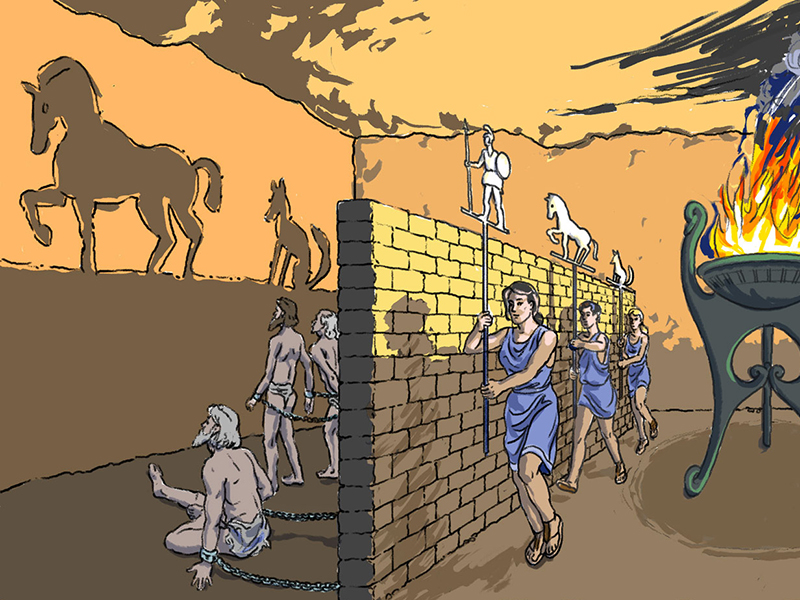
I don't mean the limited ego, the self that I largely identify with now, but the larger Self underlying it. I'm using the metaphor of a multifaceted crystal ball to represent the Self with each facet representing a life lived in Illusion and the total number of facets, making up the surface of the globe, representing all the lives, human and non-human, that I have ever lived or ever will live. They all exist in the Eternal Now. Imagine the soul, unchanging and eternal, as a light within shining through each facet simultaneously. The light passes through and is projected into the darkness in the manner of Plato's cave (see Figure 2).

Figure 2: Plato's cave illustration
from https://cdn.dribbble.com/users/221477/screenshots/4180313/platos-cave.jpg

For most of my life I've been in thrall of the dance of shadows on the walls of my 3-dimensional prism but in the final phase of my life, I should at least try to turn toward the light. It's enough to recognise the madness and emptiness that has overtaken the world but there's nothing I can do about it. Dwelling too much on my impotence to make any changes in the world however, tends to merely reinforce my ego.


As Meher Baba said:
The less you think of yourself and the more you think of Baba, the sooner the ego goes and Baba remains. When you - ego - go away entirely, I am One with you. So bit by bit, you have to go.
Dwelling on my impotence is no better than embracing an imagined omnipotence. Both inflate the ego in different ways. The only way I can influence the world around me is through the people I interact with. The more ego I project into that interaction, the less harmonious that interaction will be. Returning to the analogy of Plato's cave, the most monstrous shadow that I cast on the wall of my cave is that of my own ego. The image of myself, the "idea" of myself, is always in my head. It fills my head with thoughts and those thoughts always lead back to me in a self-reinforcing cycle. I know this is not really me. It's a notion I've formed of myself but it's just a trick of the light. I'm not really there. Such thoughts as an adolescent might have signalled the onset of schizophrenia but I established a solid foundation for my ego many decades ago.

It's time to realise that what I built was a necessary but temporary structure. It served its purpose but now it's time to let go of it. Of course, the ego is rooted in the body and upon death the severance of the connection with the body is a profound shock to the sense of self and allows the ego to view the life just lived with far more objectivity than was possible in its corporeal life. The more I can prepare for that before it happens, the easier the transition will be. At birth, I took in my first breath and at death, I shall let out my last. Both are equally important but the latter I can prepare for and it's only in corporeal existence that significant spiritual progress can be made. Life may be a grand illusion but it is a delusion nonetheless and something that I must extricate myself from.

Tuesday, April 02, 2019

Revelation

One dictionary definition of revelation is:
a surprising and previously unknown fact, especially one that is made known in a dramatic way; the divine or supernatural disclosure to humans of something relating to human existence or the world.

Figure 1: view through Starbuck's window to parked car.
The number plate B 1949 WFN is clearly visible.
Today, on the day before my 70th birthday, I had my own little revelation while sitting in the local Starbucks. I was seated and looking out through the glass windows when I noticed a car number plate: B 1949 WFN. It caught my eye because 1949 is the year of my birth. The car belonged to a male Westerner who had entered the cafe with his son, aged about 11 or 12. It was parked there for a fair while as the two of them sat somewhere in the cafe. My attention kept returning to the number plate and it was only shortly before the guy left the cafe and drove off that I had my revelation. The nature of the revelation gives some idea of how my mind works because I am forever scanning number plates to discern something of their mathematical significance.

Normally, I just try to factorise the number but I know that 1949 is prime and I was looking this time for a deeper significance. To me, the B 1949 represented BORN 1949 and WFN possibly conveyed some information about the date of my death but how can any numerical information be extracted from three letters? Well, to the mathematical eye, it's fairly obvious. When working with number bases higher than 10, the digits 0 to 9 are exhausted and letters are used instead to represent numbers in the higher bases. For example, base 16 uses A, B, C, D, E and F for 10, 11, 12, 13, 14 and 15 respectively. W is the 23rd letter of the alphabet and corresponds to a numerical value of 32 in this system and thus the smallest base that WFN could represent as a number is 33. The letters could also represent bases 34 (X), 35 (Y) or 36(Z) but I am only working with the smallest possible base in this case and that is 33.


Figure 2: my tweet for the day when
I turned 25666 days old
What decimal number is represented by WFN in base 33? The conversion is W=32, F=15 and N=23 and 32*33^2+15*33+23 gives the number 35366. How can this number be interpreted as a date? Well, my hobby is to keep track of the number of days I've been alive and to analyse the mathematical significance of that number each morning. For example, today I turned 25566 days old and this was the tweet. So how old will I be on the day that I turn 35366 days and what date does this correspond to? It turns out I'll be almost 97 years old and the date is Tuesday, January 30th 2046. Today (April 2nd 2019) is also a Tuesday. In Figure 3, I've included the information that Wolfram Alpha threw up.


Figure 3: output from Wolfram Alpha
for the input shown
I'm not taking any of this too seriously but with my very significant 70th birthday imminent, I had been thinking a lot about mortality and pondering how much longer I might have to live. This "revelation" from the car number plate has provided me with an indication of how much longer I might have. Only time will tell if it's an accurate indicator. If I do live that long then I hope I can remain strong, mentally and physically. In the meantime, that number:

35366

has been carved into my mind and gives a target to "work" towards. I notice that 366 is the maximum possible days in a year and the number contains all the digits in both 365 and 366. What other properties does this number have? Well, it's biprime, meaning that it has two prime factors: 2 * 17683. The date I turned 17683 days old was Monday, September 1st, 1997. I was living in Singapore at that time with Sylvia. 

Consulting the Online Encyclopaedia of Integer Sequences (OEIS), one entry for 35366 is: 
OEIS A187382: number of 8-step S, NW and NE-moving king's tours on an n x n board summed over all starting positions (where n=9 in the case of 35366). 
The chess reference is interesting because chess has always been in the background of my life since I first saw some family friends playing against each other when I was about seven or eight. The chessboard features in many allusions to life such as this one from the Rubaiyat of Omar Khayyam:

“Tis all a Chequer-board of nights and days
Where Destiny with men for Pieces plays:
Hither and thither moves, and mates, and slays, 
And one by one back in the closet lays.”

Just as I was typing this a Google Alert popped up for Meher Baba. There were three alerts for the day. The first contained a link from Bowdoin College Library to Baba's Discourses offering the book on loan. The second linked to a Meher Baba Meditation Centre is Bhopal. The third link contains a quote from Baba to Rano:
LOVE AND ITS EXPRESSIONS 
Meher Baba 
Never worry about repetitions of the same things in your letters to me. Love never tires of repetition, rather repetition makes words of love all the sweeter. What is there for those who love but only to say, “I love you” over and over again till the very end of life, and it includes everything which more than satisfies both the lover and the Beloved! 
So, dear Rano, go on repeating the same loving tune in all your letters. I love nothing more than love and its expressions, even if repeated millions of times. 
BECAUSE OF LOVE, p. 11, Rano Gayley  
Copyright 1983 Avatar Meher Baba Perpetual Public Charitable Trust
Of course, I noticed that the date of my demise falls a day before the anniversary of Baba's death which at first I was reluctant to comment on in case it was thought that I was comparing the insignificance of my passing with that the Lord of the Universe. However, I took the Baba alerts popping up while I was typing to indicate that I should make mention of it. My coming into the light of Meher Baba has been the single most important development of my life and so it does deserve comment when discussing my life and death.

Wednesday, January 09, 2019

Tim Buckley's Morning Glory

There's a few songs that for me at least have a spiritual significance and one of them is Morning Glory by Tim Buckley. Here's a video of his singing the song:


Here are the lyrics (there are some slight differences to what he actually sings):
I lit my purest candle close to my
Window, hoping it would catch the eye
Of any vagabond who passed it by,
And I waited in my fleeting house
Before he came I felt him drawing near;
As he neared I felt the ancient fear
That he had come to wound my door and jeer,
And I waited in my fleeting house
"Tell me stories, " I called to the Hobo;
"Stories of cold, " I smiled at the Hobo;
"Stories of old, " I knelt to the Hobo;
And he stood before my fleeting house
"No, " said the Hobo, "No more tales of time;
Don't ask me now to wash away the grime;
I can't come in 'cause it's too high a climb, "
And he walked away from my fleeting house
"Then you be damned!" I screamed to the Hobo;
"Leave me alone, " I wept to the Hobo;
"Turn into stone, " I knelt to the Hobo;
And he walked away from my fleeting house
At first sight, the lyrics may not seem to have any spiritual significance so let's look more closely. The fleeting house is a symbol of our transient physical form. As the saying goes, the eyes are windows of the soul so putting my purest candle close to my Window, hoping to catch the eye of any vagabond who passed it by means putting oneself in a very still and receptive state in the hope of making eye contact with a vagabond. A vagabond is a person who wanders from place to place without a home or job and is free of worldly ties. It serves here as a metaphor for a perfect master, a God-realised being, who has transcended duality and become one with God.

He waits and feels the vagabond drawing near but feels the ancient fear which is the threat of ego annihilation that is a necessary prelude on the path to becoming a spiritually perfect. The fear that he had come to wound my door and jeer is of course the way in which a perfect master methodically demolishes the disciple's ego. On arrival, the vagabond is referred to seven times as the Hobo and seven of course has deep mystical significance as a number of perfection. However, it is the prospective disciple that unwisely decides to set the agenda: tell me stories ... stories of cold ... stories of old.

The Hobo is not about to do this: no ... no more tales of time. Those who have attained union with God have transcended time and exist in eternity. The world of duality in which we are enmeshed however, is a world of time. Any reference to it is pointless from the spiritual point of view. Don't ask me now to wash away the grime: the grime is a reference to the karma (sanskaras) that we have accumulated over the course of our evolution and which bind us to the physical plane. Perfect masters can erase these sanskaras in an instant if they have the whim and if we are deserving of their grace.

I can't come in 'cause it's too high a climb, says the Hobo because the spiritual aspirant has put himself above the master by attempting to set the agenda. He has not shown proper humility, an essential prerequisite to spiritual progress. The perfect master, being one with God, is above everything and thus there is nowhere to climb. The master walks away from the aspirant much to the latter's annoyance, his anger demonstrating further his egotism and unsuitability for spiritual uplifting.

That's my take on it anyway.

Saturday, October 13, 2018

Soybeans Plus (Keledai Plus)

Looking back over some of my past posts, I came across this one about soy beans that resonates with what's happening at the current time. The post is dated Saturday, January 19, 2008 and refers to an article in The Jakarta Post which I'll reproduce in full below because of its importance:
Tempeh and tofu would not have disappeared from the family dining room, as it did this week, if the country's government had listened to Indonesia's scientists. 
The archipelago would have been able to stop importing soybeans from the U.S. and would probably even be exporting a high-yield protein-rich bean to other countries. 
"Perhaps we didn't have the time to pay attention to soybeans then," said Endang Sukara, deputy chairman of the natural sciences department of the Indonesian Institute of Sciences (LIPI). 
But in 2004 and after successfully breeding "newly improved" soybeans, LIPI scientists invited then-President Megawati and her agriculture officials to see their high-yield harvest in South Sumatra. Endang wasn't joking when he said the soybeans had added value. Kedelai Plus, the new improved variety, was able to produce up to three times the yield compared to regular soybeans and required less than half the amount of fertilizer. 
"We told the government all about it, and they were there during the harvesting at Musi Rawas in South Sumatra," Endang said at LIPI's Center for Biotechnology Research in Cibinong, West Java. "But they never followed it up." 
To create Kedelai Plus, a team of scientists, led by Harmastini Sukiman, isolated hundreds of Rhizobiums, a microbe that binds Nitrogen from the ground for soybean roots to absorb. They then discovered one special string called Rhizobium B64. 
"The strain worked really well for soybeans by boosting productivity and improving the plants' resistance to diseases," Harmastini said. "Soybean plants produce more beans using B64." 
The scientists grew Kedelai Plus in many areas across Indonesia, including South Sumatra, North Sumatra, West Java and East Java, with outstanding results. Farmers in Indonesia can produce on average up to 1.2 tons of soybeans per hectare, but in every harvest Kedelai Plus was yielding 2.4 to 4.5 tons per hectare. The team discovered a way to inject the microbe into the soybean, which meant farmers no longer had to glue the microbe onto the bean skin, or sprinkle it across the soil. 
"Rhizobiums grow abundantly in the soil, so for Rhizobium B64 to survive the competition, we must make sure there are enough B64 cells for the soybean roots to absorb," Harmastini said. 
With the help of a special vacuuming machine, LIPI was able to turn any type of soybean variety into Kedelai Plus with similar results. Endang said he was confident the new technology would see Indonesia end its dependency on expensive, imported American soybeans. 
"All the government needs to do now is up-scale the machine and produce Kedelai Plus in various seed centers so that farmers can purchase them at affordable prices," he said. 
Endang said he has been dreaming of a day when he could drink soybean milk, snack on soybean yogurt and have a tempeh burger for lunch, all made from domestic soybeans. But for the time being, farmers wishing to plant "newly improved" soybeans can bring their own seeds to LIPI in Cibinong to be injected with Rhizobium B64 at a cost of Rp 50,000 (US$ 5.30) for 20 kilograms of soybean seed.
Around the time I made this blog post, there were massive protests in Indonesia over the rising price of soybeans (due to government tariffs) and in another post I made the comment:
Massive protests in Jakarta have seen the Government belatedly remove the tariff on imported soybeans but there is continued demand to abolish the existing system whereby there are only four designated importers of the 1.3 million tonnes of soybeans imported. These four companies effectively form a highly lucrative cartel that is profiting at the expense of the local producers of tofu and tempeh. If the market were more open, the suspicion is that prices would decline as the competition increased. That may not happen. 
At the present time, soybean prices are rising yet again, this time because of the depreciating value of the rupiah. Here is a link September 2018 video about the problem with the caption:

Depresiasi rupiah terhadap dolar AS membuat harga kedelai melambung. Akibatnya, banyak pengusaha tahu dan tempe merumahkan pegawainya that translates to Depreciation of the rupiah against the US dollar makes soybean prices soar. As a result, many tofu and tempe entrepreneurs lay off their employees.

I wonder how much this support this Keledai Plus has received from the Indonesian Government over the past ten years. Back then, Indonesia imported over 70% of its soybean, with 80-90% coming from the United States and the rest from Argentina. The hope that Keledai Plus offered was the Indonesia would eventually become self-sufficient in soybean production.

The following excerpt from this online source shows that this has not happened:


The key phrase of course is local production remains stagnant. Note that in 2010, Indonesia was importing 1.85 million tonnes of soybeans while in 2016 the figure was 2.58 million tonnes, an increase of over 39%. Clearly, for whatever reasons, Keledai Plus has not fulfilled its promise. This Kompas article from January of 2008 emphasised the problem by quoting Deputy for Life Sciences LIPI, Prof. Dr. Endang Sukara:
... actually during the time of President Megawati, soybeans plus this had been introduced, but somehow the results of this research have not been used massively. "This is a matter of policy, a trade system problem that prioritizes imports in the form of finished soybeans, rather than developing soybean farming," he said. In fact, he reminded, the imported soybeans are genetically engineered soybeans while the domestic soybeans plus biodiversity are native. 
It's very disappointing that local production of soybeans in Indonesia has languished over the past decade. The tofu and tempe that are produced from soybeans are an important source of protein for poor people in Indonesia.

Friday, October 12, 2018

Meher Baba and Iran

Meher Baba was born Merwan Sheriar Irani. There is a detailed account of his visits to Iran to be found at this site, including information about his Iranian heritage and his connections with various Iranians. Here is a copy of the map that's presented on the site with the city of Mashhad highlighted with a blue rectangle. 


The significance of this city can be read in the following quote on the same site:
Aloba reports that, in May 1943, Meher Baba stated: “The tree of my divine manifestation is to be planted at Mashhad, where it will grow and spread, ultimately covering the whole world”. This theme for long remained obscure; the rendition has varied, another version being worded as: "The seed of the tree of my universal manifestation is planted in Mashhad." 
There is a strong association here with Meher Baba's third visit to Iran in June 1931, when he stayed at Mashhad, ignoring other cities. There he favoured a major Shi'ite shrine for purposes of seclusion on three nights. This was the tomb of Imam Ali Reza (765-818). That sojourn evidenced both the religious neutrality and incognito policy of Meher Baba, who moved about the streets of Mashhad in disguise. The visitor was only able to enter the venerated shrine because a prominent mulla, who was caretaker, relaxed rules of admission after experiencing a powerful dream which melted his resistance.

Mashhad is a city of three million people described by Wikipedia as:
Mashhad, also spelled Mashad or Meshad, is the second most populous city in Iran and the capital of Razavi Khorasan Province. It is located in the northeast of the country, near the borders with Turkmenistan and Afghanistan. It has a population of 3,001,184 inhabitants (2016 census), which includes the areas of Mashhad Taman and Torqabeh. It was a major oasis along the ancient Silk Road connecting with Merv to the east. 
The city is named after the "shrine" of Imam Reza, the eighth Shia Imam. The Imam was buried in a village in Khorasan, which afterwards gained the name Mashhad, meaning the place of martyrdom. Every year, millions of pilgrims visit the Imam Reza shrine. The Abbasid caliph Harun al-Rashid is also buried within the shrine. 
Mashhad has been governed by different ethnic groups over the course of its history. The city enjoyed relative prosperity in the Mongol period.

Mashhad is also known colloquially as the city of Ferdowsi, after the Iranian poet who composed the Shahnameh. The city is the hometown of some of the most significant Iranian literary figures and artists, such as the poet Mehdi Akhavan-Sales, and Mohammad-Reza Shajarian, the traditional Iranian singer and composer. Ferdowsi and Akhavan Sales are both buried in Tus, an ancient city that is considered to be the main origin of the current city of Mashhad. 
On 30 October 2009 (the anniversary of the death of Imam Reza), Iran's then-President Mahmoud Ahmadinejad declared Mashhad to be "Iran's spiritual capital".
Prior to this third visit to Iran, Meher Baba made a fleeting visit in 1924 and a second, more sustained visit in the autumn of 1929, including a visit to Isfahan and a sojourn at the desert city of Yazd. Given Baba's Iranian heritage and his visits, it's not surprising that Iran has been so prominent in the history of the twentieth century and remains very much in the news as this second decade of the twenty first century draws to a close. The country may well play a pivotal role in world events over the coming months and years.