Wednesday, June 24, 2009

Abdul Gaffoor Mosque

Here is a photo showing the Abdul Gaffoor Mosque as seen from the window of my hotel. This mosque has an interesting history and its own Wikipedia article. Fortunately the architecture is not marred by the presence of loudspeakers mounted on the minarets and the call to prayer seemed to benefit from their absence. The prayer was amplified because I could hear it clearly through the closed hotel window but it was not heavily amplified to the point of distortion. In Indonesia, the focus seems to be on maximising volume with no thought given to the quality of the emerging sound.

The think the Islamic call to prayer should be neither pre-recorded nor amplified and should rely on the natural, unamplified human voice. This was the way it was done before the arrival of loudspeakers. It was the way it was done for the first time by the black slave Bilal:

Bilal stood on top of the Ka’aba in Mecca. It had been a difficult and dangerous thing to do, but he had a far more important task to complete. He filled his lungs with as much air as he could, then used his deep and powerful voice to call faithful Muslims to prayer.

This was an extraordinarily emotional moment for the first Moslems. Some of the history behind this historic event is as follows:

As a free man, Bilal became a close and dear friend to both Abu Bakr and Muhammad. He helped to build the first mosque in Medina. When the time came that the Muslim’s were searching for a way to call the faithful to prayer, Bilal came into his own. The believers decided they did not want a flag, or a bell, or a rattle, or a drum, or a trumpet, but a beautiful human voice.

Abu Bakr became excited. “Then there is only one voice we could use for our first call to prayer,” he said, and explained how he had found Bilal and set him free. And so it was that Bilal became the first muezzin, the first to call people to prayer in Medina. And when the Muslims returned to Mecca, he was the first to call from the top of the Ka’aba. Source

It's a pity that what is largely heard in urban areas of Indonesia nowadays is not "a beautiful human voice" but a highly amplified and intrusive blast of sound that arrives unsynchronised from several different directions corresponding to the location of the various mosques in the vicinity. How much more pleasant it would be to hear a single human voice, natural and unamplified, at prayer time reminding us of the the way it was in the beginning with Bilal standing on the Ka'aba for the very first time.

Wednesday, June 17, 2009

The Path of Self-Knowledge

I began reading "Ramana Maharshi and the Path of Self-Knowledge", a biography by one of his disciples Arthur Osborne. I couldn't help but smile when I encountered Paul Brunton once again and his famous, or infamous, "A Search in Secret India". This is the book that I read in 1967 where I encountered my first reference to Meher Baba and, it now seems, my first reference to Ramana Maharshi because Paul Brunton visited both of them. His report on Ramana was positive while his report on Baba was quite negative. No need to dwell anymore on what that silly writer said however. Osborne's biography is very interesting and the circumstances surrounding Ramana's enlightenment are quite remarkable. More or less spontaneously, at the age of 16, he saw through the illusion of the ego and discovered his true self. As he said to Brunton is his interview:

The sense of ‘I’ pertains to the person, the body and brain. When a man knows his true Self for the first time something else arises from the depths of his being and takes possession of him. That something is behind the mind; it is infinite, divine, eternal. Some people call it the Kingdom of Heaven, others call it the soul and others again Nirvana, and Hindus call it Liberation; you may give it what name you wish. When this happens a man has not really lost himself; rather he has found himself.

Unless and until a man embarks on this quest of the true Self, doubt and uncertainty will follow his footsteps through life. The greatest kings and statesmen try to rule others when in their heart of hearts they know that they cannot rule themselves. Yet the greatest power is at the command of the man who has penetrated to his inmost depth. . . . What is the use of knowing about everything else when you do not yet know who you are? Men avoid this enquiry into the true Self, but what else is there so worthy to be undertaken?

I have to agree wholeheartedly with this and was encouraged to read that he also said:

If you meditate for an hour or two every day you can then carry on with your duties. If you meditate in the right manner, then the current of mind induced will continue to flow even in the midst of your work. It is as though there were two ways of expressing the same idea; the same line which you take in meditation will be expressed in your activities.

I now realise that without meditation there is little chance of any real change occurring in me. Some catastrophe might shake me awake but failing that I'll just remain fast asleep. Regular meditation creates the possibility of change but doesn't ensure it because it depends on the quality of the meditation. It has to be intelligent meditation in the sense that it can't be simply a routine, repetitive activity. Every session has to be entered into freshly and flexibly with no expectations. Some sessions may be relaxing, others might be deeply unsettling. Some sessions may bring fresh insights and challenges while others may not. Time and location should be varied. Although some times and locations are more conducive to meditation than others, it is important to try to sometimes meditate in difficult environments where noise and distractions abound.

In my meditation session last night, I struggled a little between attention to the outer and inner worlds. There was rumbling to be heard from distant thunder and I found my attention would move to this, then it would shift to some inner content that had arisen. I became aware of the duality but then realised that my mind had created this division between the inner and outer. What arrives from without via the senses or what arises from within should just be accepted and observed without classification. As the observer, I can unite these two seemingly disparate worlds.

Earlier that same day, during another meditation session, I became aware of a sort of inner pulsation and that seemed to grow in intensity until a sense of panic started to arise in me. I thought I might be about to have a stroke or heart attack. Simply focusing my attention of the sense of panic caused it to gradually abate. I have no idea what the seemingly physical pulsations were about but the incident illustrates my point that each meditation sessions may bring unique problems and challenges. I am encouraged to continue and I must continue.

Sunday, June 14, 2009

U G Krishnamurti

Andy Dougharty suggested I read a little about U.G.Krishnamurti (not be confused with Jiddu Krishnamurti) and not surprisingly it turned out that there was a strong link between the subject of my previous post (Ramana Maharshi) and U.G.Krishnamurti. In the Wikipedia article about the latter, it says:

In 1939, at age 21, U.G. met with renowned spiritual teacher Ramana Maharshi. U.G. related that he asked Ramana, "This thing called moksha, can you give it to me?" - to which Ramana Maharshi purportedly replied, "I can give it, but can you take it?". This answer completely altered U.G.'s perceptions of the "spiritual path" and its practitioners, and he never again sought the counsel of "those religious people". Later U.G. would say that Maharshi's answer - which he perceived as "arrogant" - put him "back on track".

Many years later however, his final view of things was not all that dissimilar to that of Ramana who advised that the essential question to ask is "who am I?" until the sense of duality disappeared and the "I" dissolved completely. U.G. Krishnamurti says that self-realization is the realization that there is no self to realise. He also talks about the "natural state" of the body in very much the same terms as Barry Long and Eckhart Tolle:

"When the totality of mankind's knowledge and experience loses its stranglehold on the body, the physical organism, then the body is allowed to function in its own harmonious way. Your natural state is a biological, neurological and physical state."

It's clear that Ramana Maharshi, U.G.Krishnamurti, Barry Long, Eckhart Tolle, Osho and Meher Baba are all telling us the same thing in their own unique way. There is no goal and nothing to strive for. Only our thoughts prevent us from realising that. There is no need to do anything but simply stop what we are currently doing wrong by letting go of our attachment to thinking. As U.G.Krishnamurti says "We don't seem to realize that it is thought that is separating us from the totality of things". He goes on to say:

"The only way for anyone who is interested in finding out what this is all about is to watch how this separation is occurring, how you are separating yourself from the things that are happening around you and inside you. Actually there is no difference between the outside and the inside. It is thought that creates the frontiers and tells us that this is the inside and something else is the outside. If you tell yourself that you are happy, miserable, or bored, you have already separated yourself from that particular sensation that is there inside you." "The only way it can maintain its continuity is through the constant demand to know. If you don't know what you are looking at, the 'you' as you know yourself, the 'you' as you experience yourself, is going to come to an end. That is death. That is the only death and there is no other death."

The key is watching "how this separation is occurring". It's no use reading about or intellectualizing about it, it's an experiential thing and it's uniquely individual. No two minds are alike and nobody can get inside your head except you. You have to go in and sort things out. There are techniques that may be helpful but you need to be adaptable and pragmatic, using what works and tossing out whatever doesn't. Needless to say this is a totally subjective activity and I'm at the point now where I know what needs to be done or I should say undone.

Sri Ramana Maharshi

Barry Long gives the following advice in his book on Meditation: Go to the great sages - for example Krishnamurti, Meher Baba, Ramana Maharshi, among others." It occurred me that I didn't know anything about the last mentioned person and so I read the Wikipedia article about him. He lived from 1879 to 1950 in Southern India and Meher Baba thought highly of him, referring to him as a saint of the sixth plane. This means that he saw THE ONE everywhere and in everything but he had not yet crossed the great abyss that the separates the sixth plane from the seventh. Having crossed this abyss, there is no longer subject and object, there is only THE ONE.

Ramana attained to his near supreme spiritual state spontaneously in a Hindu temple in Arunachala at the age of 16 and, as with Meher Baba, his mother (Alagammal) became very concerned at his sudden and unexpected spiritual awakening and tried to persuade him to return home and resume a normal life. Ultimately though she ended up attending to him at the temple, as did his younger brother Nagasundaram. He was with his mother at the end of her life and announced on her death that she had been liberated.

Though he did not take a vow of silence as did Meher Baba, Ramana did approve of "the power of silence and the relatively sparse use of speech" and he led a very simple life. His teachings are summarised in the Wikipedia article as follows:
  • As all living beings desire to be happy always, without misery, as in the case of everyone there is observed supreme love for one's self, and as happiness alone is the cause for love, in order to gain that happiness which is one's nature and which is experienced in the state of deep sleep where there is no mind, one should know one's self. For that, the path of knowledge, the inquiry of the form "Who am I?", is the principal means.

  • Knowledge itself is 'I'. The nature of (this) knowledge is existence-consciousness-bliss.

  • What is called mind is a wondrous power existing in Self. It projects all thoughts. If we set aside all thoughts and see, there will be no such thing as mind remaining separate; therefore, thought itself is the form of the mind. Other than thoughts, there is no such thing as the world.

  • Of all the thoughts that rise in the mind, the thought 'I' is the first thought.

  • That which rises in this body as 'I' is the mind. If one enquires 'In which place in the body does the thought 'I' rise first?', it will be known to be in the heart [spiritual heart is 'two digits to the right from the centre of the chest']. Even if one incessantly thinks 'I', 'I', it will lead to that place (Self)'

  • The mind will subside only by means of the enquiry 'Who am I?'. The thought 'Who am I?', destroying all other thoughts, will itself finally be destroyed like the stick used for stirring the funeral pyre.

  • If other thoughts rise, one should, without attempting to complete them, enquire, 'To whom did they arise?', it will be known 'To me'. If one then enquires 'Who am I?', the mind (power of attention) will turn back to its source. By repeatedly practising thus, the power of the mind to abide in its source increases.

  • The place where even the slightest trace of the 'I' does not exist, alone is Self.

  • Self itself is the world; Self itself is 'I'; Self itself is God; all is the Supreme Self (siva swarupam)

Sri Ramana warned against considering self-enquiry as an intellectual exercise. Properly done, it involves fixing the attention firmly and intensely on the feeling of 'I', without thinking. It is perhaps more helpful to see it as 'Self-attention' or 'Self-abiding' (cf. Sri Sadhu Om - The Path of Sri Ramana Part I). The clue to this is in Sri Ramana's own death experience when he was 16. After raising the question 'Who am I?' he "turned his attention very keenly towards himself" (cf. description above). Attention must be fixed on the 'I' until the feeling of duality disappears.

Friday, June 12, 2009

Lucid Dreaming

Hypnos and Thanatos, Sleep and His Half-Brother Death
by John William Waterhouse

I've been on holidays for one week now and that's about how long it takes to really start to slow down and relax. I've managed a daily meditation or two and have begun to re-read Osho's "The Book of Wisdom". In doing so, I was reminded of a reference he made to dreaming. He says:

The ego is a by-product, a by-product of the illusion that whatsoever you are seeing is true. If you think that objects are true, then the ego can exist; it is a by-product. If you think that objects are dreams, the ego disappears. And if you think continuously that all is a dream, then one day, in a dream in the night, you will be surprised: suddenly in the dream you will remember that this is a dream too! And immediately, as the remembrance happens, the dream will disappear. And for the first time you will experience yourself deep asleep, yet awake -- a very paradoxical experience, but of great benefit. Once you have seen your dream disappearing because you have become aware of the dream, your quality of consciousness will have a new flavor to it. The next morning you will wake up with a totally different quality you had never known before. You will wake up for the first time. Now you will know that all those other mornings were false; you were not really awake. The dreams continued -- the only difference was that in the night you were dreaming with eyes closed, in the day you were dreaming with eyes open. But if the dream has disappeared because awareness happened, suddenly you became aware in the dream.... And remember, awareness and dreaming cannot exist together. Here, awareness arises, and there, the dream disappears. When you become awake in your sleep, the next morning is going to be something so important that it is incomparable. Nothing like it has ever happened. Your eyes will be so clear, so transparent, and everything will look so psychedelic, so colorful, so alive. Even rocks will be felt to be breathing, pulsating; even rocks will have a heartbeat. When you are awake, the whole existence changes its quality. We are living in a dream. We are asleep, even when we think we are awake.

Osho is referring here to lucid dreaming about which much has been written and I was prompted to review the literature on the subject on the Internet. One technique recommended for the inducement of lucid dreaming is to carefully count the digits of your hand before going to sleep followed by a reminder to look at your hands in the dream and try counting the digits again. Apparently, this proves very difficult in a dream or you miscount the number. In either case, you are then alerted to the fact that you are dreaming. There are other techniques to maintain the state of lucid dreaming. I have an e-book titled "Exploring the World of Lucid Dreaming" by Stephen LaBerge, Ph.D. & Howard Rheingold that I think I'll make an effort to read. I notice the final chapter of the book is called "Life is a Dream: Intimations of a Wider World".

I'd like to attempt some lucid dreaming during these holidays and Osho's words have given me the stimulus. The dreaming also connects with Jung, whose writings I've recently reconnected with, and so it should be an interesting experiment. I'll need to start with the digit counting on a regular basis during the day so that it becomes so habitual that the practice will spontaneously occur to me in my dreams as well, maybe. Let's give it a try.


Sunday, June 07, 2009

Time Out Of Mind

Now that my practice of meditation has become a daily habit, I find myself a little more in sympathy with religious ritual which at least sets aside some time for supposedly "spiritual" activities not directly related to the routine of daily life. The activities themselves, as practised by the majority of individuals, are often mechanical and motivated by the desire for worldly gain but not always, the potential for some sort of spiritual breakthrough is always there. If no time is set aside, then the phenomenal world is liable to absorb our complete attention and we oscillate forever between past and future, never finding the equilibrium of the present moment. Years can go by like that, even entire lifetimes.

The key is to stay alert during the allocated time and not rely on any set routines. Initially, the mind will struggle against the discipline of setting any regular time aside at all for "mind-training" exercises. After all, like a wild horse, the mind (my mind at least) has had a lifetime of freedom, galloping off in any direction that caught its fancy. With persistence the mind will accept the discipline and the temporary reigning in of its freedom but attempt to compartmentalise and indulge the enforced practice. This is made much easier when external rituals and recitation of set prayers are being followed. The ego, the mind's greatest creation, can then bask in the false belief that it is spiritually oriented. Of course, any serious spiritual orientation has the death of the ego as its sole objection and the ego, despite its manifest limitations, is not stupid. It knows its life is on the line and will fight to the last for its survival.

The death of ignorance begins by setting aside some daily time in which there is the opportunity to drop our absorption in the phenomenal world and quiet the feverish activities of our minds. Without that daily allocation of time, there's no hope at all really but with it, there will be some "time out of mind", however momentary, and then seeds can be sown.

Reblog this post [with Zemanta]

Wednesday, June 03, 2009

Practical Meditation

It was timely that I happened upon Barry Long's book on meditation (as described in my last entry) and started to apply his suggested approach to daily meditation over the past couple of weeks. This was a time of intense pressure for me as I was the sole person responsible for printing out all of the Secondary School reports by the start of the final week of school. The meditation, undertaken for about 15 minutes prior to going to bed, proved consistently effective in allowing me to remain calm under stress. I also came to realise that I have to do what works for me and not follow any suggested methods or techniques too rigidly. For me, sinking deep into the body and feeling its solidity and density, markedly slows the activity of my mind. Thoughts are so quick and light that I find the contrast between them and the heaviness of my body helps me to catch myself before I'm carried off too far into either the past or the future.

The focus on the body leads to an awareness of its energy and rate of vibration, a rate that is so much slower than thought and even the emotions that arise from thought. This creates a real sense of stability, of being rooted in the present. I'm starting to feel less of a helpless spectator caught up in a crazed thought machine and I'm sensing that I might be able to use the machine when I need it and turn it off when I don't. Of course, I've always applauded the "thought" of being able to do this but it's so very different to actually achieve this, even if only for a few moments in meditation. So I'm very much encouraged to continue my daily practice.

Reblog this post [with Zemanta]

Wednesday, May 13, 2009

Stillness is the Way

I just happened to spy a book on my bookshelf called "Meditation: A Foundation Course" by Barry Long. I'd quite forgotten that I had it and even though I'm a great admirer of this now deceased guy, I'd never sat down and read it through. It's not a long book and its emphasis is wholely practical, just what I need really because lately I've been reading about various techniques for meditation and not deciding on any one in particular. In practical terms, I've been doing nothing and that's why chancing upon this little gem is so serendipitous.

Barry has a no-nonsense style about him. For example on page 3, he writes: "A great deal of mumbo-jumbo has been written and talked about meditation" and he goes on to say that "some meditation techniques introduce emotional excitation or arousal - through visualisation, chanting, imaginative exercises, trance and so forth - but these will not get you real results, only more confusion."

He divides the book into ten lessons to be followed sequentially over a period of days. Lesson 1 is titled "Posture, Breathing and the Still Mind" and in this Barry briefly outlines the ideas behind the practical lessons that follow, the first of which (Lesson 2) is titled "Meditating on the Body". The approach outlined there is more or less the same as the Vipassana Meditation as taught by S.N.Goenka that I'm familiar with from the 90s and so I have no conflicts or reservations in following his directions. I'll practise what he says in the second lesson for a few days and then move on to the next. At last I'll be actually meditating.

In setting up the hyperlinks for this post, I notice that the people behind Barry Long's website are still marketing his videos, audio tapes and books even though he died on December 6th 2003. This is regrettable as their focus should now be on freely disseminating the material via the Internet. To this end they should follow the example of the Meher Baba Trust and digitise all of Barry Long's books and make the ebooks downloadable at no cost. Similarly all his audio and video recordings should be freely downloadable. However, I doubt that will happen.

I also noticed that there is a Vipasanna Meditation Centre at Bogor (near Jakarta) that is offering 10 day courses in May and July but the times aren't convenient for me. In any case, I don't know if I could endure a full ten day session again. I managed a couple when I was in my mid-40s but I don't think I'd have the stamina for it now. The problem with these sessions was that they were so exhausting that I always stopped meditating after leaving the centre just out of sheer relief. I think I'll stick with a little bit of meditation every day if I can manage it. As Barry says: "Stillness is the Way".

Friday, May 08, 2009

Memories, Dreams, Reflections

I've just finished reading Jung's "Memories, Dreams, Reflections" and it was as absorbing on a second reading as it was thirty or so years ago. In this book, he writes that "it is really the individual's task to differentiate himself from all the others and stand on his own feet. All collective identities, such as membership in organizations, support of 'isms' and so on, interfere with the fulfillment of this task. Such collective identities are crutches for the lame, shields for the timid, beds for the lazy, nurseries for the irresponsible ...". His words are not to be thought of as trumpeting the ego because it is fundamental to Jung's view of the psyche that the ego is only a small part of a much larger and far more ancient whole. This wholeness can only be grasped however, after the individual has disidentified with organization and 'isms'.

Reading the book reminded me of Jung's lifetime study of the psyche and how modern education largely lacks any psychological content. Most students undertake subjects like Mathematics, Science, Business Studies, Economics, Geography etc. and even though Psychology can be studied in some syllabi I would imagine that there is little emphasis placed on introspection. The courses studied offer students no opportunity for self-reflection, no encouragement to examine their inner life. If a school provides instruction in the religion that parents have foisted on the student, there are usually no incentives given to examine or question the belief system that underlies the religion. Any self-examination needs to take place outside of the education system.

The entire education process leads the student away from their inner life and toward involvement in the outer world. There's nothing wrong with that except that the process is overwhelmingly orientated toward the outer world at the almost complete neglect of the inner. Any attempt to redress this imbalance is likely to perceived by parents who follow a particular religion as embracing the devil or undermining the faith of the students. Heaven forbid that, in the classroom, a discussion might take place about dreams or that students be encouraged to keep a dream diary.

After leaving school, students' absorption in the outer world is so one-sided that the psyche compensates. The inner world asserts itself, often suddenly and powerfully, and the adolescent is drawn to cults, religious extremism, drugs or suffers a mental breakdown. My closest friend at school began to display symptoms of paranoid schizophrenia in his last year of high school and suffered a complete mental collapse in his early twenties. He came from a quite religious family but the empty rituals that characterized this religion did nothing to satisfy the demands of his inner life for meaning and a sense of wholeness. He became a passionate reader of Nietzche, recognizing in the philosopher a kindred spirit but, like him, eventually succumbed to ego-inflation and insanity. My friend firmly believed that he had started World War III.

Wednesday, April 22, 2009

I am NOT THAT

I'm still making my way through Osho's "Book of Wisdom" and what he says about meditation is relevant to my last post about keeping physically fit. He describes meditation as anything that brings body, mind and spirit into harmony. To that end, jogging could be a form of meditation. So could swimming. He says it is important to choose a form of meditation that suits you. Sitting quietly observing the rhythm of your breathing may suit some but not others. You have to find techniques that work for you. He says that whenever a person is creative, absorbed in creativity, he or she is meditating.

As Brian Eno says, "If you study the heuristics and logistics of the mystics, you will find that their minds rarely move in a line". He goes on to say, "So it's

Before and after Science album cover

much more realistic to abandon such statistics and resign to be trapped like a leaf on the vine". It's easy to be trapped of course. We are trapped by identification. According to Osho (so this may be apocryphal), George Gurdieff said, "If I could summarise my teachings into one word, it would be 'disidentification'". I like that. Don't get trapped. Don't identify.

You can start by not accepting labels. I used to proclaim, with my ego nodding agreeably, that "I am a vegetarian". Oops, label. Of course once you allow yourself to be categorised, there are sub-categories to consider. People would ask "Do you eat eggs?" I would smilingly say "I'm an ovo-lacto vegetarian, which means I eat eggs (non-fertilised of course) and milk products". Inevitably someone asks, "Do you eat fish?" and I would be compelled to say, somewhat sternly, that I don't eat fish because if I did then I wouldn't qualify as a vegetarian. Categorisation feeds the ego. It's far simpler to say that I don't eat meat. If someone asks whether I eat fish, I can calmly say that I don't. It throws the onus back on the questioner to decide on a categorisation for my eating habits if he or she feels that it's needed.

The same goes for nationality. If someone were to ask me now, "Are you an Australian?", I'd have to say that I have an Australian passport. If the person then wants to classify me as an Australian then that's their decision. It's easy to get cute about this and use this "via negativa" as an ego trip but it's also important to free oneself of categories and this is a step in the right direction. If I say I am a vegetarian, then that implies there are non-vegetarians and immediately a divide is created. If I say on the other hand that I don't eat meat, it's rather different. It's more like saying I don't eat chocolate (not quite the same, but similar).

It's very common to describe oneself in terms of one's profession. I might say "I'm a teacher" but what I really mean is that "I'm qualified to work as a teacher in a Secondary school". It's not quite the same thing. I guess it come down to trying to remember that "I am NOT THAT". You can only find yourself by forgetting what you're not and reinforcing your false sense of identity through "I am THIS" is sensibly to be avoided.

Reblog this post [with Zemanta]

Tuesday, April 14, 2009

Exercise Time

When I went to England is late March, I dropped my normal exercise routine and since returning to Jakarta I didn't pick it up again. I decided tonight

Tape measure

that it was time to start again because physically I've been feeling stiff and uncoordinated. I had a tape measure so I decided to take some measurements in order to monitor my progress. My waist measurement came in at a disturbing 98cm with 94cm being regarded as acceptable for Western males. My biceps measured 30cm when tensed. Expanded chest was 101cm and unexpanded 101cm. Triceps measured 53cm at groin level. I'll take the same measurements in a month or so and see what sort of progress I've made. I was reminded that while meditation is important, the body needs to be attended to as well.

Wednesday, April 01, 2009

Active Meditation

There's nothing like a busy end of the school term and a week's long holiday to disrupt the regularity of blog posting but I'm determined to resume. I've done precious little meditation recently but I did follow an interesting tweet today from SambodhiPrem on Twitter that said "How I Entered the World of Meditation, Even Though I Couldn’t Sit Still! by Shanti World of Meditation, Seattle http://tinyurl.com/d8u66v".

The hyperlink led to Shanti's page on the "The World of Meditation Center" and the graphic above was taken from the Meditations link on the opening page and shows links to various types of meditation, most of which I weren't aware of. Some of them are called "active meditations" that Osho recommended for busy Western minds that found sitting in silence for long periods to be very difficult. Shanti first met Osho on Christmas Day of 1973 in Bombay and the story is an interesting one. So I'm currently reading about these different forms of meditation and may end up applying some of them in my meditation practice.


Wednesday, March 11, 2009

Let It Go

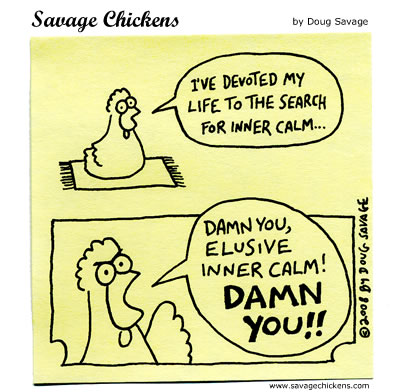
You certainly need to see the funny side of this "search for inner calm". Last night I was composing an email to my daughter and I was trying to express in words what I felt was the essence of the spiritual advice that accepted masters were trying to pass on to a benighted humanity. I suddenly came up with the phrase let it go.

This can be interpreted in two main ways; firstly in the sense of not following through on a reaction to something that is upsetting or hurtful. For example, if somebody insults me, I can react and insult them back or choose instead to let it go. In another sense it can mean not holding on to things. This is a practically impossible task because I can hold on to quite subtle things like my beliefs, my value systems, my memories, my plans for the future etc. This doesn't mean that I shouldn't have such things, only that I shouldn't hold on to them.

Once I hold on to something such as a belief, I am wanting it to remain the same. When I do this my belief becomes less flexible and I'm less open to facts that might challenge that belief. I become less tolerant of alternative beliefs. Worse still I come to identify with this and other beliefs and build up a belief system. This system become part of how I define myself and of who I think I am. But of course I'm not this or that or anything else. By holding on and not letting go, the likelihood of identification with what is held on to increases. For example, the more I hold on to the past, the more I am shaped by it.

The hapless chicken in the above cartoon has held on to a need to devote its life to the search for inner calm. Of course the more intense the devotion, the more elusive that inner calm becomes. The chicken's goal-oriented mindset ensures failure and consequent anger at the failure to achieve a life-long goal. By letting go of the goal, and everything else, inner calm arises. It was always there but by grasping at this and that I created turbulence and disturbed that calm. Let it go.

Sunday, March 08, 2009

Sanskaras

"Sanskaras" is the plural form of the Sanskrit word "sanskara" that is translated usually as "impression" or "imprint". However, I'm reluctant to use the word "sanskaras" when speaking with people who are unfamiliar with the term but using the terms "imprints" or "impressions" is equally unsatisfactory because these words by themselves don't convey what I'm trying to communicate. Interestingly and not surprisingly, the Wikipedia article on the term makes mention of Meher Baba in the following context:

According to Meher Baba, in the course of evolution sanskaras play a vital role in that they aid in the formation of conscious experience, and thus eventually bring about self-awareness in the human form, but then serve no further purpose. According to Baba they are actually a hindrance once full consciousness is achieved in the human form because they slant our experience of things as they are. The goal for the human being then is to be rid of them by "unwinding" them or through "shakings" caused by progressive variously opposite life experiences over many human lives in reincarnation, thereby eventually unveiling and revealing the true nature of reality and the true identity of the self. According to Meher Baba the ridding of sanskaras can be quickened by the help or guidance of a perfected master or satguru.

The article likens the effect to Sanskaras to that of "a lens through which the subjective aspects of our experience arise. Thus when we perceive (either thoughts or external objects) we apperceive those objects through the lens of past experience. We perceive through the imprint or conditioning of past impressions or sanskaras." Apperception is explained as:

The process by which new experience is assimilated to and transformed by the residuum of past experience of an individual to form a new whole" (Ledger Wood in
Runes). In short, it is to perceive new experience in relation to past experience.

Example 1: We see a fire (visual perception). By apperception we correlate the appearance of fire with past experiences of being burned. Having combined present and past experience we realize this is a situation in which we should avoid placing our hand in the fire and being burned.

Example 2: A rich child and a poor child walking together come across the same ten dollar bill on the sidewalk. The rich child says it is not very much money and the poor child says it is a lot of money. The difference lies in how they apperceive the same event - the lens of past experience through which they see and value (or devalue) the money.

I was sitting in the garden this morning pondering such matters. Nearby somebody was revving a motorcycle and I was observing the impression that the sound was having on me. As always the impression was negative and I thought about some related words. One of them was oppression because from my perspective I was being oppressed, in the tranquillity of my garden, by the sound of the motorcycle. I struggled to suppress negative thoughts such as wishing the offender ill-fortune when he finally mounted his steed and roared away. It would seem that impressions may be the source of oppressions, suppressions, repressions and depressions so it is important to properly understand their mechanism.

The sound of the motorcycle was not loud enough to cause discomfort, only annoyance, and I was certainly apperceiving by taking the perception of the sound and relating it to my mainly negative experiences with motorcycle riders on the streets of Jakarta. Somebody else, hearing the same sound, might be reminded by happy bike riding days, wishing to be in the saddle once again and heading off on the open road. So I sat there and got slightly annoyed but at least I was reflecting on my annoyance. Reflecting on ones reactions is the best that can be done initially by becoming a witness as well as a participant in what is happening subjectively. If lost completely in subjectivity, there is no chance to perceive rather than apperceive. All spiritual masters are unanimous on the importance of this witnessing.


Friday, February 27, 2009

Mad, Mad World


Never let the facts get in the way of a good story. I think Osho may have been telling a porky when he said that Gurdjieff was ten when his father died and gave him his deathbed advice. The Wikipedia article on Gurdjieff has this to say:

In March 1918, Ouspensky separated from Gurdjieff, and four months later Gurdjieff's eldest sister and her family reached him in Essentuki as refugees, informing him that Turks had shot his father in Alexandropol on 15 May.

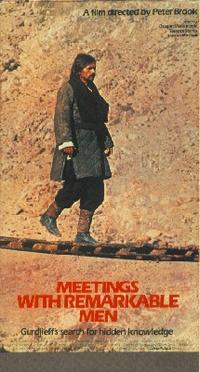
Now Gurdjieff was born sometime between 1866 and 1877, nobody is really sure, and his early life is a bit of a mystery. There's very little known about him until he showed up in Moscow in 1912 and started attracting followers. One thing's for sure, he wasn't ten years old in 1918. Of course, Osho might be quoting from Gurdjieff's autobiographical "Meetings with Remarkable Men", I haven't read this yet but it is regarded as highly suspect in terms of its historical authenticy.

I was interested to learn that this book was made into a movie in 1979 and starred Terence Stamp, with somebody called Dragon Maksimovic playing the adult Gurdjieff. Suffice to say that both Osho and Gurdjieff were never averse to bending the facts to serve their purposes and that's fair enough. To quote from Brian Eno, "if you study the heuristics and logistics of the mystics, you will find that their minds rarely run in a line" or something like that. Their primary aim is to unsettle the minds of their followers, to shake them up, and playing with historical facts is a great way to do that.

The mind loves nothing more than a solid timeline to make sense of whatever the hell is going on. If we read that Gurdjieff was nine or ten when his father died and was given this deathbed advice and later he found this advice incredibly helpful, we feel that we have a bit of a handle on what the guy is all about. Of course, we haven't but we like to think that we do. Our minds try to make the mystics understandable but of course they can't be understood with the mind at all. Our mind is the biggest barrier to understanding. Well my mind is anyway, I don't know about yours.

Gurdjieff said that most people were asleep, sleepwalking through life, caught up in daydreams and mental meanderings, going nowhere as in Gary Jules' "Mad World" lyrics:

All around me are familiar faces
Worn out place, worn out faces
Bright and early for the daily races
Going nowhere, going nowhere

Their tears are filling up their glasses
No expression, no expression
Hide my head I wanna drown my sorrow
No tomorrow, no tomorrow

And I find it kind of funny, I find it kind of sad
The dreams in which I'm dying are the best I've ever had
I find it hard to tell you, I find it hard to take
When people run in circles it's a very, very
Mad world, mad world

As Ouspensky, an early follower of Gurdjieff, quotes him as saying "Man lives his life in sleep, and in sleep he dies". I'm finding it quite a struggle to wake up.

Monday, February 23, 2009

Osho on Gurdjieff

As I continue my reading of Osho's "The Book of Wisdom", I've found some interesting anecdotes and commentaries about various spiritual figures. One figure mentioned is George Gurdjieff and the story Osho tells about him is this. When he was about ten years old, his father lay dying and he gestured to young George, who was standing at a respectful distance, to come closer. His father whispered that he some very important advice to give him and that he should never forget it. The advice was this: if ever anybody insults you, wait 24 hours before you respond to the insult. His father then passed away.

George really didn't understand what to make of this but he dutifully remembered his father's advice and faithfully practised it for the rest of his life, rating it in adulthood as the best advice that he'd ever been given. The reason was that it forced him to reflect on the insults that were directed at him during his life and he was denied the ego's usual response which is to react instantly and defensively. Normally the ego steps in to defend itself and people are drawn into an argument with insults and counter-insults being hurled about. The situation rapidly escalates and all because the ego has been slighted and wants to defend itself.

This approach of course is what all spiritual teachers advise. Create a space between what happens in your life and your reaction to it. In that space, you can decide on the most appropriate course of action rather than being overwhelmed by emotion. At times this is very difficult to do and it has to be practised continously. It is important not to be too discouraged by the setbacks that inevitably occur. I assume Osho's little story is true but I haven't corroborated it in any way. He also has some hilarious things to say about The Theosophical Society and Krishnamurti but I'll save these for a later post.

Sunday, February 22, 2009

The Black Stone

Pursuing my theme of the significance of stones, I was reminded of the famous Black Stone that is located at one corner of the Ka'ba in Mecca. Here is an excerpt from the Wikipedia article about this stone.

The Black Stone (called الحجر الأسود al-Hajar-ul-Aswad in Arabic) is a Muslim object of reverence, which according to Islamic tradition dates back to the time of Adam and Eve. It is the eastern cornerstone of the Kaaba, the ancient sacred stone building towards which Muslims pray, in the center of the Grand Mosque in Mecca, Saudi Arabia. The Stone is roughly 30 cm (12 in.) in diameter, and 1.5 meters (5 ft.) above the ground. When pilgrims circle the Kaaba as part of the Tawaf ritual of the Hajj, many of them try, if possible, to stop and kiss the Black Stone, emulating the kiss that it received from the Islamic prophet Muhammad. If they cannot reach it, they are to point to it on each of their seven circuits around the Kaaba. The Stone is broken into a number of pieces from damage which was inflicted during the Middle Ages. The pieces are held together by a silver frame, which is fastened by silver nails to the Stone.

While Muslims don't ascribe any healing powers to it, they do believe that it has an abundance of what is called Baraka. I hadn't heard of this term before but it translates as something like divine blessing. The LOOKLEX Encyclopedia has this to say about the term:

In Islam, divine blessing that is normally associated with holy men or women, waliy, either in life or in death. Baraka can be transferred from one person to another, or from a material item to a person. Common in Islam is baraka that comes from local shrines, but the strongest baraka is in Mecca, and then especially, at the Ka'ba.


Saturday, February 21, 2009

Healing Stones

There's been a lot of news coverage here in Indonesia recently about a ten year old who was out playing in the rain when he was struck by lightning. He was temporarily stunned but otherwise unharmed and immediately formed an attachment to a stone that he found nearby. This stone seems to have remarkable healing properties and thousands of people have flocked to the Indonesian village where he lives in order to be healed. Here is an article reporting on the phenomenon.

The Javanese love this sort of thing and it's easy to dismiss the whole business as mass hysteria. However, it got me thinking about rocks and their healing powers. The different varieties of crystals have well documented healing properties, regardless of whether you believe in crystal healing or not, and even quite ordinary looking rocks often contains small quantities of crystals like quartz. The photo that I used in this blog post was taken from a site called "Healing Rocks!" by Ananaia O'Leary and here is a quote:

The first step is realizing that stones are allies, not objects. They have ancient wisdom to share and will work with us generously if we approach them with respect. If you wish to find a stone ally, set your intention to welcome a healing ally and go out into Nature with an open heart. Remember, you are inviting partnership with the mineral realm, not hunting for a resource. Take a walk in your favorite green space: your backyard, local park, greenway or along a river or stream. As you walk, breathe in the scents of the Earth, feel the soil beneath your feet, the Mother holding you with each step. Be open and aware … your stone ally may come to you in many forms, a piece of landscaping rock, street gravel or a rock jutting out of a riverbank. It may jump out at you, catching a gleam of the sun, whispering to you as you walk by “Notice me.”

Now it's easy to scoff at advice like this and ridicule the idea of having a pet rock but it's obvious that this person does not view the mineral kingdom as being populated by inanimate objects. Meher Baba is quite clear about the fact that rocks possess a rudimentary form of consciousness and there is a great deal of literature on the topic of nature spirits connected with the mineral kingdom. I'd like to pursue this subject further but right now it's past midnight and sleep calls.

Friday, February 13, 2009

Osho on Love and Relationships

This being the eve of Valentine's Day, it maybe appropriate to include a little quote from Osho's "The Book of Wisdom" that can be downloaded from here. I haven't read all that much of the book but the little I have read makes excellent sense. I particularly like the way in which he draws a clear distinction between the noun "relationship" and the verb "relating". Here is a small extract:

Love is not a relationship. Love relates, but it is not a relationship. A relationship is something finished. A relationship is a noun; the full stop has come, the honeymoon is over. Now there is no joy, no enthusiasm, now all is finished. You can carry it on, just to keep your promises. You can carry it on because it is comfortable, convenient, cozy. You can carry it on because there is nothing else to do. You can carry it on because if you disrupt it, it is going to create much trouble for you. Relationship means something complete, finished, closed. Love is never a relationship; love is relating. It is always a river, flowing, unending. Love knows no full stop; the honeymoon begins but never ends. It is not like a novel that starts at a certain point and ends at a certain point. It is an ongoing phenomenon. Lovers end, love continues. It is a continuum. It is a verb, not a noun. And why do we reduce the beauty of relating to relationship? Why are we in such a hurry? -- because to relate is insecure, and relationship is a security, relationship has a certainty. Relating is just a meeting of two strangers, maybe just an overnight stay and in the morning we say goodbye. Who knows what is going to happen tomorrow? And we are so afraid that we want to make it certain, we want to make it predictable. We would like tomorrow to be according to our ideas; we don't allow it freedom to have its own say. So we immediately reduce every verb to a noun.

In fact, in "The Golden Wing" he makes further reference to nouns and verbs:

My suggestion to all my sannyasins is don’t trust in nouns, trust in verbs. Become a verb than becoming a noun. Rather than love, think of loving. Rather than being, think of becoming. Rather than of a flower, think of flowering. Always think in terms of verbs and you will never be frustrated. Your life will become a constant growth from one peak to another peak, and those peaks go on becoming higher and higher.

Monday, February 09, 2009

Gravity's Rainbow

I've recently come across a fertile source of ebooks and was elated to discover that Thomas Pynchon's "Gravity's Rainbow" was amongst them. I've been searching for this book for quite some time. It's widely regarded as a "difficult" book, akin to James Joyce's "Finnegan's Wake", but I'd come across some intriguing references to it and had managed to read an excerpt in Google Books. The little that I'd read there inclined me to read further and now I can. I'll have to choose my time. Some people have been known to sit down with this book and keep reading non-stop until they've finished.

My fertile source contains many books that I recognised and some of which I'd already read. At first I thought that it was just a collection of someone's personal predilections but then I happened upon Time's list of the 100 best English-language novels from 1923 to 2006. Most of the books on that list are in this collection and so with the number of my ebooks growing by the day the prospect of an iLiad becomes even more appealing.

Sunday, February 08, 2009

The iLiad

https://en.wikipedia.org/wiki/ILiad
This is no reference to Homer but to a portable device that let's you read and write just like you can do on paper. The image is stable in the sense that it isn't getting refreshed 60 times a second or so. The subliminal flicker caused by this refreshing is what makes reading ebooks on a computer quite tiring on the eyes. The technology is called e-Ink and involves the manipulation of little microcapsules that appear as black or white pixels depending on whether a positive or negative charge is applied. The slow page refresh, more than adequate for book reading, means that animation is not possible and the display is limited to black and white.

The fact that you can write on it with a stylus and thus add notes to what you are reading or draw your own diagrams is of course very useful. Connectivity is via Wi-Fi or USB cable and the price is around US$600 which I can't really afford at the moment but hopefully I can buy it in the middle of the year. I have a growing mountain of ebooks to read but I'm not getting through them using the software-based ebook readers on my computer and laptop. The good thing about technology however, is that the longer you wait to buy a technological device the cheaper and more feature-rich it becomes.


POSTSCRIPT (written 14th October 2018): 

Here is the start of the Wikipedia article:

The iLiad was an electronic handheld device, or e-Reader, which could be used for document reading and editing. Like the Barnes and Noble nook, Sony Reader or Amazon Kindle, the iLiad made use of an electronic paper display. In 2010, sales of the iLiad ended when its parent company, iRex Technologies, filed for bankruptcy.
Well I fortunately never did buy an iLiad but I did buy a Kindle some years later, in early 2015, for a little over US$100. I'm still using toward the end of 2018 and have felt no need to replace as it does its job. It's fine for ebooks but not adequate for PDFs so I use my old iPad for that.

Saturday, February 07, 2009

A Visitor to the Garden

This morning I spotted this beautiful lizard in our garden. It was absolutely motionless and I was fortunate enough to be able to get up close and take this shot with my Nokia N73 camera. Our garden is a walled garden with jagged pieces of glass along the top which tends to discourage wildlife from entering but little fellow found its way in. Before taking this shot, I had picked it up by the tail and repositioned it in our front garden, away from the family dog who only the night before had killed a mouse that found its way in. I didn't want the same fate befalling this creature. Sightings of animals like this are relatively rare in heavily populated Jakarta and so this discovery was a pleasant surprise. Let's hope it lives long and prospers.

Friday, February 06, 2009

Mao's Last Dancer

I was supervising an examination earlier in the week and noticed a book on a shelf called Mao's Last Dancer by Li Cunxin (pronounced Lee Schwin Sing). Now that I'm heading to Shanghai in August, I'm starting to take more of an interest in China where I'll be staying for at least two years and probably more. The book has caught my interest and I'm already well into it. Apparently, there is a film adaptation of the book and that is due for release this year. Li has his own website and has certainly come a long way from his impoverished life in rural China. In 1972, as an 11 year old, he was plucked from obscurity and chosen to train for ballet in Beijing. As an astute observer may have noticed, I am reading the Young Reader's Edition of the book.

Monday, February 02, 2009

Books Loved by OSHO

Not long after my post about shelfari and booklists, I received a Google alert about a post on a blog called http://enlightensoul.blogspot.com and the title of the post was Books Loved by OSHO. Meher Baba's God Speaks was on the list and that's why I received the alert. I won't reproduce the list here but here is the link to the actual blog post for those who might be interested.

Osho, also known as Bhagwan Shree Rajneesh was of course an interesting and controversial character. Followers of Osho are often called Orange People because of the colour of the clothes that they favour. When I first arrived in Pune in the late 90s, I remember being surprised by the number of westerners wandering around in orange robes. As I later learned, they were from the famous Osho ashram that attracts visitors from around the world. At the time, I was just passing through on my way to Ahmednagar and then on to Meherabad.

Followers of Osho are sometimes called sannyasins or neo-sannyasins (the word means "renouncer" in Sanskrit) and following Osho's death in 1990 quite a few of them were attracted to my old guru Barry Long. When I first started attending Barry's talks in the early 1990s, I noticed that a leaflet was always on display that was addressed specifically to any Osho followers who might be in attendance. Barry was based at Tambourine Mountain and often gave talks at the Gold Coast. There is a large Osho community around Byron Bay and many would have come from there to attend his meetings. Barry was always respectful of Osho and acknowledged his spiritual credentials.

Saturday, January 31, 2009

Amartithi

Today is the 40th anniversary of the death of Meher Baba. The photograph above shows where he is buried and is referred to as his Samadhi. However, Baba lovers don't think of this anniversary as a death but as the dropping of his physical body. Baba emphasised that there was really only one birth and one death, the birth of the soul into ignorance of its true nature and the death of ignorance once the soul realises its true nature. He described physical death as being akin to sleeping. When a person goes to sleep, he or she wakes up in the same body but when a person dies, he or she wakes up in a new body.

At the moment thousands of people from India and from around the world are gathered at Meherabad for a three day celebration of this anniversary. There is live coverage of the event of the Internet while video and audio highlights can be viewed here. The term Amartithi is used for this celebration and Wikipedia describes the origin of the term as follows:

Amartithi is the day which commemorates Meher Baba's death on January 31, 1969. The word "Amartithi" appears to have been coined by Meher Baba and means "deathless day" (Literally, amar, deathless; tithi, day). Also translated as "eternal date" or "date with the Eternal." 10,000-12,000 overnight and 25,000-30,000 daytime visitors from all over the world gather at Meherabad for the three-day program. Amartithi is celebrated by Meher Baba's followers all over the world, including in the United States, Europe, and Australia, and, besides "Silence Day" (July 10, commemorating the commencement of Meher Baba's lifelong silence), it is considered the most significant holiday among followers of Meher Baba. At Meherabad the climax of the event takes place on Amartithi day itself when the assembled crowd keeps silence for fifteen minutes in honor of the physical passing of Meher Baba at 12:15 p.m. on January 31, 1969. Meher Baba's flag is flown over Meherabad during Amartithi.

When I first visited Meherabad over ten years ago, it was difficult to even reach the centre via email but now there is even a live video feed to the Internet on the big occasions such as this. Times have certainly changed. Out of necessity, I remember leaving behind in Singapore in 1999 the few volumes of Bhau Kalchuri's Lord Meher that I had purchased. Now the entire collection is freely available online along with all of Baba's books and those of a great many of his followers.


Thursday, January 29, 2009

Social Networking via Books


A friend introduced me to shelfari, a site where you can keep track of books you've read, books you're currently reading and books you would like to read. You can also write your own reviews and share them with other people. It's quite interesting to reflect back on all the books that you've read over the years. Some of the first books that I can recall reading in the late 1950s were a series of science fiction books written by W.E.Johns who was better known for his Biggles novels. Around the same time, I read another series of science fiction novels, written by Ivan Southall, about a character called Simon Black. There are no biographical details in shelfari for either of these authors so I can supply these if I like, along with a photograph of the author, and everyone can then share this information. Additionally you can add a widget, as I've done, that will appear in this blog showing the book that I am currently reading.

Monday, January 12, 2009

the five people you meet in heaven


During the holidays, I finished reading the five people you meet in heaven by Mitch Albom and quite enjoyed it. I'm to keen to view the movie version that was released in 2005 and starred Jon Voight as Eddie, the central character who dies and meets these five people in heaven who explain certain things about his former life. They have all touched his life in some way although he only knew two of the people directly. There's been lots of movies made about the after-life over the years. I watched recently relaeased one tonight called Passengers starring Anne Hathaway and Patrick Wilson. I found it very moving. Books and movies like this attempt in different ways to depict the experiences that a suddenly discarnate consciousness undergoes in the immediate after-death state. A little research in Lord Meher about sudden death turned up this interesting quote from Meher Baba:

If a person dies by a sudden accident before his natural death, he immediately takes birth again and completes the remaining time of his past life, after which he dies. Some live for one, two, three, four or five years; and after finishing the remaining period of their past life, they take another body according to the sanskaras of the life which ended suddenly by accidental death. However, they cannot live longer than it takes to complete this remaining time. This is why some children die – some in a few days, some in a few months, and some after a few years. Generally, children up to the age of seven do not incur sanskaras. Their life until seven years of age is passed through according to, and depending on, the push of the sanskaras in their previous life. They are happy or miserable in accordance with the push being smooth or violent.

This makes perfect sense when you think about it. For example, in the tsunami that devastated Aceh in Indonesia, the lives of at least 120,000 people were suddenly expunged in a matter of minutes. It would be unlikely that all these people had simultaneously worked out their sanskaras and were ready for their natural death. However, I found another reference that suggests that this unlikely gathering of ill-fated individuals does indeed take place.

God is not kind, he is the ocean of mercy. But it is all according to law. And law is not complicated, it is simple. You sow a seed, you water it, you have a plant that grows - it is so simple. Law gives you all this from one seed, because all this was latent in the seed. Law deals individually, and also in multitudes of the same type. Your taking birth at a certain time, your giving up the body at a certain time, is all according to law, which shapes your actions. You are not responsible. But what about those who all die at one and the same moment, like thousands in an earthquake? Law gathers all of the similar types in one country, and ends it in one time.

I suspect that the majority of those who die in natural disasters have been gathered in the one place by the Law of Karma but a minority do die before their appointed time simply because of the indiscriminate nature of the disaster.

Friday, January 02, 2009

Life on the Road

For a few days recently, I swapped my safe, predictable and comfortable life in Jakarta for a decidedly unsafe, unpredictable and uncomfortablelife on the road to various locations in North Sumatra. Choosing to travel largely by public transport added to the stress because I found myself crammed into minivans containing more people than seats. Invariably, some male in the vehicle would light up a cigarette to add to the discomfort already caused by the overcrowding, heat and dust. It was an opportunity to exercise non-reaction in the face of provocative stimuli and overall I did very well.

I started to find that it was easier simply to accept the situation, rather than work up the emotional energy required to get annoyed and express this annoyance or try to contain it. Simply observing the situation and seeing the humour in it helped. At one point in my journeying, I was stuck in the back of a minivan when an old guy decided to light up in the seat in front of me. He was sitting beside a woman nursing a new born baby and had his own granddaughter on his lap. At least I was beside an open window and had some escape from the smoke. Nobody complained or even looked annoyed and neither did I. This old guy obviously had no awareness that the smoke from his cigarette might be harming the lungs of the baby beside him.

On another occasion, I was reminded of Meher Baba and his widespread travels throughout India. Usually he traveled by train in the third class compartments and often slept rough. My discomfort was mild and transient compared to what he would have gone through. So I just watched and found myself repeating, in mantra-like fashion, "observe but don't react, respond appropriately if the situation requires it". This practice was put to the test during the final leg of the journey when the driver of a private vehicle that we were sharing with other people was recklessly overtaking vehicles and it seemed that the appropriate response would be to ask him to stop and for me to get out. However, it was the middle of nowhere and as fate would have it, the car finally died because the driver had been pushing it beyond its limits and it had fatally overheated.

Thus it was that all the occupants of the vehicle alighted while the driver surveyed the situation. We had been standing by the side of the road for no more than two minutes when a fatal accident unfolded a couple of hundred metres up the road. A bus collided with a female motorcyclist who had been killed instantly. The bus overturned and its occupants suffered cuts and abrasions but nothing more serious. I uncovered these details because I walked up to the accident scene. This was New Year's Eve by the way and the young woman who was killed would have been looking forward to the coming year. It reminded me of the futility of thinking excessively about the future because it may not arrive.

I was also appreciative of the breakdown of our vehicle because it meant that we transferred to a taxi whose driver who was certainly less reckless and we completed our journey in safety. I have a final image of passing the motorcyclist's body as it lay by the side of the road. The body had been covered by pieces of cardboard but the bottom of the legs were visible. The victim had been wearing blue jeans and her toenails were painted red. When we arrived at the hotel it was 7pm and I wasn't in any mood to celebrate the arrival of the New Year but at least I was alive to see it in.

Monday, December 22, 2008

Puddle Consciousness


Here is a graphic of a famous woodcut created by M.C.Escher in 1952 of which Wikipedia has this to say:

Since 1936, Escher’s work had become primarily focused on paradoxes, tessellation and other abstract visual concepts. This print, however, is a realistic depiction of a simple image that portrays two perspectives at once. It depicts an unpaved road with a large pool of water in the middle of it at night. Turning the print upside-down and focusing strictly on the reflection in the water, it becomes a depiction of a forest with a full moon overhead. The road is soft and muddy and in it there are two distinctly different sets of tire tracks, two sets of footprints going in opposite directions and two bicycle tracks.

I'm using it as an illustration to introduce a spiritual reflection on the puddle as a metaphor for the human ego. The Ocean is often used as a metaphor for The One as in the Ocean of Forgiveness, the Ocean of Mercy and the Ocean of Compassion. In light of that I thought that a puddle is an appropriate and complementary metaphor for any centre of consciousness that is identified with its separateness, as is most human consciousness. A puddle is defined at Answers.com as a small pool of water, especially rainwater. If you think of yourself as a puddle then it is hard to feel self-important. A puddle is essentially transient. It owes its existence to the rain that falls from the sky, rain that came from the ocean originally. A puddle will soon disappear when the sun breaks through and evaporates its contents. In essence it is one and the same with the ocean that provided that content. As humans, we identify with the form of our puddle and forget that it is merely a temporary container for the water that circulates ceaselessly via the water cycle, always arising from and eventually returning to the ocean.

Of course when the surface of the puddle is perfectly still, it reflects the sky above it, the sky that brought the rain that created the puddle in the first place. If we can become still enough, we can glimpse that we are part of something much larger than the little puddle with which we have been identifying. We can then appreciate how really limited we are, that we are only puddles of forgiveness, puddles of mercy, puddles of compassion. I can forgive a little and I have a capacity for mercy and compassion but such qualities are most definitely finite. I am circumscribed in every possible way as long as I remain immersed in puddle consciousness.

More commonly the metaphor for the individualized consciousness is that of a drop or bubble within the ocean. Eventually the drop or bubble bursts and becomes one again with the ocean that it was always a part of. All metaphors are limited when confronting the ineffable but I find the puddle versus ocean metaphor a useful way of conceptualizing my relationship with The One, a term by the way that I'm preferring to use nowadays in preference to the G word that now carries too much baggage to be useful.